Event submissions
Published
This submission belongs to the session S2. Fractional Calculus and Its Applications in Engineering Systems of the event The 1st International Online Conference on Fractal and Fractional
Published date
08 Apr, 2026
Academic Editor
'%3e%3cpath%20d='M12.6657%2010.9104C12.4185%2010.325%2012.0599%209.79327%2011.6097%209.34482C11.1609%208.89508%2010.6293%208.5365%2010.0442%208.28888C10.0389%208.28626%2010.0337%208.28495%2010.0285%208.28233C10.8446%207.69279%2011.3752%206.73249%2011.3752%205.64904C11.3752%203.8542%209.92103%202.39999%208.1262%202.39999C6.33136%202.39999%204.87715%203.8542%204.87715%205.64904C4.87715%206.73249%205.40774%207.69279%206.22393%208.28364C6.21869%208.28626%206.21345%208.28757%206.20821%208.29019C5.62129%208.5378%205.09463%208.89284%204.64265%209.34613C4.1929%209.79493%203.83432%2010.3266%203.58671%2010.9117C3.34345%2011.4845%203.21226%2012.0987%203.20023%2012.7209C3.19988%2012.7349%203.20233%2012.7488%203.20744%2012.7619C3.21255%2012.7749%203.22022%2012.7867%203.22998%2012.7968C3.23975%2012.8068%203.25142%2012.8147%203.26431%2012.8202C3.2772%2012.8256%203.29105%2012.8284%203.30504%2012.8284H4.09109C4.14874%2012.8284%204.19459%2012.7825%204.1959%2012.7262C4.2221%2011.7148%204.62823%2010.7676%205.34617%2010.0497C6.08899%209.30683%207.0755%208.89808%208.1262%208.89808C9.17689%208.89808%2010.1634%209.30683%2010.9062%2010.0497C11.6242%2010.7676%2012.0303%2011.7148%2012.0565%2012.7262C12.0578%2012.7838%2012.1037%2012.8284%2012.1613%2012.8284H12.9474C12.9613%2012.8284%2012.9752%2012.8256%2012.9881%2012.8202C13.001%2012.8147%2013.0126%2012.8068%2013.0224%2012.7968C13.0322%2012.7867%2013.0398%2012.7749%2013.0449%2012.7619C13.0501%2012.7488%2013.0525%2012.7349%2013.0522%2012.7209C13.0391%2012.0947%2012.9094%2011.4855%2012.6657%2010.9104ZM8.1262%207.9024C7.52486%207.9024%206.9589%207.6679%206.53312%207.24211C6.10733%206.81633%205.87283%206.25037%205.87283%205.64904C5.87283%205.0477%206.10733%204.48174%206.53312%204.05596C6.9589%203.63018%207.52486%203.39567%208.1262%203.39567C8.72753%203.39567%209.29349%203.63018%209.71927%204.05596C10.1451%204.48174%2010.3796%205.0477%2010.3796%205.64904C10.3796%206.25037%2010.1451%206.81633%209.71927%207.24211C9.29349%207.6679%208.72753%207.9024%208.1262%207.9024Z'%20fill='%235D1EE1'/%3e%3c/g%3e%3c/svg%3e) Haci Mehmet Baskonus
Haci Mehmet BaskonusCitation
Jocelyn Sabatier, DRT, diffusive representation and infinite state description: application to fractional behaviours analysis and modelling, in Proceedings of The 1st International Online Conference on Fractal and Fractional, 13 April–15 April 2026, MDPI: Basel, Switzerland
Share
Email
Facebook
Twitter
LinkedIn
DRT, diffusive representation and infinite state description: application to fractional behaviours analysis and modelling

Jocelyn Sabatier 1
1. IMS Laboratory, Bordeaux University, Talence, France, France
Abstract
The study of complex dynamical systems exhibiting memory effects, anomalous diffusion, or multi-scale relaxation has grown significantly across physics, electrochemistry, porous media, and biology. Experimental evidence shows that many real-world systems do not follow classical exponential laws or standard integer-order diffusion models. This has motivated the development of alternative mathematical frameworks capable of capturing long-range temporal correlations and broad relaxation spectra.
Fractional-order models have become popular because they naturally produce power-law memory kernels and can reproduce several experimentally observed behaviors. However, their use now appears increasingly problematic. Major limitations include: lack of a clear physical interpretation of fractional parameters, structural non-uniqueness, numerical difficulties, multiplicity of definitions of fractional derivatives, physical inconsistency of initial conditions, and the risk of misinterpreting fractional behavior.
These issues call for caution and for systematic criteria to determine whether a system truly requires fractional-calculus-based modeling. In many cases found in the literature, such justification is absent.
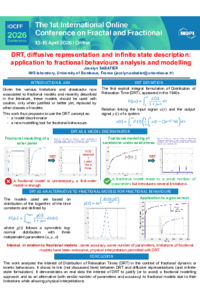
In this context, two alternative approaches, the Distribution of Relaxation Times (DRT) and diffusive representations, provide physically interpretable and mathematically transparent modeling tools. Both rely on expressing the system response as a continuous superposition of exponentially decaying modes, and they can be seen as equivalent formulations of the same underlying spectral framework.
The article therefore aims to (1) clarify the theoretical links between DRT, diffusive representation, and infinite-state models; (2) show on several examples from the literature that DRT can rigorously distinguish genuinely fractional behaviors from behaviors that are not fractional (to avoid using fractional models unjustifiably); (3) demonstrate how DRT enables direct time-domain modeling from experimental data produced by a gas sensor with comparable accuracy and as few parameters as a fractional model; and (4) illustrate how DRT-derived kernels yield accurate and physically meaningful models. Overall, the goal is to promote DRT and diffusive representations as robust alternatives to fractional-order models.
Keywords
Fractionl dynamic behaviours
Distribution of Relaxation time
Diffusive representation
System modelling.
Poster
POSTER_162673.pdf
Advanced foundational tensors and fractional calculus and applications
Modeling and Analysis of Fractional Maxwell Fluid in Intra-Articular Drug Injection Flow