Event submissions
Published
This submission belongs to the session S2. Fractional Calculus and Its Applications in Engineering Systems of the event The 1st International Online Conference on Fractal and Fractional
Published date
08 Apr, 2026
Academic Editor
'%3e%3cpath%20d='M12.6657%2010.9104C12.4185%2010.325%2012.0599%209.79327%2011.6097%209.34482C11.1609%208.89508%2010.6293%208.5365%2010.0442%208.28888C10.0389%208.28626%2010.0337%208.28495%2010.0285%208.28233C10.8446%207.69279%2011.3752%206.73249%2011.3752%205.64904C11.3752%203.8542%209.92103%202.39999%208.1262%202.39999C6.33136%202.39999%204.87715%203.8542%204.87715%205.64904C4.87715%206.73249%205.40774%207.69279%206.22393%208.28364C6.21869%208.28626%206.21345%208.28757%206.20821%208.29019C5.62129%208.5378%205.09463%208.89284%204.64265%209.34613C4.1929%209.79493%203.83432%2010.3266%203.58671%2010.9117C3.34345%2011.4845%203.21226%2012.0987%203.20023%2012.7209C3.19988%2012.7349%203.20233%2012.7488%203.20744%2012.7619C3.21255%2012.7749%203.22022%2012.7867%203.22998%2012.7968C3.23975%2012.8068%203.25142%2012.8147%203.26431%2012.8202C3.2772%2012.8256%203.29105%2012.8284%203.30504%2012.8284H4.09109C4.14874%2012.8284%204.19459%2012.7825%204.1959%2012.7262C4.2221%2011.7148%204.62823%2010.7676%205.34617%2010.0497C6.08899%209.30683%207.0755%208.89808%208.1262%208.89808C9.17689%208.89808%2010.1634%209.30683%2010.9062%2010.0497C11.6242%2010.7676%2012.0303%2011.7148%2012.0565%2012.7262C12.0578%2012.7838%2012.1037%2012.8284%2012.1613%2012.8284H12.9474C12.9613%2012.8284%2012.9752%2012.8256%2012.9881%2012.8202C13.001%2012.8147%2013.0126%2012.8068%2013.0224%2012.7968C13.0322%2012.7867%2013.0398%2012.7749%2013.0449%2012.7619C13.0501%2012.7488%2013.0525%2012.7349%2013.0522%2012.7209C13.0391%2012.0947%2012.9094%2011.4855%2012.6657%2010.9104ZM8.1262%207.9024C7.52486%207.9024%206.9589%207.6679%206.53312%207.24211C6.10733%206.81633%205.87283%206.25037%205.87283%205.64904C5.87283%205.0477%206.10733%204.48174%206.53312%204.05596C6.9589%203.63018%207.52486%203.39567%208.1262%203.39567C8.72753%203.39567%209.29349%203.63018%209.71927%204.05596C10.1451%204.48174%2010.3796%205.0477%2010.3796%205.64904C10.3796%206.25037%2010.1451%206.81633%209.71927%207.24211C9.29349%207.6679%208.72753%207.9024%208.1262%207.9024Z'%20fill='%235D1EE1'/%3e%3c/g%3e%3c/svg%3e) Saptarshi Das
Saptarshi DasCitation
Marcelo Kaminski Lenzi, Ervin Kaminski Lenzi, Analysis of Multivariable Control Loops in Distillation Columns Using Variable-Order Fractional Calculus, in Proceedings of The 1st International Online Conference on Fractal and Fractional, 13 April–15 April 2026, MDPI: Basel, Switzerland
Share
Email
Facebook
Twitter
LinkedIn
Analysis of Multivariable Control Loops in Distillation Columns Using Variable-Order Fractional Calculus

Marcelo Kaminski Lenzi 1

Ervin Kaminski Lenzi 2
1. Department of Chemical Engineering - Federal University of Paraná, Rua Coronel Francisco H. dos Santos, 100, Curitiba, PR, Brazil, Brazil
2. Department of Physics - State University of Maringá, Avenida Colombo, 5790 , 87020-900 - Maringá, PR, Brazil, Brazil
Abstract
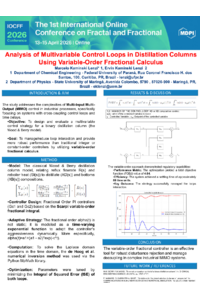
This paper presents an advanced analysis of multivariable control loops applied to industrial processes using variable-order fractional calculus. The study focuses on a Multi-Input Multi-Output (MIMO) system represented by the classical Wood & Berry model of a binary distillation column. This benchmark model is characterized by cross-coupling and time delays, relating the distillate (XD) and bottoms (XB) compositions to the manipulated variables: reflux flow rate and reboiler heat duty.
To address the challenges of these coupled dynamics, the proposed control strategy employs Fractional Order PI controllers (Gc1 and Gc2) based on the Scarpi variable-order fractional integral. The fractional order of the integral part of the controller, α(t), is modeled as a time-varying exponential function rather than a fixed value, allowing the controller to adapt its aggressiveness over time. To obtain the time-domain response, the closed-loop equations formulated in the Laplace domain were numerically inverted. While various inversion methods are reported in the literature, this work used the method proposed by de Hoog et al., implemented via the invertlaplace function from the Python MpMath package (Version 1.2.1).
The controller parameters were estimated by minimizing the Integral of Squared Error (ISE), resulting in a total objective function value of 4.04. The transient response analysis indicates a settling time of approximately 60 time units. The variable-order strategy successfully decoupled the system, suppressing the interaction peak on the bottoms composition ($X_B$) and returning it to the set-point, demonstrating robust disturbance rejection capabilities.
Keywords
Variable-Order Fractional
Multivariable
Distillation Column
PID Control
Poster
poster_lenzi.pdf
Modeling and Analysis of Fractional Maxwell Fluid in Intra-Articular Drug Injection Flow
The use of generalised fractional models to elucidate the rheological behaviour of nanofluids