Event submissions
Published
This submission belongs to the session S2. Fractional Calculus and Its Applications in Engineering Systems of the event The 1st International Online Conference on Fractal and Fractional
Published date
08 Apr, 2026
Academic Editor
'%3e%3cpath%20d='M12.6657%2010.9104C12.4185%2010.325%2012.0599%209.79327%2011.6097%209.34482C11.1609%208.89508%2010.6293%208.5365%2010.0442%208.28888C10.0389%208.28626%2010.0337%208.28495%2010.0285%208.28233C10.8446%207.69279%2011.3752%206.73249%2011.3752%205.64904C11.3752%203.8542%209.92103%202.39999%208.1262%202.39999C6.33136%202.39999%204.87715%203.8542%204.87715%205.64904C4.87715%206.73249%205.40774%207.69279%206.22393%208.28364C6.21869%208.28626%206.21345%208.28757%206.20821%208.29019C5.62129%208.5378%205.09463%208.89284%204.64265%209.34613C4.1929%209.79493%203.83432%2010.3266%203.58671%2010.9117C3.34345%2011.4845%203.21226%2012.0987%203.20023%2012.7209C3.19988%2012.7349%203.20233%2012.7488%203.20744%2012.7619C3.21255%2012.7749%203.22022%2012.7867%203.22998%2012.7968C3.23975%2012.8068%203.25142%2012.8147%203.26431%2012.8202C3.2772%2012.8256%203.29105%2012.8284%203.30504%2012.8284H4.09109C4.14874%2012.8284%204.19459%2012.7825%204.1959%2012.7262C4.2221%2011.7148%204.62823%2010.7676%205.34617%2010.0497C6.08899%209.30683%207.0755%208.89808%208.1262%208.89808C9.17689%208.89808%2010.1634%209.30683%2010.9062%2010.0497C11.6242%2010.7676%2012.0303%2011.7148%2012.0565%2012.7262C12.0578%2012.7838%2012.1037%2012.8284%2012.1613%2012.8284H12.9474C12.9613%2012.8284%2012.9752%2012.8256%2012.9881%2012.8202C13.001%2012.8147%2013.0126%2012.8068%2013.0224%2012.7968C13.0322%2012.7867%2013.0398%2012.7749%2013.0449%2012.7619C13.0501%2012.7488%2013.0525%2012.7349%2013.0522%2012.7209C13.0391%2012.0947%2012.9094%2011.4855%2012.6657%2010.9104ZM8.1262%207.9024C7.52486%207.9024%206.9589%207.6679%206.53312%207.24211C6.10733%206.81633%205.87283%206.25037%205.87283%205.64904C5.87283%205.0477%206.10733%204.48174%206.53312%204.05596C6.9589%203.63018%207.52486%203.39567%208.1262%203.39567C8.72753%203.39567%209.29349%203.63018%209.71927%204.05596C10.1451%204.48174%2010.3796%205.0477%2010.3796%205.64904C10.3796%206.25037%2010.1451%206.81633%209.71927%207.24211C9.29349%207.6679%208.72753%207.9024%208.1262%207.9024Z'%20fill='%235D1EE1'/%3e%3c/g%3e%3c/svg%3e) Saptarshi Das
Saptarshi DasCitation
Yuanyuan Dong, Zifeng Wei, Yuze Li, On the Optimal Mechanism of Aerodynamic Efficiency in Near-Ground Unmanned Aerial Vehicle Flight Using Fractional-Order Entropy, in Proceedings of The 1st International Online Conference on Fractal and Fractional, 13 April–15 April 2026, MDPI: Basel, Switzerland
Share
Email
Facebook
Twitter
LinkedIn
On the Optimal Mechanism of Aerodynamic Efficiency in Near-Ground Unmanned Aerial Vehicle Flight Using Fractional-Order Entropy
'%3e%3cpath%20d='M12.6647%2010.9104C12.4176%2010.325%2012.0589%209.7933%2011.6088%209.34485C11.16%208.89511%2010.6283%208.53653%2010.0432%208.28891C10.038%208.28629%2010.0327%208.28498%2010.0275%208.28236C10.8437%207.69282%2011.3743%206.73252%2011.3743%205.64907C11.3743%203.85423%209.92005%202.40002%208.12522%202.40002C6.33038%202.40002%204.87618%203.85423%204.87618%205.64907C4.87618%206.73252%205.40677%207.69282%206.22296%208.28367C6.21772%208.28629%206.21248%208.2876%206.20724%208.29022C5.62031%208.53783%205.09365%208.89287%204.64167%209.34616C4.19192%209.79496%203.83334%2010.3266%203.58573%2010.9117C3.34247%2011.4846%203.21128%2012.0987%203.19925%2012.721C3.1989%2012.735%203.20135%2012.7489%203.20646%2012.7619C3.21157%2012.7749%203.21924%2012.7868%203.22901%2012.7968C3.23877%2012.8068%203.25045%2012.8148%203.26334%2012.8202C3.27623%2012.8256%203.29007%2012.8284%203.30406%2012.8284H4.09012C4.14776%2012.8284%204.19362%2012.7825%204.19493%2012.7262C4.22113%2011.7148%204.62726%2010.7676%205.34519%2010.0497C6.08802%209.30686%207.07452%208.89811%208.12522%208.89811C9.17592%208.89811%2010.1624%209.30686%2010.9052%2010.0497C11.6232%2010.7676%2012.0293%2011.7148%2012.0555%2012.7262C12.0568%2012.7839%2012.1027%2012.8284%2012.1603%2012.8284H12.9464C12.9604%2012.8284%2012.9742%2012.8256%2012.9871%2012.8202C13%2012.8148%2013.0117%2012.8068%2013.0214%2012.7968C13.0312%2012.7868%2013.0389%2012.7749%2013.044%2012.7619C13.0491%2012.7489%2013.0515%2012.735%2013.0512%2012.721C13.0381%2012.0947%2012.9084%2011.4856%2012.6647%2010.9104ZM8.12522%207.90243C7.52388%207.90243%206.95792%207.66793%206.53214%207.24215C6.10636%206.81636%205.87185%206.2504%205.87185%205.64907C5.87185%205.04773%206.10636%204.48177%206.53214%204.05599C6.95792%203.63021%207.52388%203.3957%208.12522%203.3957C8.72655%203.3957%209.29252%203.63021%209.7183%204.05599C10.1441%204.48177%2010.3786%205.04773%2010.3786%205.64907C10.3786%206.2504%2010.1441%206.81636%209.7183%207.24215C9.29252%207.66793%208.72655%207.90243%208.12522%207.90243Z'%20fill='%235D1EE1'/%3e%3c/g%3e%3c/svg%3e)
Yuanyuan Dong 1,2
Zifeng Wei 1,2
Yuze Li 1
1. School of Science, Beijing University of Civil Engineering and Architecture, Beijing 100044, China, China
2. Beijing Key Laboratory of Functional Materials for Building Structure and Environment Remediation, Beijing 100044, China
Abstract
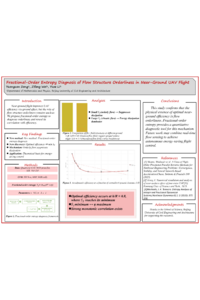
During near-ground flight, unmanned aerial vehicles (UAVs) experience enhanced aerodynamic efficiency due to the ground effect. However, the underlying flow mechanisms governing this optimal state—particularly the critical role of flow-structure orderliness—remain insufficiently clarified. To quantify flow orderliness and uncover its relationship with efficiency, this paper proposes a diagnostic method based on fractional-order entropy. The method utilizes unsteady lift time-series data obtained from computational fluid dynamics. Recognizing that this data embodies the historical memory and hereditary properties of the flow field, we introduce the Grünwald–Letnikov fractional-order derivative—well-suited for discrete sequences—to perform multi-scale fractional differentiation on the lift series. This process extracts embedded features reflecting the memory and scale-invariant characteristics of the flow structure. Permutation entropy is then calculated from the resulting fractional-order differential sequences and directly defined as the fractional-order entropy, which quantifies the dynamic orderliness of the flow field. Results indicate that at the flight altitude corresponding to peak aerodynamic efficiency, fractional-order entropy exhibits a distinct minimum. This extremum signifies that the flow field under this condition achieves the highest level of dynamic order, where ineffective turbulent dissipation is significantly suppressed and energy is efficiently converted into lift. Moreover, a strong monotonic correlation exists between fractional-order entropy and aerodynamic efficiency, confirming its effectiveness as a quantitative diagnostic indicator. From the novel perspective of flow-structure orderliness, this study systematically explains the formation mechanism of optimal efficiency in near-ground flight. The proposed fractional-order entropy framework not only provides a new theoretical tool for understanding complex ground effects but also lays a methodological foundation for the development of autonomous energy-saving flight control systems based on real-time flow-field perception.
Keywords
Fractional-order entropy
Ground effect
Aerodynamic efficiency
Flow structure
UAV
Poster
海报.pdf
The Caputo-like discrete fractional 4D hyperchaotic Rossler system
Fractional Time–Space Viscoelastic Wave Equation: Analysis and Solution Framework