
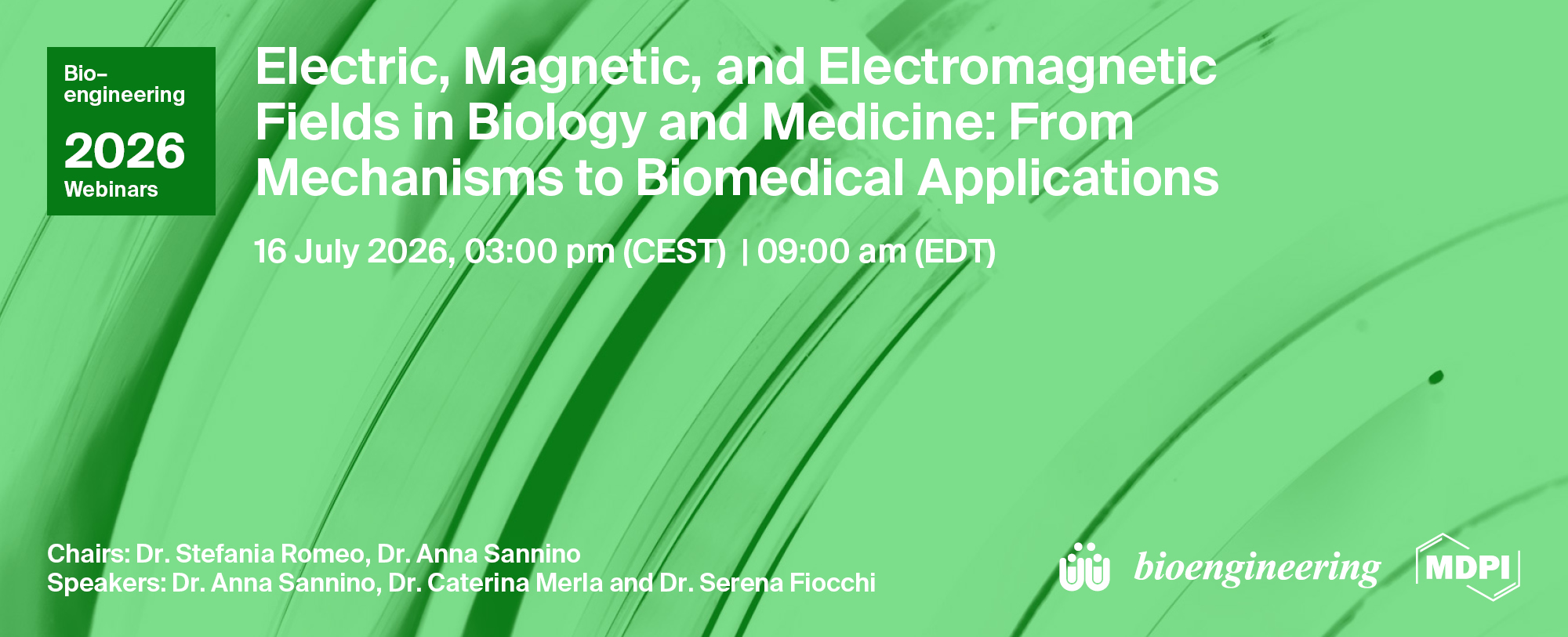
Bioengineering Webinar | Electric, Magnetic, and Electromagnetic Fields in Biology and Medicine: From Mechanisms to Biomedical Applications
the chairs
Nowadays, the study of the interaction between electromagnetic fields and biological systems has never been more critical and presents a fascinating dualism. On one hand, the rapid expansion of 5G networks introduces complex new exposure scenarios that warrant careful health risk assessments. On the other hand, the biomedical field is successfully leveraging non-ionizing radiation for innovative diagnostic and therapeutic strategies, such as MRI, microwave hyperthermia, and electroporation. Understanding the underlying interaction mechanisms is crucial, not only to evaluate potential health risks but also to optimize existing therapies and foster the development of new biomedical solutions. To explore these topics further, we are honoured to have three distinguished experts with us today who will share their latest research.
Our journey builds upon three successful past editions: the first focused on health risk evaluation, the second on therapeutic and diagnostic advancements, and the third consolidated the latest breakthroughs in electromagnetic biosciences. Now, with our 4th edition currently underway, the incoming contributions continue to showcase a remarkably wide and diverse range of new research. This Special Issue remains an open, multidisciplinary platform. We welcome in vitro, in vivo, and epidemiological investigations covering any frequency range, dosimetry, risk assessment, and exposure management. We warmly invite researchers and scholars from industry, academia, and government to submit their full research, reviews, systematic reviews, and meta-analyses. We hope this event and the Special Issue will serve as a catalyst for your next research breakthrough.
Date: 16 July 2026
Time: 3:00 pm CEST | 9:00 am EDT
Webinar ID: 894 3290 8547
Webinar Secretariat: journal.webinar@mdpi.com
Meet Our Chairs

CNR – Institute for Electromagnetic Sensing of the Environment, Naples, Italy;Anna Sannino earned an M.Sc. in Biological Sciences from the University of Naples Federico II (2002) and a PhD in Biochemistry and Pathology of Drug Action from the University of Salerno (2013). She is currently a Senior Researcher at the Institute for Electromagnetic Sensing of the Environment (IREA) of the National Research Council (CNR) in Naples, Italy. Her specialization in bioelectromagnetics has resulted in more than 60 peer-reviewed publications, including journal articles, book chapters, and conference proceedings, as well as memberships in several international scientific communities. She has been involved as a team member in several national and international research projects. Her research focuses on the in vitro biological effects of radiofrequencies (3G, 4G, and 5G), extremely low frequencies (ELF), and high-voltage nanosecond electric pulses. Her expertise encompasses genotoxic and non-genotoxic carcinogenesis, experimental studies on the interaction between biological systems and electromagnetic fields, occupational exposure assessment, biomedical applications, and systematic reviews of scientific literature.

CNR – Institute for Electromagnetic Sensing of the Environment, Naples, Italy;Stefania Romeo received a Master’s degree (summa cum laude) in Biomedical Engineering from the University of Naples Federico II, and a Ph.D. in electronic engineering from the Second University of Naples in 2008 and 2012, respectively. Since 2012, she has been with CNR–IREA (Institute for Electromagnetic Sensing of the Environment) where she currently holds a Senior Researcher position. From September 2010 to March 2011, she was a visiting student at the Dept. of Electrical Engineering and Electrophysics, University of Southern California. In May 2014, she was a visiting scientist at the University of Copenhagen at Herlev Hospital for a short-term scientific mission in the framework of the COST Action TD1104 (“European Network for the Development of Electroporation-based Technologies and Treatments”). In 2015, she received the Young Researcher Award at the “1st World Congress on Electroporation and Pulsed Electric Fields in Biology, Medicine and Environmental Technologies”. Dr Romeo was Ambassador for the 2019 “Electroporation-based Technologies and Treatments School”. The research activity of Dr. Romeo is in the framework of bioelectromagnetics and deals with the design and realization of high voltage, ns pulse generators for in vitro biological applications, the study of biological effects of RF electromagnetic fields and pulsed electric fields on mammalian cells with experimental and modeling approaches, and the employment of numerical and experimental dosimetry techniques for in vitro exposures to RF electromagnetic fields. Her activities in bioelectromagnetics have resulted in more than 70 peer-reviewed publications, including journal articles, book chapters, and conference proceedings, as well as memberships in several international scientific communities. She has been involved as Principal Investigator or team member in several national and international research projects.
Dedicated to the Special Issue "Electric, Magnetic, and Electromagnetic Fields in Biology and Medicine: From Mechanisms to Biomedical Applications: 4th Edition", this webinar addresses a fascinating dualism at a time when studying the interaction between electromagnetic fields and biological systems has never been more critical. While the rapid expansion of 5G networks introduces complex exposure scenarios requiring careful health risk assessments, the biomedical field successfully leverages non-ionizing radiation for innovative diagnostic and therapeutic strategies. Understanding these underlying interaction mechanisms is crucial to both evaluate potential risks and optimize targeted medical solutions. To explore these topics further, three distinguished experts share their latest research:
Dr. Anna Sannino emphasizes the strict methodological and dosimetric rigor needed in bioelectromagnetics. She highlights how non-thermal radiofrequency fields—while causing no direct damage—trigger an adaptive response capable of selectively protecting mammalian cell cultures against subsequent physical or chemical stressors.
Dr. Caterina Merla highlights the innovative dual role of microsecond pulsed electric fields (µsPEFs) in selectively targeting brain cancer stem cells while sparing healthy tissue. In Medulloblastoma, µsPEFs act as a direct apoptotic agent by destroying the CD133-mitochondrial axis, whereas in resistant Glioblastoma, they serve as a physical enabler to permeabilize the extracellular matrix, significantly accelerating the uptake of a novel anti-Tenascin-C immunotoxin for targeted tumor eradication.
Dr. Serena Fiocchi outlines the evolution of non-invasive brain stimulation toward precision medicine, moving away from "one-size-fits-all" protocols. She highlights how patient-specific computational modelling overcomes anatomical variability, while artificial intelligence enables adaptive, closed-loop neurostimulation based on real-time neural activity. Ultimately, combining electromagnetism, thermal effects, and physiology allows researchers to deliver the right stimulation to the right patient at the right time.
Meet Our Speakers
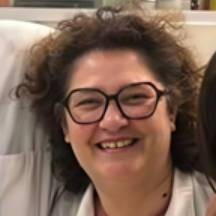
CNR – Institute for Electromagnetic Sensing of the Environment, Naples, Italy;Anna Sannino earned an M.Sc. in Biological Sciences from the University of Naples Federico II (2002) and a PhD in Biochemistry and Pathology of Drug Action from the University of Salerno (2013). She is currently a Senior Researcher at the Institute for Electromagnetic Sensing of the Environment (IREA) of the National Research Council (CNR) in Naples, Italy. Her specialization in bioelectromagnetics has resulted in more than 60 peer-reviewed publications, including journal articles, book chapters, and conference proceedings, as well as memberships in several international scientific communities. She has been involved as a team member in several national and international research projects. Her research focuses on the in vitro biological effects of radiofrequencies (3G, 4G, and 5G), extremely low frequencies (ELF), and high-voltage nanosecond electric pulses. Her expertise encompasses genotoxic and non-genotoxic carcinogenesis, experimental studies on the interaction between biological systems and electromagnetic fields, occupational exposure assessment, biomedical applications, and systematic reviews of scientific literature.

Italian National Agency for New Technology, Energy and Sustainable Economic Development (ENEA), SSPT- Division of Health Protection Technologies, Rome, Italy;Caterina Merla received her M.Sc. and Ph.D. degrees in Electronic Engineering from Sapienza University of Rome, Italy, in 2004 and 2008, respectively. From 2008 to 2012, she was a Postdoctoral Fellow at XLIM (CNRS–University of Limoges, France) and at the Italian Inter-University Research Center on Electromagnetic Fields and Biosystems, Rome, Italy. In 2012, she worked as a Research Scientist at Lehigh University (Bethlehem, PA, USA). She is currently a Senior Scientist at the Italian National Agency for New Technologies, Energy and Sustainable Economic Development (ENEA) in Rome, Italy. She serves on the council of the International Society for Electroporation-Based Technologies and Treatments. Her research focuses on bioelectromagnetics for both safety and biomedical applications. She has authored more than 70 peer-reviewed journal articles and over 100 conference contributions, including invited and plenary lectures. She holds a patent related to pulsed electric fields for cancer stem cells and interactions with ionizing radiation. She has been involved as Principal Investigator or team member in several national and international research projects.

Institute of Electronics, Computer and Telecommunication Engineering of the Italian National Research Council (IEIIT-CNR);Serena Fiocchi is Senior Researcher at the Institute of Electronics, Computer and Telecommunication Engineering of the Italian National Research Council (IEIIT-CNR). She received her Ph.D. in Bioengineering with a European Doctorate certification from the Polytechnic of Milan in 2013, following her M.Sc. in Biomedical Engineering in 2009. Her research focuses on bioelectromagnetics, computational modeling of electromagnetic field interactions with biological systems, neuromodulation technologies, exposure assessment, and biomedical applications of electromagnetic fields. She has participated in numerous European and national research projects, serving as Principal Investigator and coordinator in several initiatives related to 5G exposure, electromagnetic safety, brain stimulation, and medical technologies. She is a member of the WHO Task Group on Radiofrequency Fields and Health Risks and serves on the Executive Board of the Italian National Group of Bioengineering. She has authored more than 70 peer-reviewed journal articles, 4 book chapters, and over 100 conference papers, with an h-index of 23 and more than 1,500 citations. She is actively involved in scientific publishing as Guest Editor for several international journals and regularly serves as an invited speaker, session chair, reviewer, and supervisor of graduate and postgraduate students.


Guest Editors: Dr. Stefania Romeo, Dr. Anna Sannino
Deadline for manuscript submissions: 25 October 2026