
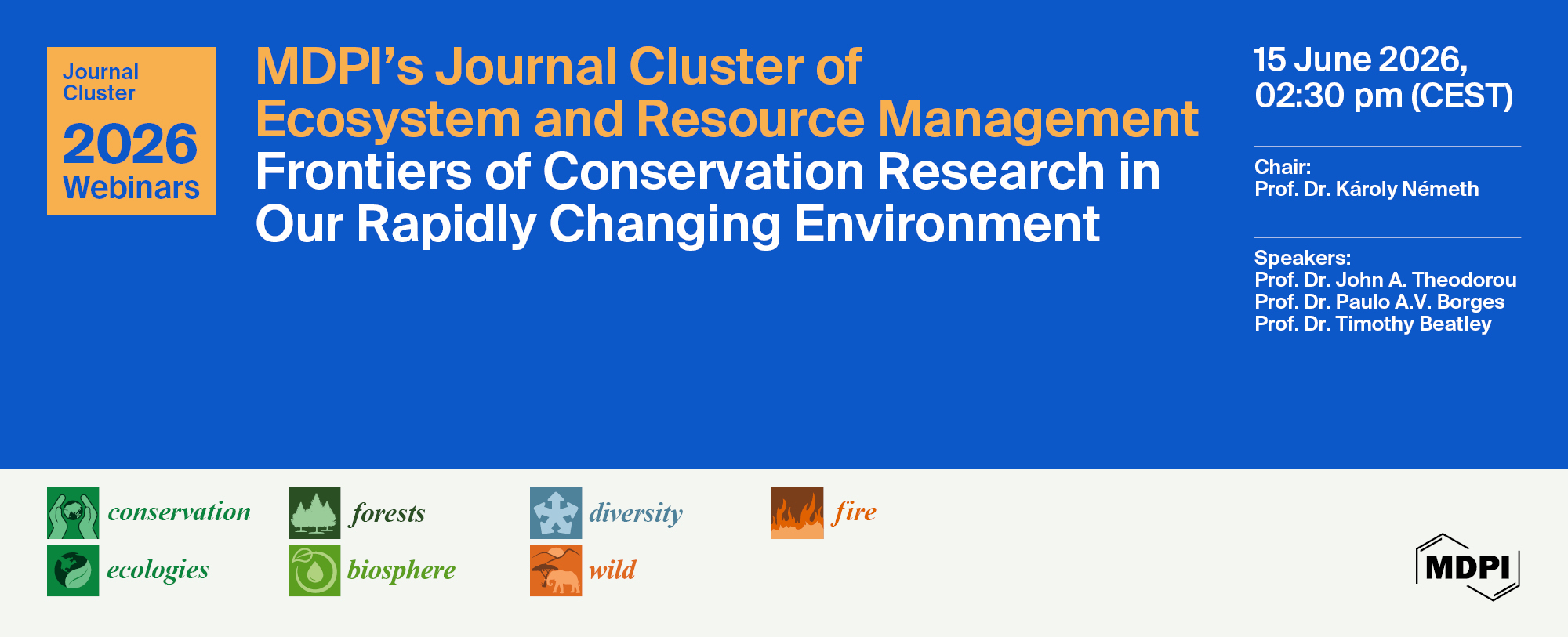
MDPI’s Journal Cluster of Ecosystem and Resource Management Webinar | Frontiers of Conservation Research in Our Rapidly Changing Environment
the chair
MDPI’s Journal Cluster of Ecosystem and Resource Management
Frontiers of Conservation Research in Our Rapidly Changing Environment
We welcome any interested audience to join to listen to three exciting lectures hosted by the journal Conservation as a flagship media of the MDPI’s Journal Cluster of Ecosystem and Resource Management. This webinar offers a snapshot of leading research on conservation efforts in a changing environment, where the human–nature interface inevitably generates conflict. The webinar offers three lectures on seemingly distant subjects, from the marine environment to native forests on islands, to aspects of the concept of biophilic cities, where nature and human society coexist symbiotically. The three lectures present specific research themes but are interlinked by the nature of the environments, in which preserving natural conditions is vital. The lectures will be general enough to be enjoyable to anyone interested in current developments in conservation science and will provide deep insight into the complexity that successful conservation strategies must embrace.
Date: Monday, 15 June 2026
Time: 14:30 CEST | 8:30 EDT
Webinar ID: 863 1928 4580
Webinar Secretariat: journal.webinar@mdpi.com
Meet Our Chair
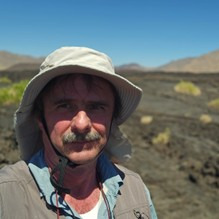
School of Agriculture and Environment, Massey University, Palmerston North 4442, New Zealand;Saudi Geological Survey, National Program of Earthquakes and Volcanoes, Jeddah, Saudi Arabia;Institute of Earth Physics and Space Science, Lithosphere Research Group, Sopron, Hungary;The Geoconservation Trust Aoteroa Pacific, Opotiki, New Zealand;Prof. Károly Németh is a distinguished geologist with a rich academic background and extensive research experience. He holds dual PhDs in geology and environmental sciences and has served as a Professor in Geology at Massey University, New Zealand. He is a Doctor of the Hungarian Academy of Sciences and currently works as an advisor to the Saudi Geological Survey and for the Institute of Earth Physics and Space Science in Sopron, Hungary. His research spans volcanic fields in New Zealand, Saudi Arabia, and Hungary, focusing on monogenetic volcanoes, volcanic field evolution, and volcanic geoheritage. Dr. Németh is also an Editorial Board Member of several international journals and has been involved in numerous research projects, contributing significantly to the understanding of volcanic hazards and geoconservation. He has been listed in the Stanford Top 2% of researchers in Earth Sciences for the past four consecutive years. ORCID: https://orcid.org/0000-0003-1026-0407 Google Scholar: https://scholar.google.com/citations?user=ULBOle0AAAAJ&hl=en Scopus: https://www.sciencedirect.com/author/7004989401/karoly-nemeth
In this section, you will find the recordings of this webinar to watch, re-watch and share with your colleagues!
Meet Our Speakers
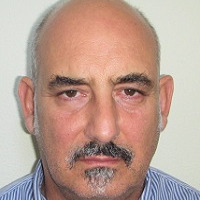
Department of Fisheries and Aquaculture, School of Agricultural Sciences, University of Patras, Patras, Greece;Prof. Ioannis Theodorou is a graduate of the Department of Biology at the University of Patras with a specialization in Fisheries & Shellfish Farming (Bangor University, Wales, UK), Quality Management of Fishery Products & Marketing (University of Hull, UK) and has a PhD in Applied Biological Sciences (Ghent University, Belgium). He has over 25 years of professional experience in Mediterranean Aquaculture, during which he has implemented more than 30 industrial, educational, and research projects in this field. As an expert, he has served as a consultant to national (SETH, Ministry of Environment & Climate Change) and international agencies & organizations (FAO-GFCM) in Europe (EU, AquaTT) and the USA (NOAA). He has published 78 papers and 13 chapters in collective volumes and supervised the completion of 1 PhD thesis and 10 master’s theses. ORCID: https://orcid.org/0000-0002-7127-5779 Google scholar: https://scholar.google.com/citations?user=y2CYJNIAAAAJ&hl=en&oi=ao Scopus: https://www.scopus.com/authid/detail.uri?authorId=6603499253 Web of Science Researcher: https://www.webofscience.com/wos/author/record/2072990
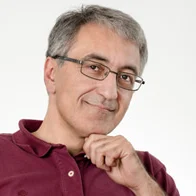
CE3C—Centre for Ecology, Evolution and Environmental Changes/Azorean Biodiversity Group, CHANGE—Global Change and Sustainability Institute, School of Agricultural and Environmental Sciences, University of the Azores, Azores, Portugal;IUCN SSC Atlantic Islands Invertebrate Specialist Group, 9700-042 Angra do Heroísmo, Azores, Portugal;IUCN SSC Monitoring Specialist Group, 9700-042 Angra do Heroísmo, Azores, Portugal;I received a Ph.D. in Insect Ecology from the University of London (Imperial College) in 1997 and I am currently leading the Island Biodiversity, Biogeography and Conservation research group (IBBC). I participated in the development of the Azorean Biodiversity Portal (http://azoresbioportal.uac.pt/), a unique and important web interface for communicating biodiversity research in the Azorean region to the public. I am a professor of Ecology at the University of Azores. My research focuses on arthropod macroecology patterns and processes on island ecosystems. For many years, I have been involved in island research using the Macaronesian islands and in particular the Azores as a model system. I am currently Co-Chair of the IUCN/SSC Atlantic Island Invertebrates Specialist Group and member of the IUCN - Spider and Scorpion Specialist Group and the IUCN/SSC Monitoring Specialist Group. My current research is driven by three overarching objectives: i) collect long-term ecological data to investigate the processes affecting patterns of species diversity, abundance and distribution at different spatial scales; ii) use Macaronesia as a model system to investigate ecological and evolutionary mechanisms responsible for shaping island biotas; iii) identify pathways that impact oceanic indigenous assemblages under global change for conservation purposes.
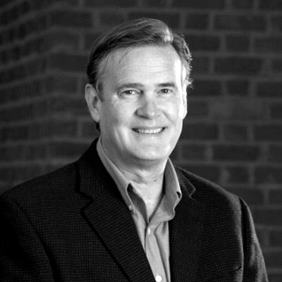
Department of Urban & Environmental Planning, School of Architecture, University of Virginia, USA;Timothy Beatley is the Teresa Heinz Professor of Sustainable Communities at the University of Virginia, where he has taught for more than thirty years. He is the author or co-author of more than twenty-five books, including Blue Urbanism: Connecting Cities and Oceans (Island Press) and Blue Biophilic Cities: Nature and Resilience Along the Urban Coast (Palgrave-MacMillan). Beatley directs the Biophilic Cities Network at UVA (http://biophiliccities.org/) co-founded UVA’s Center for Design and Health, and is helping to create a new Center for Forest Urbanism.








Conservation
Ethical Issues in Conservation
Edited by Prof. Dr. Timothy Beatley
Deadline for manuscript submissions: 30 August 2026
Diversity
Diversity as the Cornerstone for Ecology, Conservation, and Co-Viability on Earth
Edited by Dr. Tim Mullet and Prof. Dr. Almo Farina
Deadline for manuscript submissions: 30 June 2026
When History Meets Future Challenges: The Case of Pinna nobilis “Early Fishery” in Greek Waters
Conservation2026, 6(2), 46; https://doi.org/10.3390/conservation6020046
Ecological Decline and Roadless Habitat Restoration After Two Centuries of Multiple-Use Management in Algonquin Park, Ontario, Canada
Biosphere 2026, 2(1), 1; https://doi.org/10.3390/biosphere2010001
Temporal Shifts in Biological Community Structure in Response to Wetland Restoration: Implications for Wetland Biodiversity Conservation and Management
Diversity 2025, 17(3), 198; https://doi.org/10.3390/d17030198
Landscape Ecological Integrity Assessment to Improve Protected Area Management of Forest Ecosystem
Ecologies 2025, 6(2), 38; https://doi.org/10.3390/ecologies6020038