
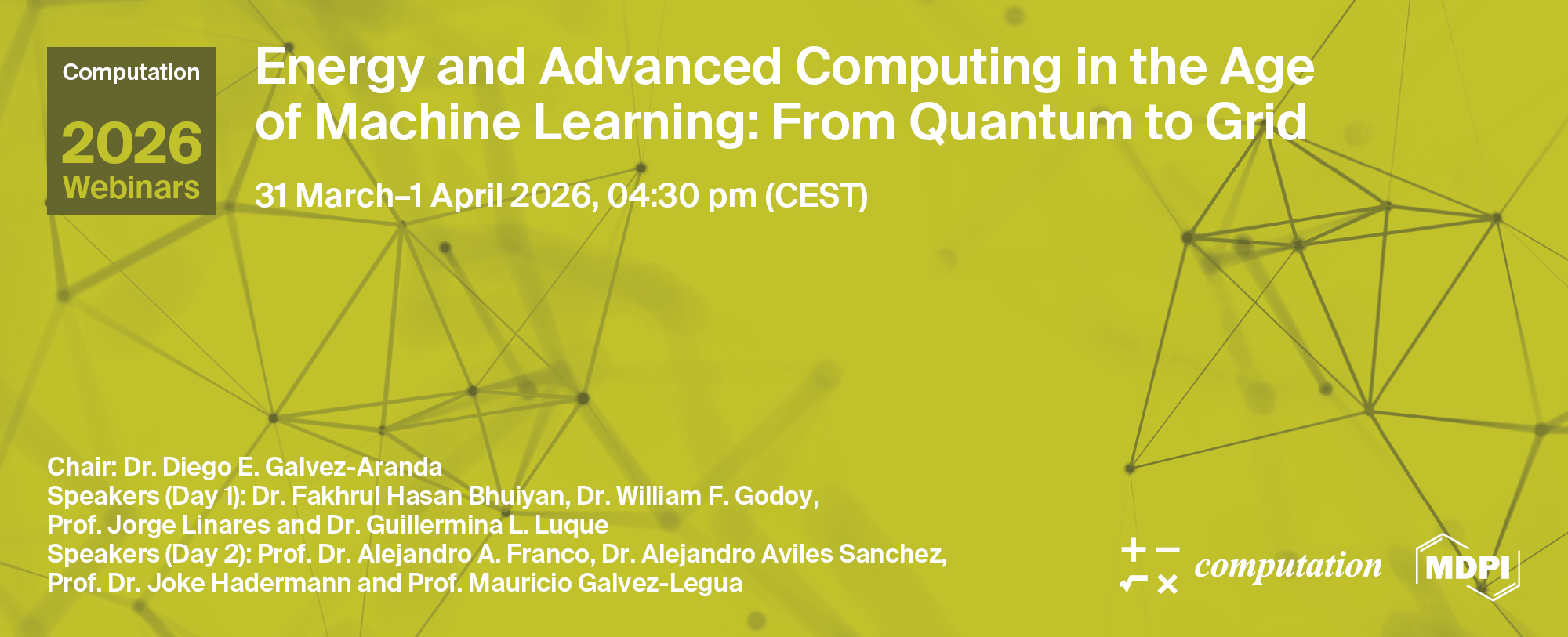
Computation Webinar | Energy and Advanced Computing in the Age of Machine Learning: From Quantum to Grid
the chair
3rd Computation Webinar
Energy and Advanced Computing in the Age of Machine Learning: From Quantum to Grid
This two-day webinar brings together recent advances in computational methods, machine learning, and materials science, highlighting how modern simulation and data-driven approaches are transforming the understanding and design of complex systems.
Day 1 focuses on methodological and computational innovations. Topics include Monte Carlo entropic sampling applied to spin crossover nanoparticles to understand their thermodynamic behavior at the nanoscale, the development and fine-tuning of MACE foundation machine learning interatomic potentials for accurate and transferable atomistic modeling, and emerging approaches to improving productivity in high-performance computing through the integration of large language models and modern programming paradigms.
Day 2 shifts toward applications in energy storage, manufacturing, and next-generation computing materials. Presentations will cover digital twin frameworks for modeling battery manufacturing processes, computational studies of energy storage materials and interfacial phenomena, and redox-mediated electronic transport in metal–organic frameworks for neuromorphic computing. The program will also feature experimental and electrochemical work on the synthesis and characterization of sodium thiophosphate catholytes for nonaqueous redox flow batteries.
Together, the sessions provide a cohesive perspective on how advanced algorithms, machine learning, and multiscale modeling are accelerating discovery and enabling new functionalities across materials for energy, electronics, and intelligent systems.
Date: 31 March 2026 - 1 April 2026
Time: 4:30 p.m. CEST | 10:30 a.m. EDT
Webinar ID: 854 8999 0073
Webinar Secretariat: journal.webinar@mdpi.com
Meet Our Chair
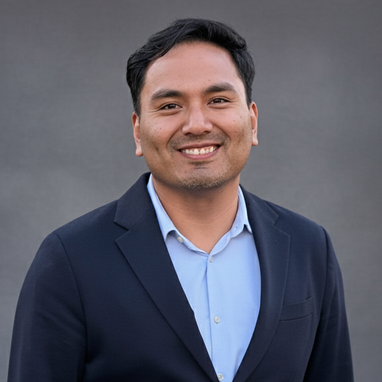
Department of Chemical Engineering, Texas A&M University, United States;Dr. Galvez holds an international academic background spanning Peru, the United States, and France. He earned his PhD in Electrical Engineering from Texas A&M University. He then completed postdoctoral training at LRCS (Laboratoire de Réactivité et de Chimie des Solides) in France and currently serve as a postdoctoral researcher in the Chemical Engineering Department at Texas A&M. His expertise centers on atomistic simulations of electrode–electrolyte interfaces, computational materials science, and machine learning–driven predictive modeling. His work integrates physics-based simulations with data-driven approaches to understand and accelerate the design of advanced materials, particularly for energy and electrochemical systems.
Meet Our Speakers

Dr. Fakhrul Hasan Bhuiyan
Computational Science Division, Argonne National Laboratory, USA;Dr. Bhuiyan is a postdoctoral researcher in Argonne National Laboratory’s Computational Science Division and a computational materials scientist who combines density functional theory, molecular dynamics, and machine learning to provide atomistic insight that complements experimental results. His research focuses on developing machine-learning interatomic force fields and predictive models such as graph neural networks to enable accurate, high-throughput simulations of complex materials and chemical systems, including tribochemical reactions, molten salts, electrolytes, and transition-metal containing compounds, on large-scale supercomputers. Dr. Bhuiyan earned his Ph.D. in Mechanical Engineering from the University of California, Merced (2024), and his work has been recognized with the Nor-Cal STLE Research Scholarship (2020), the Graduate Dean’s Dissertation Fellowship (2024), and a Scientific Reports “Top 100 in Materials Science” paper (2024).

Dr. William F. Godoy
Oak Ridge National Laboratory, Computer Science and Mathematics Division, USA;William F. Godoy is a Senior Computer Scientist in the Computer Science and Mathematics Division at Oak Ridge National Laboratory (ORNL) since 2016. His research interests are in the areas of high-performance computing (HPC), AI for scientific software, programming models, and workflows. At ORNL, William has contributed to several projects for the US Department of Energy HPC scientific mission. Prior experiences include a staff position at Intel Corporation and a postdoctoral fellowship at NASA Langley. He obtained his PhD and MSc from the University at Buffalo, and a BSc from the National Engineering University (UNI) Lima, Peru, all in mechanical engineering. He has published more than 60 papers in computational and computer science venues. William is a IEEE Senior member and ACM member currently serving in several conference venues.

Laboratoire GEMAC, Université de Versailles SQY, Paris-Saclay, France;Jorge LINARES, born in Chepén (PERU), was a full Professor at the Pontificia Universidad Catolica del Peru, Associate Professor at the Université Pierre et Marie Curie (Paris-Sorbonne) and, since 1995, a full Professor in Versailles’s University (now Paris-Saclay). He is solid state physicist and an expert in phase transitions in molecular solids and applications of MonteCarlo techniques in bistables crystals. He is member of the National Academy of Science of Peru. He has published more than 182 papers with an h-index of 43 in Google Scholar.

Universidad Nacional de Córdoba, Facultad de Ciencias Químicas, Departamento de Química Teórica y Computacional, Córdoba, Argentina;Consejo Nacional de Investigaciones Científicas y Técnicas (CONICET), Instituto de Investigaciones en Fisicoquímica de Córdoba (INFIQC), Córdoba, Argentina;Dr. Guillermina L. Luque received her degree in Chemistry in 2003 and her PhD in 2009 from the National University of Córdoba (Argentina). She is currently a researcher at INFIQC-CONICET and a faculty member in the Department of Theoretical and Computational Chemistry at the Faculty of Chemical Sciences, National University of Córdoba. She has authored over 50 publications in high-impact international journals. Her research interests include the experimental and computational study of lithium-ion and next-generation post-lithium battery technologies.


In this section, you will find the recordings of this webinar to watch, re-watch and share with your colleagues!
This webinar explored how advanced computational methods and machine learning are transforming materials science specially focused on energy storage devices. Day 1 highlighted methodological innovations, including Monte Carlo simulations, machine-learned interatomic potentials, and the integration of AI tools to enhance high-performance computing. Day 2 focused on real-world applications such as battery manufacturing, energy storage materials, and neuromorphic computing using metal–organic frameworks. Overall, the sessions showed how data-driven and multiscale approaches are accelerating material discovery enabling next-generation energy and computing technologies.
"Energy and Advanced Computing in the Age of Machine Learning: From Quantum to Grid"
Guest Editor: Dr. Diego E. Galvez-Aranda
Deadline for submission: 15 December 2026