Please login first

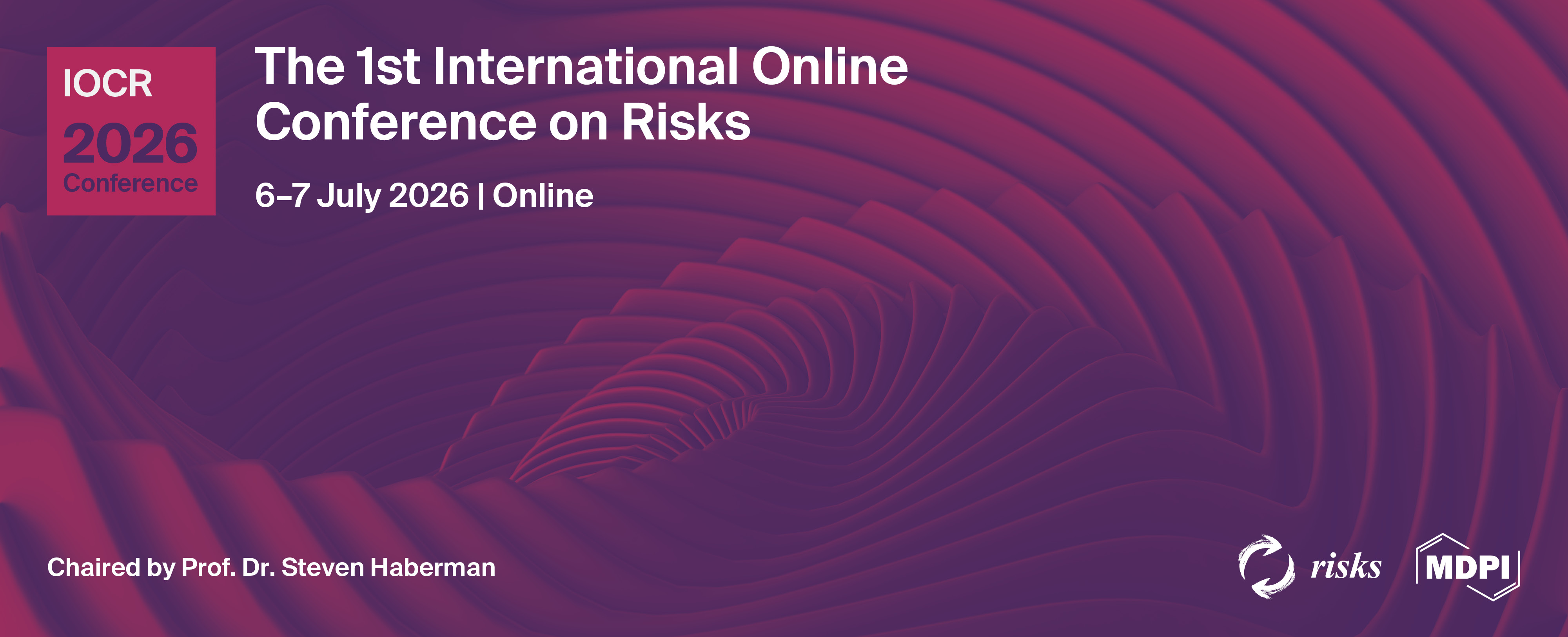
The 1st International Online Conference on Risks

Part of the International Online Conference on Risks series
6–7 July 2026
Event's Timezone: Central European Summer Time
Abstract Submission Deadline
5 April 2026
Abstract Acceptance Notification
10 May 2026

Registration Deadline
1 July 2026

Financial Risk Management, Actuarial Science, Statistical Modelling, Insurance
Bookmark
Bookmark event Remove event from bookmarks
Add this event to bookmarks
Event Registration Contact Us Become a Sponsor

The Abstract Submission period has officially closed on 5 April 2026. We warmly invite you to register for the event.


Register for free HERE by 1 July 2026.

For any inquiries, please contact us at iocr2026@mdpi.com.

Welcome from the Chair

Dear Colleagues,

We are delighted to invite you to the upcoming conference, organised by the MDPI journal Risks (ISSN: 2227-9091, Impact Factor 1.5). This online conference will take place from 6-7 July 2026, breaking down geographical barriers and enabling global participation.

At a time characterised by intensifying market volatility, rapidly evolving regulatory landscapes, and a proliferation of emerging threats—ranging from climate-related disruptions to cyber vulnerabilities—this conference aims to be a pivotal forum for interdisciplinary dialogue. In a world where risks intertwine and impact every aspect of business, society, and the global economy, the need for collaborative and innovative approaches to risk management has never been more pressing.

Our conference offers a prestigious international platform. Here, you will have the invaluable opportunity to engage in cutting-edge research discussions, exchange insights with renowned academics and experienced industry practitioners, and play an active role in shaping a resilient risk management framework for the future. This framework is not only essential for withstanding the current challenges but also for anticipating and adapting to future uncertainties.

The five curated topics of our conference serve as the cornerstones for bridging theoretical innovation with practical applications. By exploring these areas, we aim to develop collaborative strategies that will enable us to navigate the complex web of uncertainties ahead.

S1. Insurance;
S2. Actuarial Science;
S3. Financial Risk Management;
S4. Asset Pricing and Investment Strategies;
S5. Emerging Risks and Interdisciplinary Topics.

We are committed to ensuring inclusive participation in our conference. All interested attendees are invited to register free of charge for our online sessions, providing access to a wealth of knowledge and networking opportunities, regardless of geographical location or financial constraints. Additionally, all submitted abstracts will undergo a rigorous review process by our esteemed scientific committee, ensuring the highest quality of research and discussions at the conference.

We would like to express our deepest gratitude to the Risks journal for its unwavering support in promoting open access. Their support has been instrumental in making this conference a reality and in facilitating the dissemination of knowledge and ideas across the global academic and practitioner communities.

As we embark on this exciting journey of exploration and collaboration, we look forward to engaging in lively discussions, forging new partnerships, and collectively contributing to the advancement of risk management. We sincerely hope that your participation in this conference will be both fruitful and enlightening, and we wish you a rewarding and memorable experience.

Kind regards,
Prof. Dr. Steven Haberman
Faculty of Actuarial Science and Insurance, Bayes Business School, City George's, University of London, London, UK

More News about MDPI Conferences


Program Overview

6 JULY
Morning (9:0011:40 CEST)
7 JULY
Morning (9:00–11:35 CEST)
Session 3. Financial Risk Management
Session 1. Insurance
Break
Break
6 JULY
Afternoon (14:00–16:30 CEST)
7 JULY
Afternoon (14:00–17:10 CEST)
Session 5. Emerging Risks and Interdisciplinary Topics
Session 2. Actuarial Science

Session 4. Asset Pricing and Investment Strategies

IOCR 2026 Program - Day 1

Session 3. Financial Risk Management
Date: 6 July 2026 (Monday)
Time: 9:00 (CEST, Basel) | 03:00 (EDT, New York) | 15:00 (CST Asia, Beijing)
Time
(CEST)
Speaker Title

09:00-09:10

Prof. Dr. Steven Haberman
The Event Chair

Opening Remarks from the Event Chair
09:10-09:20 Prof. Dr. Rüdiger Kiesel
Session Chair
Welcome from the Session Chair
09:20-09:45 Prof. Dr. Ying Yuan
Invited Speaker
To be announced
09:45-10:10 Dr. Katarzyna Czech
Invited Speaker
Risk-Off or Policy Shock? Regime-Switching Evidence on CHF and JPY Safe-Haven Behaviour
10:10-10:25

Arief Rahman Hakim
Selected Speaker

Directional Predictability of Financial Instability Under Climate Transition Scenarios

10:25-10:40

Modisane Seitshiro
Selected Speaker
Analysis of a Long-Memory GARCH-Type Model of Stock Returns and Their Risk Measures
10:40-10:55

Vincenzo Di Sauro
Selected Speaker

Assessing Spatial Risk Dependence in Temperature Portfolios: A Spatially Continuous Neural Network Framework
10:55-11:10 Serena Gallo
Selected Speaker
Life Expectancy as a Driver of Pension Fund Equity Allocation: Evidence from Cross-Country Data
11:10-11:25

Christian Laudagé
Selected Speaker

Towards a Unified Theory of Return Risk Measures
11:25-11:40

Natavan Safikhanova
Selected Speaker

On Minimization of Shortfall Risk in Tradable and Non-Tradable Assets
11:40-14:00 Break

Session 5. Emerging Risks and Interdisciplinary Topics
Date: 6 July 2026 (Monday)
Time: 14:00 (CEST, Basel) | 08:00 (EDT, New York) | 20:00 (CST Asia, Beijing)
Time
(CEST)
Speaker Title

14:00-14:10

Prof. Dr. Paolo Giudici
Session Chair
Welcome from the Session Chair
14:10-14:35 Dr. Kwangmin Jung
Invited Speaker
Systemic Cyber Risks and Insurance Regulatory Capital
14:35-15:00 Dr. Blake Rayfield
Invited Speaker
To be announced
15:00-15:15 Abid Ullah
Selected Speaker
Emerging Risks and Interdisciplinary Frontiers: Integrative Approaches for a Complex and Uncertain World
15:15-15:30 Diana Andreea Ujică
Selected Speaker
The Impact of ESG Reporting Quality on Operational and Reputational Risk Factors at European Companies in Different Risk Sectors
15:30-15:45 Susana Herrero Olarte
Selected Speaker
Financial Literacy for the Mitigation of Credit Risk and Default Probability
15:45-16:00 Abdullah Azeem
Selected Speaker
CIRIS: A Multi-Project Risk Intelligence Framework for Operational Risk Mitigation and Supply Chain Resilience
16:00-16:15 Claude Valery Essimi Ayissi
Selected Speaker
The Asymmetric Effect of Life Insurance on Longevity: An Analysis of the Cameroonian Case
16:15-16:30 Edit Rroji
Selected Speaker
Market-Implied Time to Transition to a Low-Carbon Economy

IOCR 2026 Program - Day 2

Session 1. Insurance
Date: 7 July 2026 (Tuesday)
Time: 9:00 (CEST, Basel) | 03:00 (EDT, New York) | 15:00 (CST Asia, Beijing)
Time
(CEST)
Speaker Title

09:00-09:10

Prof. Dr. Annamaria Olivieri
Prof. Dr. Mercedes Ayuso

Session Chairs

Welcome from the Session Chairs
09:10-09:40 Prof. Dr. Alexandru Valentin Asimit
Keynote Speaker
Distribution-Free Shrinkage of High-Dimensional Mean Vector
09:40-10:05 Prof. Dr. Andrea Macrina
Invited Speaker
Optimal Insurance for Index Risk
10:05-10:20 Debbie Kusch Falden
Selected Speaker
When Indemnity Insurance Fails: Parametric Coverage under Binding Budget and Risk Constraints
10:20-10:35

Massimiliano Menzietti
Selected Speaker

A Multi-State Actuarial Framework for Health-Contingent NDC Pensions

10:35-10:50

Alba Roviello
Selected Speaker
Reverse Mortgage in Italy: Life-Cycle Theoretical Approach vs Empirical Evidences
10:50-11:05

Miguel Santolino
Selected Speaker

Population Density, Traffic Injury Severity, and Their Monetary Valuation: Evidence and Policy Implications for Insurers
11:05-11:20 Alberto Piscitelli
Selected Speaker
Optimal Risk Transfer with Imperfect Hedging: A Framework for Insurers
11:20-11:35

Brayan Felipe Parra Martínez
Selected Speaker

Economic Loss Distribution Conditional on Extreme Meteorological Events: An Actuarial Copula–Extreme Value Approach
11:35-14:00 Break

Session 2. Actuarial Science
Date: 7 July 2026 (Tuesday)
Time: 14:00 (CEST, Basel) | 08:00 (EDT, New York) | 20:00 (CST Asia, Beijing)
Time
(CEST)
Speaker Title

14:00-14:10

Prof. Dr. Hailiang Yang
Prof. Dr. Corina Constantinescu
Session Chairs

Welcome from the Session Chairs
14:10-14:40 Prof. Dr. Tak Kuen Ken Siu
Keynote Speaker
Bayesian Lower and Upper Estimates for Ether Option Prices with Conditional Heteroscedasticity and Model Uncertainty
14:40-15:10 Dr. Guojun Gan
Keynote Speaker
Beyond Structured Data: Large Language Models in Modern Actuarial Analytics
15:10-15:25 Ziwei Chen
Selected Speaker
GLM Solutions via Shrinkage
15:25-15:40 Francesco Strati
Selected Speaker
Time-Consistent Dynamic Risk Measures on State-Dependent Musielak–Orlicz Hearts
15:40-15:55 Carlos Matos
Selected Speaker
Climate-Adjusted Ruin under Finite Horizons: Extending the Cramér–Lundberg Model with Covariate-Dependent Claims

Session 4. Asset Pricing and Investment Strategies

Date: 7 July 2026 (Tuesday)
Time: 15:55 (CEST, Basel) | 09:55 (EDT, New York) | 21:55 (CST Asia, Beijing)
Time
(CEST)
Speaker Title

15:55-16:05

Dr. Young Shin Aaron Kim
Session Chair

Welcome from the Session Chair
16:05-16:30 Prof. Dr. Evangelos Vasileiou
Invited Speaker
Local Panic or Global Attention? Filtered Internet Searches and Tel Aviv Stock Exchange Performance during the Israel–Hamas War
16:30-16:45 David-Jacob Economides
Selected Speaker
Perpetual American Knock-Out Barrier Options in a Random Inspection Scheme
16:45-17:00 Davide Sandretto
Selected Speaker
Corporate Bond Factor Momentum
17:00-17:10 Prof. Dr. Steven Haberman
The Event Chair
Closing Remarks from the Event Chair

Event Chair

Faculty of Actuarial Science and Insurance, Bayes Business School, City George's, University of London, London, UK

Introduction
Bio
Steven Haberman is Professor of Actuarial Science at Bayes Business School, City St Georges, University of London. Between 2002 and 2015, he was Deputy Dean and then Dean of Bayes (formerly Cass). He graduated from Cambridge University with a first-class degree in Mathematics. He was a Fellow of the Institute of Actuaries and obtained a PhD and DSc in Actuarial Science from City University. He has taught a wide range of actuarial subjects at BSc and MSc levels and successfully supervised 33 doctoral students. He has given presentations at many national and international conferences and seminars at many universities. In 2018, he was awarded an honorary doctorate by the University of Haifa for his contributions to actuarial science. He has published over 180 refereed academic papers. His research work has covered a wide range of subjects in actuarial science and applied statistics, including the development and application of stochastic mortality models, with applications in annuities and pensions (including the widely-used Renshaw-Haberman model); analysing the cost of annuity guarantees (with particular application of the closure of Equitable Life in 2000); modelling defined benefit and defined contribution pension plans; and calculating compensation for loss of earnings, based on estimates of work life expectancy (these calculations underpin the Ogden Tables used by the UK courts). He has also co-authored 5 books. He was a Founding Editor of the "Journal of Pension Economics and Finance" from 2002 to 2015 and is currently Editor-in-Chief of "Risks”. He has been a member of the Council of the Institute of Actuaries and of the UK Financial Reporting Council's Board for Actuarial Standards. He is currently a member of Legal & General's Longevity Science Panel.

Session Chairs

Prof. Dr. Annamaria Olivieri

Department of Economics and Management, University of Parma, Parma, Italy

Introduction
Bio
Annamaria Olivieri is Professor of Mathematical Methods for Economics, Actuarial Science and Finance at the Department of Economics and Management of the University of Parma (Italy). She is a qualified Italian actuary. She is an Editor of ASTIN Bulletin, Associate Editor of the European Actuarial Journal, Associate Editor of Insurance: Mathematics and Economics, and an editorial board member of Risks. Her research interests include life and health insurance actuarial modelling and actuarial risk management, with a particular focus on longevity risk. Her work has been published (among others) in Insurance: Mathematics and Economics, Astin Bulletin, Annals of Actuarial Science, European Actuarial Journal, Risks.

Prof. Dr. Mercedes Ayuso

Riskcenter, University of Barcelona, Barcelona, Spain

Introduction
Bio
Full Professor in the Department of Econometrics, Statistics, and Applied Economics at the University of Barcelona. She holds a PhD in Economics and a BSc in Economics and Actuarial Science. Director of the MBA in Insurance and Finance (UB) and the Postgraduate Diploma in Sustainability in Insurance and Finance (UB). Full Member Riskcenter-IREA. Her main research areas include longevity, pension systems, long-term care, and general insurance. She has published widely in leading international journals, led numerous research and technology transfer projects, and serves, among others, on the BBVA Pension Institute Board and the EY Institute for Employment Innovation Advisory Council.

Prof. Dr. Corina Constantinescu

Institute for Financial and Actuarial Mathematics, Department of Mathematical Sciences, University of Liverpool, Liverpool, UK

Introduction
Bio
Corina Constantinescu is Professor of Mathematics and Director of the Institute for Financial and Actuarial Mathematics at the University of Liverpool. A former actuary in Romania, she co-founded the PARTY conferences and coordinated the EU-funded RARE network on risk analysis, ruin, and extremes. Since 2018, she has supervised MSc students through the African Institute of Mathematical Sciences network. In 2020, she was included in Cranfield University’s 100 Women to Watch. Her research spans ruin theory, fair insurance pricing, and financial inclusion. She is an associate editor of several actuarial journals and was a Visiting Scholar at the ILO (2022–23).

Prof. Dr. Hailiang Yang

Department of Financial and Actuarial Mathematics, Xi'an Jiaotong-Liverpool University, Suzhou, China

Introduction
Bio
Hailiang Yang is currently a professor in the Department of Financial and Actuarial Mathematics at Xian Jiaotong-Liverpool University. Before joining XJTLU, he worked at the University of Hong Kong for 27 years. His research focuses on actuarial science and mathematical finance. He was an editor of Insurance, Mathematics and Economics from 2018 to 2025 and is an associate editor of six other journals. In addition, he is an Associate of the SoA, and he is an Honorary Fellow of IFoA and a Corresponding Member of the Swiss Association of Actuaries. He is an elected member of the International Statistical Institute (ISI).

Prof. Dr. Rüdiger Kiesel

Chair for Energy Trading and Finance, University Duisburg-Essen, Essen, Germany

Introduction
Bio
Rüdiger Kiesel heads the chair for “Energy Trading and Financial Services” and is Member of the Board of the “House of Energy, Climate and Finance” at the University Duisburg-Essen. Previously, he held positions at the London School of Economics and the University of Oslo. His research centers on quantitative climate finance and risk management for financial and energy-related institutions, always with a focus on applicability. Besides the monographs “Carbon Finance” and “Risk-Neutral Valuation”, he has written more than seventy published research papers. He is also a frequent speaker at international conferences, summer schools, and practitioner seminars.

Dr. Young Shin Aaron Kim

College of Business, Stony Brook University, Stony Brook, NY, USA

Introduction
Bio
Dr. Young Shin Aaron Kim received his doctorate from Sogang University, Korea, in 2005, and completed the Habilitation (Doctor of Science) at Karlsruhe Institute of Technology, Germany, in 2011. His research focuses on mathematical modeling and its applications in finance, with a particular interest in models capturing fat tails, asymmetric dependence, volatility clustering, and long-range dependence. More recently, his work integrates artificial intelligence and machine learning techniques into financial modeling, including risk management, portfolio optimization, and derivative pricing. Dr. Kim has published over 50 articles in internationally refereed journals, holds one patent, and is an expert in computer programming, sharing libraries and tools he has developed.

Prof. Dr. Paolo Giudici

Department of Economics and Management, University of Pavia, Pavia, Italy

Introduction
Bio
Paolo Giudici is a Professor of Statistics at the University of Pavia. He has authored more than 300 scientific publications, achieving an h-index of 56 on Google Scholar and 43 on Elsevier Scopus. His research focuses on developing statistical learning models that measure the opportunities and risks associated with artificial intelligence and financial technologies, aiming to enhance their quality and safety. Paolo Giudici has coordinated 14 funded scientific projects, including the European projects PERISCOPE and FIN-TECH. The projects have supported the work of 25 PhD and Post-doc researchers. He is the editor of the scientific journals Statistics (Taylor and Francis), International Journal of Data Science and Analytics (Springer), and Artificial Intelligence in Finance (Frontiers). Paolo Giudici has served as a research expert for several institutions, such as the European Commission, the European University Institute, the Bank for International Settlements, the Organisation for Economic Cooperation and Development, the Bank of Italy, the Italian Ministry of Development, and the Italian Banking Association. He also served on the board of Credito Valtellinese bank from 2010 to 2018. Paolo Giudici is an elected fellow of the International Statistical Institute (ISI) and an active member of several academic associations, including the Institute of Mathematical Statistics (IMS), the Association for Computing Machinery (ACM), the European Network for Business and Industrial Statistics (ENBIS), and the Italian Statistical Society (SIS). He is an honorary member of the Italian Financial Risk Management Association.

Event Committee

Department of Economics, Business and Statistics, University of Palermo, Palermo, Italy

Introduction
Research Keywords
financial and insurance modeling; portfolio optimization; numerical methods for risk management; computational finance; simulation models

Department of Mathematics, Université du Québec à Montréal, Montreal, Canada

Introduction
Research Keywords
actuarial science; predictive modeling; computational science; statistics and econometrics; risks; visualization; data science

Department of Finance, International Business and Insurance, Howard University, Washington, DC, USA

Introduction
Research Keywords
insurance; efficiency; market structure; advertising impact

Department of Statistics and Actuarial Science, University of Waterloo, Waterloo, ON, Canada

Introduction
Research Keywords
quantitative finance; actuarial science; quantitative risk management; portfolio theory; stochastic optimization

Department of Economic and Statistical Sciences, University of Naples Federico II, Naples, Italy

Introduction
Research Keywords
Longevity Risk; valuation of the life insurance business; solvency assessment; risk measurement for life insurance; measuring and managing the interplay between demographic and financial risks; mortality models, mathematical modelling, survival analysis

Department of Mathematics, University of Connecticut, Storrs, CT, USA

Introduction
Research Keywords
actuarial science; data mining; computational finance

Faculty of Actuarial Science and Insurance, Bayes Business School, City St George's, University of London, London, UK

Introduction
Research Keywords
numerical methods: transform techniques and Monte Carlo simulation; stochastic asset modelling; exotic derivatives; commodity markets; actuarial science

Department of Mathematics and Statistics, Concordia University, Montreal, Canada

Introduction
Research Keywords
risk theory; insurance statistics; credibility theory; risk measures; actuarial and financial mathematics

Department of Finance, Macquarie Business School, Macquarie University, Sydney, Australia

Introduction
Research Keywords
asset pricing, portfolio selection, and nonlinear financial market modeling

Department of Economics and Statistics, University of Salerno, Fisciano, Italy

Introduction
Research Keywords
longevity risk; disability risk; NDC pension systems; long term care insurance; health insurance

ZHAW School of Management and Law, Institute of Business Information Technology, Winterthur, Switzerland

Introduction
Research Keywords
risk modelling, in particular tail risk; quantitative risk management; financial mathematics; machine learning and data analytics; applied probability (change of measure, urn models, etc.)

Department of Actuarial Studies and Business Analytics, Macquarie University, Sydney, Australia

Introduction
Research Keywords
modelling extreme events; dependence modelling; state–space models; Monte Carlo methods; optimal stochastic control; machine learning methods

Department of Mathematical Sciences, University of Copenhagen, København Ø, Denmark

Introduction
Research Keywords
interest rate, exchange rate and volatility modelling; optimal portfolio choice for pensions and mortgages; model risk

Department of Actuarial Science, Faculty of Business and Economics (HEC Lausanne), University of Lausanne, Vaud, Switzerland

Introduction
Research Keywords
mortality models; cause-of-death mortality rates; cause-specific mortality dependence; social security; notional defined contribution pension schemes; Inclusive insurance; UN SDG

Global Management Studies, Ted Rogers School of Management, Toronto Metropolitan University, Toronto, ON, Canada

Introduction
Research Keywords
statistical machine learning; explainable data analytics; risk modeling; rate making; multivariate statistical methods; time series analysis; predictive analytics; health informatics; biosignal analysis

School of Business, University of Southern Queensland, Toowoomba, Australia

Introduction
Research Keywords
corporate finance; corporate governance; mergers and acquisitions; corporate disclosures; environmental finance; FinTech

Department of Actuarial Studies and Business Analytics, Macquarie Business School, Macquarie University, Sydney, Australia

Introduction
Research Keywords
mathematical finance; actuarial science; quantitative risk management; applications of stochastic processes; filtering and control; applied statistics; quantitative analytics

Mathematics and Statistical Sciences Department, Faculty of Science, University of Alberta, Edmonton, Canada

Introduction
Research Keywords
mathematical finance and risk; insurance and actuarial science; statistics and stochastic analysis; stochastic differential equations and their applications

Department of Finance and Real Estate, Colorado State University, Fort Collins, CO, USA

Introduction
Research Keywords
asset pricing and derivatives; behavior finance; energy and commodities; financial risk management; quantitative finance; FinTech/InsurTech; operational/cyber/catastrophic risk; enterprise risk management

NOVA IMS—Information Management School, New University of Lisbon, Lisbon, Portugal & Department of Economics, Paris-Dauphine University, Paris, France

Introduction
Research Keywords
longevity risk management; pensions; actuarial science; social policy; financial economics; labour economics; interest rate risk management; credit risk management; data science; population economics

Faculty of Actuarial Science and Insurance, University of London, London, UK

Introduction
Research Keywords
extreme value statistics, quantitative finance, risk management, risk sharing, and shrinkage estimation methods.

University of Toronto, Toronto, Canada

Introduction
Research Keywords
Risk and ruin theory; Matrix analytic methods in insurance and related areas; Stochastic claim reserving; Dependence modelling in actuarial science; Predictive analytics

ESOMAS Department, University of Turin, Turin, Italy

Introduction
Research Keywords
actuarial mathematics; corporate finance; longevity risk

National Frontiers Science Center for Industrial Intelligence and Systems Optimization, Northeastern University, Shenyang, China & School of Business Administration, Northeastern University, Shenyang, China

Introduction
Research Keywords
Financial Risk Management, Tail Risk, Climate Risk, Complex Networks, Green Finance.

Department of Econometrics and Statistics, Institute of Economics and Finance, Warsaw University of Life Sciences, Warsaw, Poland

Introduction
Research Keywords
financial econometrics; time series modelling; international financial markets; economic and geopolitical uncertainty; volatility modelling; financial market reactions to crisis-related events

Keynote Speakers

Department of Mathematics, University of Connecticut, Storrs, CT, USA

Introduction
Talk
Beyond Structured Data: Large Language Models in Modern Actuarial Analytics
Bio
Dr. Guojun Gan is an Associate Professor in the Department of Mathematics at the University of Connecticut, where he joined the actuarial science program in August 2014. His research interests lie in the interdisciplinary fields of actuarial science and data science. From April 2008 to April 2014, he worked in the Global Variable Annuity Hedging Department at Manulife Financial, an international life insurance company headquartered in Toronto, Canada. In this role, his primary responsibility was to improve, develop, and implement mathematical models supporting the company’s global hedging programs. Prior to that, he worked for approximately one year at a hedge fund in Oakville, Ontario, Canada. Dr. Guojun Gan is passionate about both research and teaching. During his time in industry, he published two books focused on teaching clustering algorithms and mathematical finance to students and practitioners.

Department of Actuarial Studies and Business Analytics, Macquarie Business School, Macquarie University, Sydney, Australia

Introduction
Talk
Bayesian Lower and Upper Estimates for Ether Option Prices with Conditional Heteroscedasticity and Model Uncertainty
Bio
Tak Kuen Siu is a Professor in the Department of Actuarial Studies and Business Analytics, Macquarie Business School, Macquarie University. He received a B.S. degree from the Hong Kong University of Science and Technology and a Ph.D. degree from the University of Hong Kong. He serves as a member of the editorial boards of several journals, such as Stochastics, the IMA Journal of Management Mathematics, Risks and Journal of Industrial and Management Optimization. His research interests include mathematical finance, actuarial science and quantitative risk management. He has published more than 200 papers.
Faculty of Actuarial Science and Insurance, University of London, London, UK

Introduction
Talk
Distribution-free shrinkage of high-dimensional mean vector
Bio
Vali Asimit is a Professor of Actuarial Analytics at Bayes Business School (formerly Cass), City St George’s, University of London. His work bridges academic research and practical applications in actuarial science, risk modelling, and data analytics. He has been serving as Associate Editor of Insurance: Mathematics and Economics and sits on the editorial boards of Risks and Investment. His research has received international recognition, including the Fortis Award for the best paper presented at the International Congress of Insurance: Mathematics and Economics. Vali is actively engaged with professional education through the Institute and Faculty of Actuaries, where he has been serving as Module Leader for CS2 Subject (Risk Modelling and Survival Analysis). He is also the Founding Programme Director of the MSc Business Analytics Programme, contributing to the development of future professionals at the interface of analytics and decision-making. In addition to his academic career, Vali brings substantial industry and policy experience. He began his career as a non-life actuary with Allianz and Vienna Insurance Group, working on pricing, portfolio management, and risk assessment. He has since provided consulting support to public sector bodies, including the UK Government Actuary’s Department and NHS Resolution, where he developed models to forecast medical malpractice liabilities and assess long-term risk. Vali also leads impactful industry collaborations. As Academic Lead Consultant with Moody’s RMS, he contributed to the development of Climate on Demand Pro, a global platform for assessing physical climate risks. He was Principal Investigator on an Innovate UK-funded project (£310,845) focused on developing a digital financial advisory system using AI to improve access to financial advice.


Invited Speakers

Coggin College of Business (CCB), University of North Florida, Jacksonville, FL, USA

Introduction
Bio
Blake Rayfield is an Assistant Professor of Finance and FinTech at the University of North Florida, where he teaches and researches topics at the intersection of corporate finance, technology, and artificial intelligence. His work spans academic publishing, curriculum innovation, and applied projects, with a focus on AI-driven financial analysis, risk management, and data-driven decision making.
Research Keywords
corporate finance; financial technology; machine learning applications; portfolio management

Department of Accounting and Finance, Hellenic Mediterranean University, Heraklion, Greece

Introduction
Bio
Dr. Evangelos Vasileiou is an Associate Professor of International Economics and Finance at the Department of Accounting and Finance, Hellenic Mediterranean University. Before joining academia, he worked in the banking and asset management industry, holding key positions as Credit Manager, Portfolio Analyst, and Financial Risk Manager. His research focuses on financial markets, portfolio management, market efficiency, behavioral finance, investment strategies, and risk management. Dr. Vasileiou has published numerous studies in prestigious international journals, including the Journal of Behavioral Finance, Journal of Economic Studies, Research in International Business and Finance, Computational Economics, and Finance Research Letters, among others.
Research Keywords
financial economics; behavioral finance; investment strategies; financial risk; asset pricing; financial markets; international economics and finance

Department of Industrial and Management Engineering, Pohang University of Science and Technology, Pohang, Republic of Korea

Introduction
Talk
Systemic cyber risks and insurance regulatory capital
Bio
Kwangmin Jung, Ph.D, is an associate professor at the Department of Industrial and Management Engineering, Pohang University of Science and Technology (POSTECH) in South Korea. Prior to joining the faculty of POSTECH, he was the Robb B. Kelley distinguished visiting assistant professor at Drake University in the U.S. His research explores the intersection of actuarial science, risk management, and insurance, particularly studying data science and information technology in insurance, emerging risk analysis (e.g., cyber risk and climate change risk), and extreme risk modeling. He has published his academic findings in leading journals in fields of actuarial science, risk management, and insurance, including, e.g., Journal of Risk and Insurance, Insurance: Mathematics and Economics, and North American Actuarial Journal. He was the winner of the AFIR-ERM best research paper prize of the IAA in 2019 and the SCOR Actuarial Award in the Asia-Pacific regions in 2018. He received his doctoral degree in Finance (with a focus on risk management and insurance) at the University of St. Gallen, Switzerland.
Research Keywords
risk management; insurance economics; risk (actuarial) modeling; insurance operations; emerging risks

National Frontiers Science Center for Industrial Intelligence and Systems Optimization, Northeastern University, Shenyang, China & School of Business Administration, Northeastern University, Shenyang, China

Department of Econometrics and Statistics, Institute of Economics and Finance, Warsaw University of Life Sciences, Warsaw, Poland

Introduction
Talk
Risk-Off or Policy Shock? Regime-Switching Evidence on CHF and JPY Safe-Haven Behaviour
Bio
Katarzyna Czech, PhD, is an Assistant Professor at the Department of Econometrics and Statistics, Institute of Economics and Finance, Warsaw University of Life Sciences - SGGW. Her research interests include financial markets, exchange rates, volatility modelling, safe-haven assets and risk analysis. She applies financial econometrics methods to study market behaviour during periods of uncertainty, crisis events and global shocks.

Department of Mathematics, University College London (UCL), London, United Kingdom

Introduction
Talk
Optimal Insurance for Index Risk
Bio
Andrea Macrina is Professor of Mathematics at the Department of Mathematics, University College London (UCL) and Honorary Professor at the University of Cape Town (UCT) in the African Institute of Financial Markets and Risk Management. In 2012, Prof. Macrina launched the Financial Mathematics MSc Programme at UCL, of which he was programme director for twelve years until September 2024. In 2014, he co-founded the Financial Mathematics Team Challenge (FMTC), an international research student workshop held annually at UCT. He is a recipient of the Fields Research Fellowship and Elliott-Yui Distinguished Visitor of The Fields Institute for Research in Mathematical Sciences, and an Academic Visitor of the Bank of England, Insurance Policy Division. Prof. Macrina holds a PhD in Mathematics from King's College, University of London, and an MSc in Physics from the University of Bern. His current research includes projects in applied probability, mathematical climate finance, and insurance risk management.

Registration


The registration for IOCR2026 will be free of charge! The registration includes attendance to all conference sessions.

If you are registering several people under the same registration, please do not use the same email address for each person, but their individual university email addresses. Thank you for your understanding.

Please note that the submission and registration are two separate parts. Only scholars who registered can receive a link to access the conference live streaming.

The deadline for registration is 1 July 2026.

Instructions for Authors

Procedure for Submission

IOCR2026 will accept abstracts only. The accepted abstracts will be available online on Sciforum.net during and after the conference.

Important Deadline
1. Deadline for abstract submission: 5 April 2026.
2. Abstract acceptance notification: 10 May 2026.

Please note:
An abstract acceptance email only confirms that your abstract has been accepted. Oral or poster presentation invitations are determined separately by the conference chairs, and you will receive an additional email with the presentation result.

Abstract Submission
If you do not have an account, please register at www.sciforum.net. After logging in, submit your abstract using the "Submit Abstract" button on the conference homepage. No template is required.

Abstract Requirements
1. Types of Submissions
- Accepted: Original research abstracts; systematic reviews or meta-analyses abstracts (must comply with PRISMA 2020).
- Not accepted: Narrative, scoping, comparative, perspective, opinion, or essay-style reviews

2. Content Requirements
- Length: 200–300 words
- Structure: Introduction, Methods, Results, Conclusions
- Language: Clear, publication-ready English
- Originality: Must be original and unpublished; previously published abstracts will not be considered

3. Authorship

All listed authors must have made substantial contributions to the work, participated in drafting or critically revising the abstract, and approved the final version. The submitting (presenting) author is responsible for ensuring that all co-authors have reviewed and approved the submission, including its content and authorship order.

Requests for changes to authorship (including the addition, removal, or reordering of authors) after submission must be submitted using a signed Authorship Change Form, with written consent from all affected authors. Such requests are subject to review and approval by the Conference Organizing Team. All authors share collective responsibility for the accuracy, integrity, and ethical compliance of the submitted work.

Authors may submit multiple abstracts, but only one abstract per author may be selected for an oral presentation.

Presentation Requirements
1. Each abstract must designate one presenter. To change the presenter, please contact us after you receive the oral/poster presentation invitation.
2. Only live presentations are accepted.
3. Presenters who do not attend the live session will not be eligible for awards or presentation certificates.
Oral Presentation and Slides Preparation
The slot for the oral presentation is 15 mins. We advise that your presentation lasts for a maximum of 12 mins, leaving at least 3 mins for the Q&A session.

Authors are encouraged to prepare presentations using PowerPoint or equivalent software for online display alongside their abstract. If provided, slides will be presented directly on the conference website via the Sciforum.net slide viewer and should be prepared in the same format as a traditional conference presentation of research results. All slides must be converted to PDF format prior to submission to ensure accurate online display.

Each presentation should:
- Communicate the research question or objective, methodology, key results, and scientific novelty;
- Use a clear and logical structure, typically Introduction-Methods-Results&Discussion structure (IMRaD) or a field-appropriate alternative;
- Emphasize the relevance of the work;
- Support key findings with clear figures or tables where appropriate;
- Conclude with a critical interpretation of the results and their impact.
Poster Presentation

Posters should be designed to allow independent understanding of the research and clearly present the essential elements of the study.

Each poster should include:
- Title, authors, affiliations, and contact details (clearly displayed at the top);
- Brief introduction outlining the research objective;
- Concise methodology summary;
- Main results, supported by clear, well-labeled figures or tables where appropriate;
- Short conclusion summarizing key findings and their relevance.

Technical specifications:
Dimensions (cm): 84.1 × 118.9 (A0 - portrait)
Resolution:300 dpi
Pixel size (portrait, 300 dpi):9933 × 14043 px
Minimum font size:≥24

The poster template can be downloaded HERE. We will reach out to you closer to the dates of the conference with more information.

Note: The uploaded poster may be used as provided and serves as a reference. However, as long as the technical specifications are followed, scholars are welcome to use any poster template of their choice.

Withdrawal Policy

Any request concerning abstract or proceedings paper withdrawal should be communicated to the Conference Organizing Team as early as possible, preferably prior to final acceptance and confirmation of the conference program. Please note that once abstracts are published in the Conference Report or once Proceedings papers are published in the Proceedings journal and assigned a DOI, they become part of the permanent scholarly record and cannot be fully removed.

AI policy
The responsible use of generative AI tools in the preparation of abstracts, posters, and presentations is permitted; however, any such use must be clearly disclosed, specifying the tool employed and its role. Authors retain full responsibility for the accuracy and integrity of their work.

Potential Conflicts of Interest
Authors must disclose any financial, professional, or personal relationships that could reasonably be perceived as influencing the integrity, interpretation, or presentation of their work. Failure to provide accurate disclosures may result in the removal of the abstract from the conference program and associated publications.

If there is no conflict, please state "The authors declare no conflicts of interest." This should be conveyed in a separate "Conflict of Interest" statement preceding the "Acknowledgments" and "References" sections at the end of the manuscript. Any financial support for the study must be fully disclosed in the "Acknowledgments" section.

Copyright Policy

1. Copyright Ownership
In accordance with Swiss copyright law, you, as the author, are the original creator of your work and retain full copyright ownership of your submitted abstract.

2. License Grant
By submitting your abstract for publication on the Sciforum.net platform, you grant MDPI, the platform’s publisher, a worldwide, royalty-free, non-exclusive license to:
- Publish, reproduce, and distribute the abstract online.
- Make the abstract publicly available in connection with the conference.

3. Author’s Retained Rights
This license is non-exclusive. As you retain full copyright, you are free to:
- Reuse, republish, and build upon your work in any way.
- Develop the abstract into a full paper for submission to other journals or publications.
- Enter into subsequent agreements, including granting an exclusive license or transferring copyright to another publisher for a future version of the work.

4. Author’s Responsibility
You remain solely responsible for complying with the policies of any other journal or publisher to which you may submit a subsequent version of your work, particularly concerning prior publication rules. MDPI and Sciforum.net bear no responsibility for any conflicts arising from your future submissions.

Publication Opportunities

1. Risks Journal Publication
Participants in this conference are cordially invited to contribute a full manuscript to the conference's Special Issue, published in Risks (ISSN 2227-9091, Impact Factor 1.5), with a 20% discount on the publication fee.

Conference discounts cannot be combined with reviewer vouchers. All submitted papers will undergo MDPI’s standard peer-review procedure. The abstracts should be cited and noted on the first page of the paper.

2. Proceeding Paper Publication
All accepted abstracts will be published in the conference report of the 1st International Online Conference on Risks in the Proceedings (ISSN: 2504-3900); authors of accepted abstracts are highly encouraged to submit an extended proceeding paper (ideally 4-8 pages in length) for free, please submit it to the same journal after the conference.

Proceeding paper submission deadline: 14 August 2026

Please click HERE to submit your proceeding paper to the Proceedings, and be sure to disclose the conference information in your cover letter or mention the conference name in your submission.
IOCR2026_proceeding_paper_template.dot

Publication Notice: Conference report and proceeding papers will undergo peer-review procedure. Acceptance at the conference does not ensure final publication.

Event Awards

To acknowledge the support of the conference's esteemed authors and recognise their outstanding scientific accomplishments, we are pleased to announce the establishment of the Best Oral Presentation Award and Best Poster Award.

The Awards
Best Oral Presentation Awards and Best Poster Awards

Number of Awards Available: 4

1. Best Oral Presentation Award
Eligibility: Open to all authors selected as oral speakers who have delivered their presentation. Failure to present, delegation of the presentation to another person, or use of AI-generated voice or similar substitutes will result in disqualification.
Criteria: Evaluation considers scientific rigor (clear, literature-supported research question or hypothesis, appropriate methodology, robust analysis and critical discussion of the results), IMRaD/field-appropriate structure, clarity of presented data (clear, well-labeled figures and tables), presentation skills and audience engagement, demonstrated scientific novelty and impact.
Prize: An award of CHF 200 and a certificate in recognition of your outstanding contribution.

2. Best Poster Award
Eligibility: Open to all authors who have presented their work through posters. Failure to present, delegation of the presentation to another person, or use of AI-generated voice or similar substitutes will result in disqualification.
Criteria: Evaluation considers scientific rigor (clear, literature-supported research question or hypothesis, appropriate methodology, robust analysis, and critical discussion of the results), IMRaD/field-appropriate structure enabling independent understanding, clarity of presented data (clear, well-labeled figures and tables), presentation skills (if orally presented), demonstrated scientific novelty and impact.
Prize: An award of CHF 200 and a certificate in recognition of your outstanding contribution.

Winner Announcement: The award winners will be evaluated and selected by the scientific committee after the conference. Results will be announced on the website, and all winners will be individually contacted via email.

Sponsors and Partners

For information regarding sponsorship and exhibition opportunities, please click here.

Organizers


Media Partners

Conference Secretariat

Ms. Diana Lacusteanu
Mr. Ionut Spatar

Mr. Russell Wang

Email: iocr2026@mdpi.com

For inquiries regarding submissions and sponsorship opportunities, please feel free to contact us.

Top