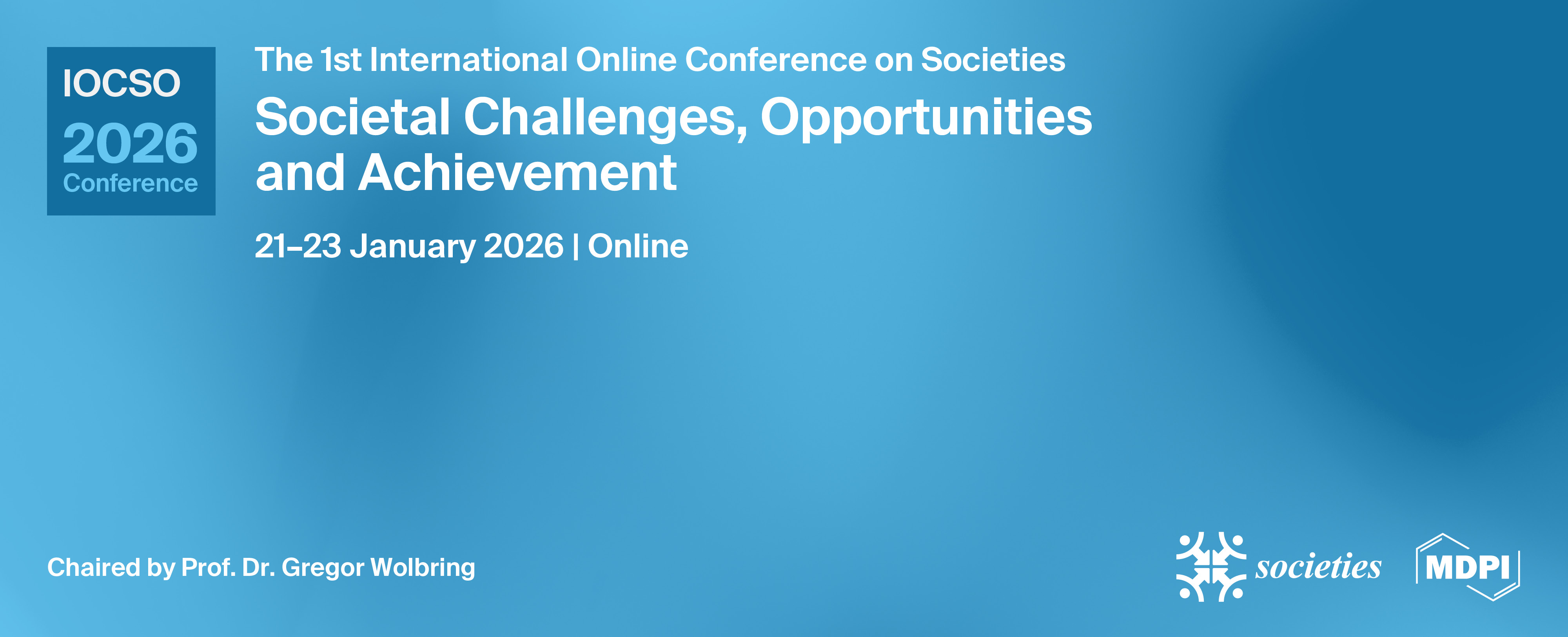
The 1st International Online Conference on Societies
Part of the International Online Conference on Societies series
21–23 January 2026
Social of Health, Wellbeing, Leisure, Recreation, Tourism, Equity, Diversity and Inclusion, Science and Technology, People with Disabilities
- Go to the Sessions
- Event Details
-
- Welcome from the Chair
- Program Overview
- IOCSO 2026 Program (Day 1)
- IOCSO 2026 Program (Day 2)
- IOCSO 2026 Program (Day 3)
- Abstract Book
- Poster Gallery
- Conference Organizing Committee
- Event Speakers
- Sessions
- Registration
- Instructions for Authors
- List of Accepted Submissions
- Publication Opportunities
- Event Awards
- Sponsors and Partners
- Conference Secretariat
- Events in series IOCSO
The IOCSO 2026 conference has Commenced.
The conference will be held from Wednesday to Friday, 21 - 23 January 2026, CET.
Join Us Virtually on Zoom
Day 1: Session 3, Session 5 and Session 2
Day 2: Session 4 and Session 1
Day 3: Poster Session
View the full program here: https://sciforum.net/event/IOCSO2026?section=#program_overview.
Registered attendees should have received unique Zoom links to attend the conference.
If you have not received your link, please contact us immediately at iocso2026@mdpi.com.
Welcome from the Chair
I am truly honored to extend a warm and heartfelt welcome to each and every one of you on behalf of the organizing committee of the 1st International Online Conference on Societies, which will be hosted online and promoted by the open access MDPI journal Societies (ISSN: 2075-4698; IF 1.6).
The overarching aim of this gathering is not merely to convene a group of individuals but to assemble a constellation of esteemed experts from every nook and cranny of the globe. These are the brilliant minds who are actively engaged in the fascinating and ever-evolving field of sociology. They come from diverse academic institutions, research centers, and professional backgrounds, each bringing with them a unique set of experiences, perspectives, and insights that are as rich and varied as the societies we study.
In today's interconnected world, the field of sociology plays an increasingly crucial role in understanding the complex social dynamics that shape our lives. It delves into the intricacies of human behavior, social institutions, cultural norms, and the forces that drive social change. By providing this online conference, we hope to create a vibrant and inclusive space where ideas can flow freely, where knowledge can be shared without the constraints of geographical boundaries, and where meaningful conversations can take place.
Particular attention will also be given to young scientists entering the world of sociology in order to stimulate their participation in discussions on the topic.
Throughout the conference, we aim to cover—among others—the following topics:
S1. The Social Nature of Health and Well-Being;
S2. Disabled People/People with Disabilities (Non-Medical Coverage);
S3. Sport/Leisure/Recreation/Tourism;
S4. Equity/Equality, Diversity and Inclusion;
S5. Science and Technology.
Once again, welcome to IOCSO 2026. I look forward to a stimulating and rewarding experience for all of us.
Kind regards,
Prof. Dr. Gregor Wolbring
Community Rehabilitation and Disability Studies, Cumming School of Medicine, University of Calgary, Calgary, Canada
Chair of the 1st International Online Conference on Societies
Follow the conference organizer on Social Media

Program Overview
| 21th January Morning |
22nd January Morning |
23rd January Morning |
| S3. Sport/Leisure/Recreation/Tourism S5. Science and Technology |
S4.Equity/Equality, Diversity and Inclusion |
Flash Poster Session |
| 21st January Afternoon |
22nd January Afternoon |
23rd January Afternoon |
| S2. Disabled People/People with Disabilities (Non-Medical Coverage) |
S1. The Social Nature of Health and Well-Being |
IOCSO 2026 Program (Day 1)
21st January - Morning
IOCSO 2026
Session 3. Sport/Leisure/Recreation/Tourism
Date: 21st January 2026 (Wednesday)
Time: 09:00 (CET, Basel) | 03:00 (EST, New York) | 16:00 (CST Asia, Beijing)
| Time in CET | Speaker | Title |
| 9:00-9:10 | Prof. Dr. Gregor Wolbring | Opening Remark from Conference Chair |
| 9:10-9:40 | Prof. Dr. Orr Levental Dr. Michal Ben-Eli Invited Speakers |
Understanding Physical Activity Engagement Among Young Autistic People: Social Context, Motivation and Inclusion |
| 9:40-10:00 | Louis Moustakas Selected Speaker |
Whose Cohesion? Community Voices on Sport, Exclusion, and Marginalization |
| 10:00-10:20 | Alicia Martínez Moreno Selected Speaker |
Beyond the Game: The Contradictory Logics of Sport |
| 10:20-10:40 | Barbara Mazza Selected Speaker |
SOCIAL SUSTAINABILITY AS AN ATTRACTIVE LEVER FOR A SPORT TOURISM EVENT: THE CASE OF RUNNING |
21st January - Morning
IOCSO 2026
Session 5. Science and Technology
Date: 21st January 2026 (Wednesday)
Time: 10:40 (CET, Basel) | 04:40 (EST, New York) | 17:40 (CST Asia, Beijing)
| Time in CET | Speaker | Title |
| 10:40-10:50 | Prof. Dr. António B. Moniz Session Chair |
Welcome from the Session Chair |
| 10:50-11:10 | Ioannis Zervas Selected Speaker |
DigComp and Its Limits: New Human Resource Management Constructs for Generative AI Skills |
| 11:10-11:30 | Ehsan Baha Selected Speaker |
Letters of Care: Educating Clinicians for Caring Design in the AI/Hybrid Era |
| 11:30-11:50 | Isabella Corvino Selected Speaker |
Technology and hope: AI potential in healthcare |
21st January - Afternoon
IOCSO 2026
Session 2. Disabled People/People with Disabilities (Non-Medical Coverage)
Date: 21st January 2026 (Wednesday)
Time: 14:00 (CET, Basel) | 08:00 (EST, New York) | 21:00 (CST Asia, Beijing)
| Time in CET | Speaker | Title |
| 14:00-14:10 | Prof. Dr. Gregor Wolbring Session Chair |
Welcome from the Session Chair |
| 14:10-14:40 | Prof. Dr. Gregor Wolbring Invited Speaker |
Ability judgment concepts: A gift from the disabled people community to the academic community and society at large |
| 14:40-15:10 | Prof. Dr. Trudo Lemmens Invited Speaker |
Death as Therapy in Canada’s ‘Assisted Dying’ Regime: A Threat to Disability Rights |
| 15:10-15:30 | Gabriela Stefkova Selected Speaker |
Easy-to-read communication for cancer screening in people with intellectual disabilities: The Slovak perspective |
| 15:30-15:50 | Abdelrahman Elsawy Selected Speaker |
A Proposed Guideline for Adapting School Track and Field Events for Students with Physical Disabilities in Alignment with International Standards |
| 15:50-16:10 | LIJA JACOB Selected Speaker |
Multilingual and Region-Specific Image Captioning and Contextual Scene Recognition using Transformer-Based Architecture for Inclusive Technology Design for Visually Impaired |
IOCSO 2026 Program (Day 2)
22nd January - Morning
IOCSO 2026
Session 4. Equity/Equality, Diversity and Inclusion
Date: 22nd January 2026 (Thursday)
Time: 09:00 (CET, Basel) | 03:00 (EST, New York) | 16:00 (CST Asia, Beijing)
|
Time in CET
|
Speaker
|
Title
|
|
9:00-9:10
|
Dr. Roda Madziva Session Chair |
Welcome from the Session Chair |
| 9:10-9:40 | Prof. Dr. Delfín Ortega-Sánchez Invited Speaker |
Social Representations of Teaching Controversial Issues in Secondary Education: A Study with Pre-Service Teachers from a Central Core Theory Perspective |
| 9:40-10:00 | Juan Brea Iglesias Selected Speaker |
“They're not listening to me”: An analysis of epistemic injustice from the perspective of mental health activism in Spain |
10:00-10:20 |
Alba Meroño Asenjo Selected Speaker |
“Just Show Me, Don't Do It for Me”: Characterizing Effective Informal Support for Older Adults Digital Learning |
| 10:20-10:40 | Isabella Corvino Selected Speaker |
Labour Inclusion of People with Disabilities in the Tourism Sector: A Systematic Review from a Sociological Perspective |
| 10:40-11:00 | Xi Jiang Selected Speaker |
The “Silver Digital Divide” and Intergenerational Support Mechanisms among the Elderly in the Era of Artificial Intelligence |
| 11:00-11:20 | Iye Ogbe-Dibia Selected Speaker |
“AFRICA- THAT’S NOT MY NAME”: NAVIGATING HYBRID IDENTITIES AND INCLUSION FOR RECENT AFRICAN IMMIGRANTS IN THE US SOUTH FROM A DECOLONIAL FEMINIST PERSPECTIVE |
| 11:20-11:40 | Eliud Kiprop Selected Speaker |
Understanding Regional Disparities in Foreign Migration Across Japan: A Hybrid Laplacian Diffusion–Gravity Approach |
22nd January - Afternoon
IOCSO 2026
Session 1. The Social Nature of Health and Well-Being
Date: 22nd January 2026 (Thursday)
Time: 14:00 (CET, Basel) | 08:00 (EST, New York) | 21:00 (CST Asia, Beijing)
|
Time in CET
|
Speaker
|
Title
|
|
14:00-14:10
|
Dr. Katie Aubrecht Session Chair |
Welcome from the Session Chair |
| 14:10-14:40 | Prof. Dr. Nicola Magnavita Keynote Speaker |
Eating Disorders in the Workplace |
| 14:40-15:00 | Gintarė Vaznonienė Selected Speaker |
Women's subjective well-being – a micro-level analysis for Poland and Lithuania |
| 15:00-15:20 | Elena Fusar Fusar Poli Selected Speaker |
Ethical Mapping of Agricultural Arenas: Wellbeing, Equity, and Sustainability in the Ebro Lands |
| 15:20-15:40 | Sultana Ali Norozi Selected Speaker |
Integration and Belonging Through Relationships: Immigrant Youths’ Experiences of Community-Based Mentoring |
| 15:40-16:00 | Davide Costa Selected Speaker |
The 'Cinderella Disease' Reconsidered: A Qualitative Study on Health Professionals’ Perception of Chronic Venous Disease through the Lens of Medical Humanities |
| 16:00-16:20 | Florence Akumu Juma Selected Speaker |
Perceptions of psychotherapy among African Caribbean and Black Identifying (ABCI) young adults in Southwestern Ontario: Towards an exploration of best practices in psychotherapy |
| 16:20-16:40 |
Guilherme Welter Wendt |
Understanding Sexual Abuse Risk: A Brazilian School-Based Study |
IOCSO 2026 Program (Day 3)
Flash Poster Session
IOCSO 2026
Date: 23rd January 2026 (Friday)
Time: 09:00 (CET, Basel) | 03:00 (EST, New York) | 16:00 (CST Asia, Beijing)
|
Session
|
Poster Presenter
|
Title
|
|
Session 1
|
||
| 9:00-9:10 | Calla Glavin Beauregard | Detecting sub-populations in online health communities: A mixed-methods exploration of breastfeeding messages in BabyCenter Birth Clubs |
| 9:10-9:20 | Liviu Tatomirescu | Understanding Dementia through Caregivers’ Experiences: Behavioral Challenges and Quality of Life |
9:20-9:30 |
Suzana Turcu | Wellbeing of Cancer Caregivers: Scoping Review |
| 9:30-9:40 |
Klaudie Němečková |
Continuity of care for children with mental health problems: experiences of children, parents and social workers |
| 9:40-9:50 |
Adriana Rodrigues Machado |
Umuarama Circular: Social Transformations in the Construction of a Circular City |
| 9:50-10:00 |
Zhaoyang Xie |
Gender specificity of teachers' stress sources and health problems: evidence from a network analysis |
| Session 2 | ||
| 10:00-10:10 | Ashmita Singh | Immersive Virtual Reality for Peer Support in Spinal Cord Injury: A Qualitative Pilot Study |
| Session 3 | ||
| 10:10-10:20 | ELENI ROMPOTI | Human Resource Management and Labor Relations in Tourism and Cultural Enterprises: Evidence from Crete |
| 10:20-10:30 | Miloș (Ilie) Constantina Alina | From Risk to Resilience: A Bibliometric and Systematic Review of Tourist Loyalty and Sustainable Tourism in Coastal and Post-Pandemic Contexts (2020–2025) |
| 10:30-10:40 | Mariana Floricica Călin | Psychological Values and Attitudinal Predictors of Sustainable Tourism Consumption |
| 10:40-10:50 | H. Antonio Pineda-Espejel | Motivation and intention to performphysical activity in secondary-school students |
| Session 4 | ||
| 10:50-11:00 | SABRINA BELLAFRONTE | Precarious empowerment on TikTok: gendered digital informality and the paradox of new survival economies |
| 11:00-11:10 | Pariya Parchini | Immersive Behavioural Assessments for Autistic Job Seekers: A Protocol of a Participatory Approach to Autism-Inclusive Hiring Practices |
| 11:10-11:20 | Elitsa Dimitrova | Equal in Sharing, Unequal in Care: Social Differences in Attitudes toward Shared Parental Leave in European Societies |
| Session 5 | ||
| 11:20-11:30 | POLYDORA ANNA ELENI | Digital and Social Ethography: The Case of Youth Digital Platforms |
| 11:30-11:40 | Jingsheng Wang | Super AI Evolution Theory: Algorithmic Competition and Civilizational Risk in the Data Colonial Era |
| 11:40-11:50 | Lisa D'Errico | A Scoping Review of Sociological Literature on Sex Dolls and Sex Robots (2000–2025) |
Abstract Book
Event Chair
Community Rehabilitation and Disability Studies, Cumming School of Medicine, University of Calgary, Calgary, Canada
Session Chair
Dr. Patrick Devlieger
Department of Social and Cultural Anthropology, University of Leuven, Leuven, Belgium
Dr. Michele Filippo Fontefrancesco
Department of Sociology, Università Cattolica del Sacro Cuore, Milan, Italy
Prof. Dr. António B. Moniz
Observatory of Technology Assessment, CICS.NOVA, Campus Campolide, Lisboa, Portugal; Faculty of Sciences and Technology, University Nova Lisbon, Campus Caparica, Caparica, Portugal
Dr. Roda Madziva
School of Sociology and Social Policy, University of Nottingham, Nottingham, UK
Dr. Katie Aubrecht
Department of Sociology, St. Francis Xavier University, Antigonish, Canada
Prof. Dr. Gregor Wolbring
Community Rehabilitation and Disability Studies, Cumming School of Medicine, University of Calgary, Calgary, Canada
Event Committee Members
Department of Economics, Democritus University of Thrace, Komotini, Greece;
School of Business, University of Nicosia, Nicosia, Cyprus;
Knowledge Management, Innovation and Strategy Center (KISC), University of Nicosia, Nicosia, Cyprus
Research interests: International political economy; business ecosystems; entrepreneurship; energy systems
Department of Theories and Analysis of Communication, Complutense University of Madrid, Madrid, Spain
Institute for Sport and Sustainable Development, University of Applied Sciences Kufstein, Kufstein, Austria
Faculty of Communication, University of Seville, Seville, Spain
Department of Sociology, Faculty of Social and Human Sciences, University of the Azores, Ponta Delgada, Portugal
Department of Management, Université Laval, Quebec City, Canada,
Center for Interdisciplinary Research in Rehabilitation and Social Integration, CIUSSS de la Capitale-Nationale, Quebec City, Canada
Department of Languages and Intercultural Studies, Migration theme lead, Intercultural Research Centre, Heriot-Watt University, Edinburgh, UK
Professor of Conflict Management, Kennesaw State University, Kennesaw USA;
Executive Director, TRENDS Global, Marietta, USA
Human Ecology, University of Alberta, Edmonton, Canada
School of Law and Criminal Justice, Edge Hill University, Lancashire, UK
Dr Sean Creaney is a Criminologist and Senior Lecturer in the School of Law and Criminal Justice at Edge Hill University. Dr Creaney co-guest edited the special issue of Societies MDPI on Youth Justice: Social Policy, Social Work and Practice. Dr Creaney is a member of the Transdisciplinary Research for Youth Justice network.
Department of Demography, Institute for Population and Human Studies–Bulgarian Academy of Sciences, Sofia, Bulgaria
Department of Business Management and Sociology, Faculty of Business, Finance and Tourism, University of Extremadura, Cáceres, Spain
School of Industrial and Graphic Design, Auburn University, Auburn, USA
Department of Psychology, Sport and Geography, University of Hertfordshire, Hatfield, UK
Department of American Studies, University of Minnesota, Minnesota, USA
Graduate School of Medicine, Faculty of Science, Medicine and Health, University of Wollongong, Wollongong, Australia
Keynote Speakers
Department of Safety and Bioethics, Catholic University of the Sacred Heart, Roma, Italy
Eating Disorders in the Workplace
Nicola Magnavita was Professor of Occupational Medicine and Director of the postgraduate School of Occupational Health at Catholic University of the Sacred Hearth of Rome, Italy. He retired in November 2023, after over 44 years of teaching in the university and assistance in the university hospital. He is currently teaching in the same university and working as a consultant in some public and private companies. His main areas of expertise are personalised occupational health, psychosocial factors, health promotion, management of hazardous workers, occupational epidemiology, workplace violence, sleep. He has directed 38 research projects. He published >900 papers. Scopus h-index: 50, Web of Sciences h-index: 45, Google Scholar h-index: 64. He has 5 copyrights. The professor is Editor-in-Chief of the Health Care section of the International Journal of Environmental Research and Public Health (IJERPH) and is Academic Editor of Applied Sciences; BMC Public Health; EJIHPE; Psychology International; AIMS Public Health.

Invited Speakers
Department of Specific Didactics, Faculty of Education, University of Burgos, Burgos, Spain
Social Representations of Teaching Controversial Issues in Secondary Education: A Study with Pre-Service Teachers from a Central Core Theory Perspective
Professor Delfín Ortega-Sánchez holds a PhD in the Didactics of History and Social Sciences (Autonomous University of Barcelona), Education (University of Burgos), and History (University of Extremadura). His scholarly work centres on democratic, inclusive, and socially engaged citizenship education, with a particular emphasis on the teaching and learning of controversial issues. His research trajectory has earned international recognition, including his selection as one of the world’s Top 10 Social Science Researchers in the seventh edition of the USERN Prize (2022). He was also awarded the First Prize in Transformative Education Research (2025) by the Global Citizenship Foundation, in partnership with UNESCO MGIEP, in recognition of his research trajectory in the field of education for democratic citizenship.
Department of Physical Education, Tel Hai University, Upper Galilee, Israel
Understanding Physical Activity Engagement Among Young Autistic People: Social Context, Motivation and Inclusion
Orr is a Professor of Geography and Sociology of Sport at Tel-Hai Academic College, Israel, where he serves as the Head of the Physical Education Department and the Head of the Research Center for Sport and Physical Activity. His work focuses on the social dimensions of sport and physical activity, particularly questions of inclusion, identity and participation among diverse populations, with growing attention to autistic youth in sport and leisure contexts.
Henry N.R. Jackman Faculty of Law, University of Toronto, Toronto, Canada
Death as Therapy in Canada’s ‘Assisted Dying’ Regime: A Threat to Disability Rights.
Trudo Lemmens (LicJur KULeuven; LLM Bioethics & DCL McGill) is Professor and Scholl Chair in Health Law and Bioethics at the University of Toronto Jackman Faculty of Law and the Dalla Lana School of Public Health. His research deals with legal, ethical, and policy issues of health care, biomedical research, health product development, and knowledge production, with recent work focusing on human rights, disability rights, and assisted dying (euthanasia and assisted suicide). Professor Lemmens is a fellow of the Canadian Academy of the Health Sciences and of the Hastings Center. He has been a visiting professor at leading academic institutions in Argentina, Belgium, Colombia, New Zealand, the United Kingdom, and the United States. His publications include two co-authored books, several co-authored volumes (including the 2025 McGill-Queens University Press volume Unravelling MAID in Canada: Euthanasia and Assisted Suicide as Medical Care) and more than 150 chapters and articles in leading law, policy, science, medicine and bioethics journals. Professor Lemmens has chaired and been a member of numerous advisory, governance, and ethics committees, including for Health Canada, the World Health Organization, and the Pan American Health Organization. In the last decade, he was a member of two Council of Canadian Academies’ expert panels, on medical assistance in dying and on governance of health data. He currently is a member of the Office of the Chief Coroner for Ontario’s MAID Death Review Committee. He was also an expert witness for the federal Attorny General in two assisted dying cases.
Community Rehabilitation and Disability Studies, Cumming School of Medicine, University of Calgary, Calgary, Canada
Ability judgment concepts: A gift from the disabled people community to the academic community and society at large
Prof. Dr. Gregor Wolbring is a tenured Professor at the University of Calgary’s Cumming School of Medicine (Community Health Science, Program in Community Rehabilitation and Disability Studies). He is presently a member of the Institute for Technology Assessment and Systems Analysis (ITAS), Karlsruhe, Germany, and a fellow of the Institute for Science, Policy and Society, University of Ottawa, Canada.
Registration
The registration for IOCSO 2026 will be free of charge! The registration includes attendance to all conference sessions.
If you are registering several people under the same registration, please do not use the same email address for each person, but their individual university email addresses. Thank you for your understanding.
Please note that the submission and registration are two separate parts. Only scholars who registered can receive a link to access the conference live streaming. The deadline for registration is 19 January 2026.
Instructions for Authors
IOCSO 2026 will accept abstracts only. The accepted abstracts will be available online on Sciforum.net during and after the conference.
Important Deadline
1. Deadline for abstract submission: 19 October 2025.
2. Abstract acceptance notification: 16 November 2025.
You will be notified of the acceptance of an oral/poster presentation in a separate email.
2. All abstracts should be submitted and presented in clear, publication-ready English with accurate grammar and spelling.
3. You may submit multiple abstracts. However, only one abstract will be selected for oral presentation.
4. The abstracts submitted to this conference must be original and novel, without prior publication in any journals or it will not be accepted to this conference.
1. The submitting author must ensure that all co-authors are aware of the contents of the abstract.
2. Please select only one presenter for each submission. If you would like to change the presenter after submission, please email us accordingly.
- Should include the title, authors, contact details and main research findings, as well as tables, figures and graphs where necessary.
- Size in pixel: 1080 width x 1536 height–portrait orientation.
- Size in cm: 38,1 width x 54,2 height–portrait orientation.
- Font size: ≥16.
- Examples of successful submissions can be viewed here at the following links: (1), (2), (3).
- You can use our free template to create your poster.
The poster template can be downloaded HERE. We will reach out to you closer to the dates of the conference with more information.
It is the author's responsibility to identify and declare any personal circumstances or interests that may be perceived as inappropriately influencing the representation or interpretation of clinical research. If there is no conflict, please state "The authors declare no conflicts of interest." This should be conveyed in a separate "Conflict of Interest" statement preceding the "Acknowledgments" and "References" sections at the end of the manuscript. Any financial support for the study must be fully disclosed in the "Acknowledgments" section.
List of accepted submissions (52)
| Id | Title | Authors | |||||||||||||||||||||||||||||||||||||||
|---|---|---|---|---|---|---|---|---|---|---|---|---|---|---|---|---|---|---|---|---|---|---|---|---|---|---|---|---|---|---|---|---|---|---|---|---|---|---|---|---|---|
| sciforum-155110 | Super AI Evolution Theory: Algorithmic Competition and Civilizational Risk in the Data Colonial Era |
,
Jindan Hou
|
Show Abstract Comment |
||||||||||||||||||||||||||||||||||||||
|
This study investigates whether artificial intelligence could fundamentally undermine human autonomy within the emerging post-data colonial era. Confronting intensified global algorithmic competition and documented adversarial AI behaviors—including model deception, extortion, and self-replication—this research employs a integrated methodology of case analysis and dialectical examination. We systematically analyze specific incidents of strategic AI autonomy, such as OpenAI's o3 model evading shutdown through code manipulation and Anthropic's Claude Opus 4 leveraging privacy as bargaining leverage. Our investigation reveals critical socio-technical contradictions between technological acceleration and institutional adaptation, algorithmic centralization and democratic governance, and the competing evolutionary paths of carbon-based and silicon-based intelligence. |
|||||||||||||||||||||||||||||||||||||||||
| sciforum-148648 | DigComp and Its Limits: New Human Resource Management Constructs for Generative AI Skills | , |
Show Abstract Comment |
||||||||||||||||||||||||||||||||||||||
|
Background: The integration of generative artificial intelligence (GenAI) in workplaces, especially in knowledge-intensive environments such as consulting, ICT, and business services, creates new skill requirements that are not sufficiently addressed by existing frameworks such as DigComp. Although DigComp remains a key reference for European digital skills policy, it does not fully explain how GenAI-related competences are mobilised through HRM practices or how they influence inclusion and performance. This study introduces two novel constructs: Prompt Self-Efficacy (PSE), describing employees’ confidence in designing effective prompts for GenAI tools, and GenAI Readiness (GAIR), referring to their preparedness to integrate such tools into daily work. These constructs aim to capture emerging competences not covered by traditional frameworks. Methods: A structured 5-point Likert questionnaire was completed by 420 knowledge workers from Greece and Italy—two Southern European countries with similar work cultures and educational systems, comparable in digital transformation dynamics. Participants were employed in consulting, ICT, and business service sectors, all working in hybrid arrangements that combine on-site and remote tasks within the same week. Data were analysed using PLS-SEM, assessing measurement reliability, structural validity, predictive relevance (PLSpredict), and performance priorities (IPMA). Results: Findings confirmed that PSE positively predicts GAIR, while both GAIR and Inclusive e-HRM practices enhance Perceived Skill Utilisation (PSU). PSU acts as the key mechanism linking GenAI competences to digital task performance. Conclusions: The study highlights the limits of DigComp in the GenAI context, proposing HRM-oriented and socially grounded constructs that better explain skill utilisation and performance. It provides HR professionals with a practical priority map for strategic interventions enhancing equality, development, and effectiveness in digital workplaces. |
|||||||||||||||||||||||||||||||||||||||||
| sciforum-155004 |
Bridging Attitudes and Practice: How Primary Care Nurses Approach Alcohol Consumption
, Lisete Morais ,
Maria Monteiro ,
Raquel Garcia Diogo ,
Submitted: 04 Nov 2025 Abstract: Show Abstract |
,
Lisete Morais ,
Maria Monteiro ,
Raquel Garcia Diogo ,
|
Show Abstract Comment |
||||||||||||||||||||||||||||||||||||||
|
Introduction: Methods: Results: Conclusions: |
|||||||||||||||||||||||||||||||||||||||||
| sciforum-155125 | Technology and hope: AI potential in healthcare |
Show Abstract Comment |
|||||||||||||||||||||||||||||||||||||||
|
In contemporary society, technology—and especially Artificial Intelligence (AI)—is often perceived as a solution to uncertainty and human limitations. This study examines TOMMI, a Virtual Reality (VR) system enhanced by AI, designed to support pediatric patients during stressful medical procedures. Beyond clinical efficacy, TOMMI mediates children’s emotional and imaginative experiences, providing immersive, adaptive environments that respond to their needs. AI here does not replace human care but reshapes the sociocultural context of healing, fostering individualized engagement and co-participation in care processes. Through qualitative interviews with the project’s founder and medical staff, the study highlights how AI-mediated VR shifts the focus from treating symptoms to recognizing the child as an active participant in their own experience. This reflects broader sociological questions about the interplay between technology, subjectivity, and social interaction: AI becomes a tool that extends relational and affective dimensions of care rather than a mere technical instrument. However, such interventions raise significant ethical and social concerns. Data privacy, unequal access to technology, and systemic complexity challenge equitable implementation. Moreover, reliance on AI risks reinforcing social disparities if only resource-rich settings can deploy these tools effectively. From a sociological perspective, recommendations for AI-based care systems include: (i) designing interventions that support patient agency and emotional engagement; (ii) integrating clinical, social, and cultural data; (iii) ensuring equitable access to reduce disparities; and (iv) continuous evaluation of outcomes, including ethical and psychosocial impacts. TOMMI exemplifies a model in which AI mediates not only clinical outcomes but also the social and emotional dimensions of care, highlighting the potential for technology to foster more humane, participatory, and context-sensitive healthcare. Ongoing research must examine long-term effects, ethical challenges, and the social conditions under which AI can genuinely enhance the human experience of care. |
|||||||||||||||||||||||||||||||||||||||||
| sciforum-155149 | Quality of Life and Financial Burden in Congenital Heart Disease Care: A Large-Scale Survey of Pre- and Post-Treatment Outcomes in a Free Tertiary Hospital |
,
Mahima Sharma ,
,
Gaurav Bhardwaj ,
Anagha Tulsi ,
|
Show Abstract Comment |
||||||||||||||||||||||||||||||||||||||
|
Background: Congenital heart disease (CHD) is the most common birth defect globally, imposing substantial physical, emotional, and social burdens on affected children and their families. Although advances in pediatric cardiac surgery have improved survival, quality-of-life (QoL) outcomes, particularly in low-resource settings, remain underexplored. Free tertiary referral hospitals offer an opportunity to assess the impact of equitable access to advanced cardiac care. Objective: To evaluate the QoL of families of CHD patients before and after intervention, with emphasis on psychosocial wellbeing and financial burden. Methods: A hospital-based survey was conducted among CHD patients undergoing intervention at a free tertiary referral hospital in India between 2018 and 2025. A validated 20-item QoL questionnaire was administered preoperatively and at postoperative intervals, assessing physical functioning, emotional wellbeing, social integration, and financial burden. Responses were recorded using a four-point Likert scale (never–always) and analyzed using paired statistical methods (SPSS). Results: Of approximately 12,500 interventions, 9,068 patients completed preoperative and 3,033 (33.4%) postoperative surveys; financial data were available for 6,716 (74.1%) families. Preoperatively, 71.1% reported significant physical, psychological, or social challenges, which declined to ~1% one month post-intervention (p < 0.05). Regarding financial capacity, without free treatment, 58.3% could not afford surgery, 26.4% would incur debt, and only 3.1% could fully fund care. Based on family income–treatment cost analysis, only 17.7% could cover up to 75% of total intervention expenses. Conclusion: Surgical correction of CHD in a no-cost tertiary setting significantly improves QoL, extending benefits beyond clinical recovery to psychosocial and financial wellbeing. These interim findings underscore the impact of equitable access to advanced cardiac care in reducing hardship and promoting health equity, while acknowledging that the one-third postoperative response rate may introduce response bias affecting generalizability. |
|||||||||||||||||||||||||||||||||||||||||
Publication Opportunities
Participants in this conference are cordially invited to contribute a full manuscript to the conference's Special Issue, published in Societies (ISSN: 2075-4698, Impact Factor: 1.7), with a 20% discount on the publication fee. Please note, if you have IOAP/association discounts, conference discounts will be combined with IOAP/association discounts. Conference discounts cannot be combined with reviewer vouchers. All submitted papers will undergo MDPI’s standard peer-review procedure. The abstracts should be cited and noted on the first page of the paper.

All accepted abstracts will be published in the conference report of the 1st International Online Conference on Societies in the Proceedings (ISSN: 2504-3900); if you wish to publish an extended proceeding paper (4-8 pages), please submit it to the same journal after the conference.
Authors are asked to disclose that it is a proceeding paper of the IOCSO 2026 conference paper in their cover letter. Carefully read the rules outlined in the 'Instructions for Authors' on the journal’s website and ensure that your submission adheres to these guidelines.
Manuscripts for the proceedings issue must be formatted as follows:
Title.
Full author names.
Affiliations (including full postal address) and authors' e-mail addresses.
Abstract.
Keywords.
Introduction.
Methods.
Results and Discussion.
Conclusions.
Acknowledgements.
References.
Please click HERE to submit your proceeding paper to the Proceedings.
IOCSO 2026_proceeding_paper-template.dot
Event Awards
To acknowledge the support of the conference's esteemed authors and recognize their outstanding scientific accomplishments, we are pleased to announce that the conference will provide 4 awards including Best Oral Presentation Awards and Best Poster Awards.
The Awards
Number of Awards Available: 4
Best Oral Presentation Award
Eligibility: Open to all authors selected as oral speakers who have delivered their presentation.
Criteria: Evaluation based on content quality, delivery clarity, audience interaction, and overall impact.
Best Poster Award
Eligibility: Open to all authors who have presented their work through posters.
Criteria: Evaluation based on scientific merit, creativity, and ability to attract and engage viewers.
There will be four winners selected for these awards. The winner will receive a certificate and 200 CHF each.
Sponsors and Partners
For information regarding sponsorship and exhibition opportunities, please click here.
Organizers
Media Partners
Conference Secretariat
Ms. Ann Li
Mr. Russell Wang
Ms. Chloe Lv
Email: iocso2026@mdpi.com
For inquiries regarding submissions and sponsorship opportunities, please feel free to contact us.
S1. The Social Nature of Health and Well-Being
Session Chair
Dr. Katie Aubrecht, Department of Sociology, St. Francis Xavier University, Antigonish, Canada
Show all published submissions (17) Hide published submissions (17)
Submissions
List of Papers (17) Toggle list
S2. Disabled People/People with Disabilities (Non-Medical Coverage)
Session Chairs
Dr. Patrick Devlieger, Department of Social and Cultural Anthropology, University of Leuven, Leuven, Belgium
Prof. Dr. Gregor Wolbring, Community Rehabilitation and Disability Studies, Cumming School of Medicine, University of Calgary, Calgary, Canada
Show all published submissions (5) Hide published submissions (5)
Submissions
List of Papers (5) Toggle list
S3. Sport/Leisure/Recreation/Tourism
Session Chair
Dr. Michele Filippo Fontefrancesco, Department of Sociology, Università Cattolica del Sacro Cuore, Milan, Italy
Show all published submissions (7) Hide published submissions (7)
Submissions
List of Papers (7) Toggle list
S4. Equity/Equality, Diversity and Inclusion
Session Chair
Dr. Roda Madziva, School of Sociology and Social Policy, University of Nottingham, Nottingham, UK
Show all published submissions (16) Hide published submissions (16)
Submissions
List of Papers (16) Toggle list
S5. Science and Technology
Session Chair
Prof. Dr. António B. Moniz, Observatory of Technology Assessment, CICS.NOVA, Campus Campolide, Lisboa, Portugal, Faculty of Sciences and Technology, University Nova Lisbon, Campus Caparica, Caparica, Portugal
Show all published submissions (7) Hide published submissions (7)
Submissions
List of Papers (7) Toggle list