Limnological Review Webinar | The Wastewater Microbiome and Resistome: Implications for Receiving Water Bodies and Public Health
the chairs
1st Limnological Review Webinar
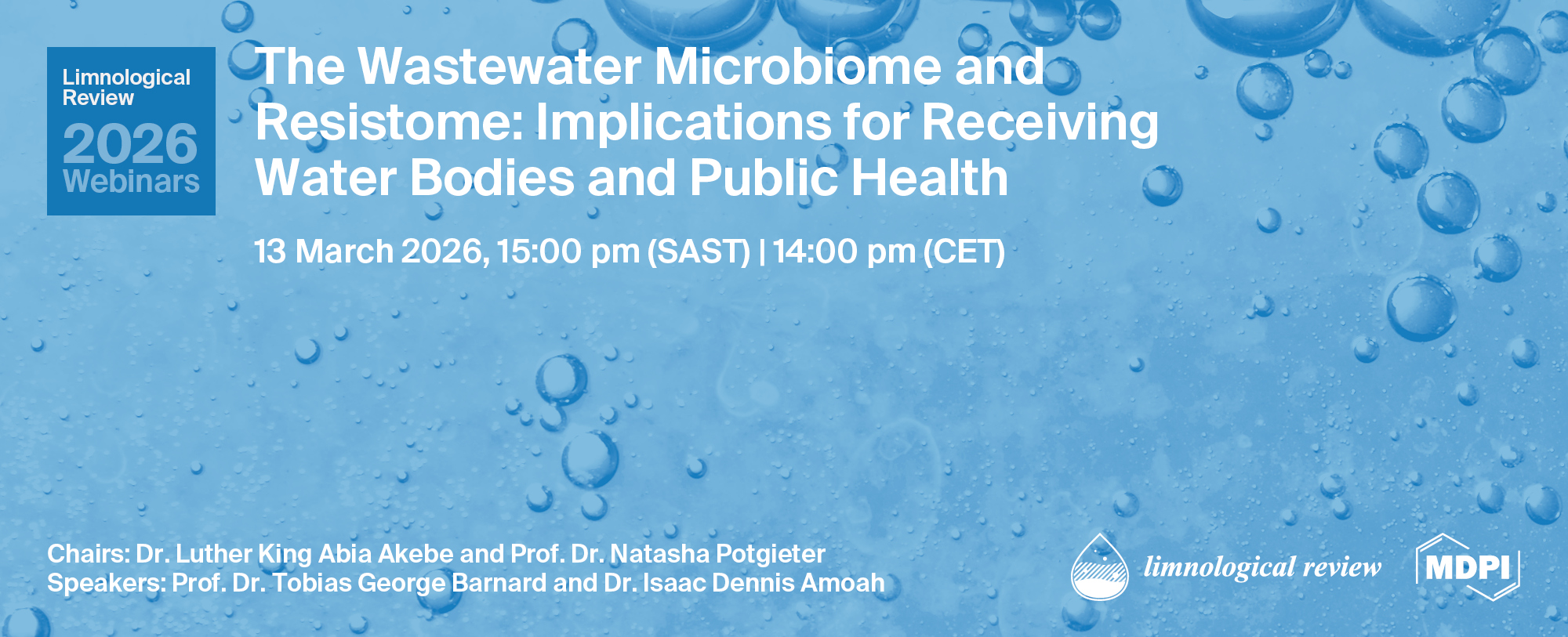
The Wastewater Microbiome and Resistome: Implications for Receiving Water Bodies and Public Health
Infectious diseases are among the ten leading causes of death globally. However, determining the disease burden is becoming challenging using conventional epidemiology tools due to the rapidly growing global population. However, the evaluation of wastewater has become a more acceptable technique for overcoming this challenge, given that wastewater treatment plants are macrocosms representing entire communities. Furthermore, effluent from these treatment plants is often discharged into surrounding freshwater bodies, potentially polluting them due to suboptimal treatment or plant failure. Thus, although freshwater ecosystems (rivers, lakes, streams, wetlands, ponds, and groundwater sources) are vital for human survival, serving as key sources of drinking water, food, recreation, and livelihoods, increasing anthropogenic pressures and climate change are profoundly altering their microbiological composition. These changes have far-reaching consequences for ecosystem function, biodiversity, and public health.
This webinar brings together two seasoned researchers from two continents. Professor TG Barnard will present findings from a multi-province study on antimicrobial resistance in wastewater treatment plants and their receiving water bodies, as well as their relation to clinical settings. Dr ID Amoah will deliver a presentation entitled "The Environmental Resistome and Planetary Health: Mapping the Flow of AMR Through Urban Aquatic Systems".
Date: Friday, 13 March 2026
Time: 15:00 SAST to 16:10 SAST | 14:00 CET to 15:10 CET
Webinar ID: 846 5416 2076
Webinar Secretariat: journal.webinar@mdpi.com
Meet Our Chairs

Executive Dean: Faculty Science, Engineering and Agriculture at University of Venda;Prof. Potgieter holds a doctoral degree in Medical Virology from the University of Pretoria and is a C2 NRF-rated researcher. She established a focus research group on One Health at the University of Venda, which conducts multi- and transdisciplinary research on all aspects of One Health, including water quality, sanitation, and hygiene aspects; the role of infectious diseases in the transmission of diarrheal diseases related to water/sanitation/hygiene problems; antimicrobial resistance surveillance; and treatment options with plant extracts. Her research concentrates on rural and peri-urban communities in South Africa and Sub-Saharan Africa, the epidemiology of enteric bacteria and viruses, TB epidemiology, and treatment options using plant extracts, where most people are exposed to various food-, water-, and sanitation-related diseases and water and sanitation infrastructure is either absent or inadequate. She has graduated over 50 PhD and MSc students and has over 120 journal publications, several book chapters, and technical reports. She is actively involved in several national and international research consortia and serves as the Chair of the African Centre of Excellence (ACE) Advisory Board for development and impact, the Regional Water and Environmental Sanitation Centre, Kumasi [RWESCK], Kwame Nkrumah University of Science and Technology [KNUST].

Total Environment Research (TEN-R) Group, School of Health Sciences, College of Health Sciences, University of KwaZulu-Natal, Private Bag X54001, Durban, South Africa;Luther King Abia Akebe (King) is a C2-rated and High-Impact Researcher in Applied and Environmental Microbiology in the College of Health Sciences at the University of KwaZulu-Natal. His research focuses on, but is not limited to, the dynamics of microbial pathogens in aquatic ecosystems under changing climatic conditions, antimicrobial resistance surveillance in the environment and how this relates to humans and animals through the One Health approach, the use of culture and genomic techniques, the impact of anthropogenic activities like burial practices and informal settlements on surface/groundwater resources, and the use of different ecofriendly nanomaterials to eliminate pathogenic bacteria from water and wastewater. King’s expert opinion has been sought by national and international organizations, such as the South African National Research Foundation (NRF), the South Africa Water Research Commission, and UK Research and Innovation (UKRI). His current international collaborations include the USA, Canada, the UK, Egypt, UAE, Algeria, Ghana, Cameroon, India, and Nigeria. King has co-authored over 130 peer-reviewed journal articles, 13 book chapters, and four books. He has also supervised/co-supervised over 40 PhD and MSc students (some ongoing).
Meet Our Speakers

Water and Health Research Centre, Faculty of Health Sciences, University of Johannesburg, Johannesburg, South Africa;Prof. Tobias Barnard is the Director of the Water and Health Research Centre in the Faculty of Health Science at the University of Johannesburg (UJ). He is from Bloemfontein in the Free State, where he obtained his PhD in Biochemistry from the University of the Free State. He was recruited by the UJ as a post-doctoral fellow in 2006 and worked his way up to his current position. He has served on national and international boards, councils, and committees and is a proud founding member of the South African Young Water Professionals. The Water and Health Research Centre team consists of staff and students with various educational backgrounds undertaking research into potential commercial products, routine sample analysis, and community engagement. Their research focuses on how pathogens enter, survive, and adapt in communities, especially related to water, sanitation, and hygiene. The Centre translates this work into community engagement activities, for which they received the UJ Service Excellence Award in Community Engagement in 2023. Most recently, he was one of the founding members of the Creative Microbiology Creative Colab laboratory housed in the Faculty of Art, Design, and Architecture, a lab created to use microbes for art. This year, the second bioart exhibition will be held at the FADA art gallery on the Bunting Road campus, where two members of the Centre will display pieces.

Department of Environmental Science, The University of Arizona, Tucson Northwest Agriculture and Forestry University, China;Dr. Isaac Dennis Amoah is a multidisciplinary public health scientist specializing in the intersection of environmental microbiology, genomics, and epidemiology. He currently serves as a Global Professor in the Department of Environmental Science at the University of Arizona (Yangling Microcampus) and is an Honorary Research Associate at the Durban University of Technology. Dr. Amoah’s research focuses on developing advanced molecular surveillance systems, including Wastewater-Based Epidemiology (WBE) and environmental metagenomics, to serve as early warning systems for infectious diseases and antimicrobial resistance (AMR).
"Freshwater Microbiology and Public Health"
Edited by Dr. Luther King Abia Akebe
Deadline for manuscript submissions: 29 June 2026
In this section, you will find the recordings of this webinar to watch. Re-watch and share with your colleagues!
The webinar “Wastewater Microbiome and Resistome: Implications for Receiving Water Bodies and Public Health” brought together experts to explore the role of wastewater systems in shaping microbial ecology and antimicrobial resistance (AMR). The session was chaired by Professor Natasha Potgieter and Dr. Akebe Luther King Abia and featured presentations by Professor Tobias Barnard and Dr. Dennis Amoah. The discussions used a One Health framing, emphasizing the interconnectedness of environmental, human, and microbial systems in driving public health risks.