
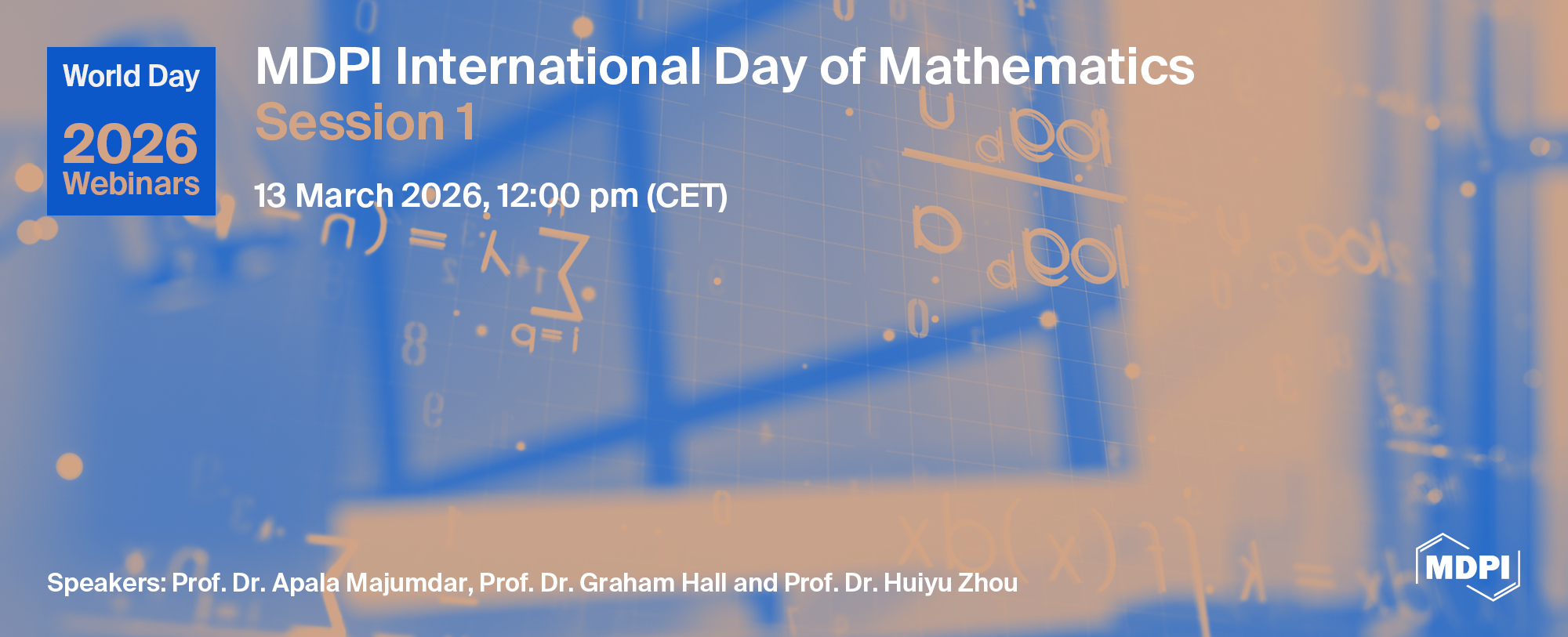
MDPI International Day of Mathematics Webinar 2026 | Session 1
Meet Our Speakers

University of Manchester, UK;Apala Majumdar is a professor of applied mathematics at the University of Manchester, UK. Apala received her PhD in applied mathematics from the University of Bristol in 2006, followed by postdoctoral fellowships at the University of Oxford and took up her first faculty position at the University of Bath in 2012. Apala was appointed a Global Talent Attraction Platform Professor of Applied Mathematics at the University of Strathclyde in 2019, and she moved to the University of Manchester in 2025. Apala is an internationally acclaimed applied mathematician with expertise in mechanics, modelling, calculus of variations and nonlinear partial differential equations. Apala’s research programme is highly international and interdisciplinary and has been recognised with multiple national and international awards. Notably, Apala was awarded a Friedrich Wilhelm Bessel research award by the Humboldt Foundation in 2022. Apala was elected Fellow of the Royal Society of Edinburgh in 2024.

University of Aberdeen, UK;Graham Hall graduated from the University of Newcastle upon Tyne, England, receiving his B.Sc in 1968 and PhD in 1971. He has been a member of the staff at the University of Aberdeen since 1973 and was apointed professor in 1996. Since then, he has successfully supervised 20 PhD students and many M.Sc students, in addition to delivering invited research seminars at many universities in North and South America, Europe, Asia, Africa and Australasia. He was elected to a fellowship of The Royal Society of Edinburgh in 1995, followed by a fellowship of The Royal Astronomical Society in 2003. He is currently Emeritus Professor at Aberdeen.

University of Leicester, UK;Dr. Huiyu Zhou received his Bachelor of Engineering degree in Radio Technology from Huazhong University of Science and Technology of China, and his Master of Science degree in biomedical engineering from the University of Dundee of United Kingdom, respectively. He was awarded the Doctor of Philosophy degree in computer vision from Heriot-Watt University, Edinburgh, United Kingdom. Dr. Zhou is currently a full Professor at the School of Computing and Mathematical Sciences, University of Leicester, United Kingdom. He has published over 600 peer-reviewed papers in the field. His research work has been or is presently being supported by UK EPSRC, ESRC, AHRC, MRC, EU, Innovate UK, Royal Society, British Heart Foundation, Leverhulme Trust, Puffin Trust, Alzheimer’s Research UK, Invest NI and industry. Homepage: https://le.ac.uk/people/huiyu-zhou


To celebrate International Day of Mathematics 2026, MDPI is hosting a special webinar series that brings researchers together to foster collaboration and highlight the essential role that mathematics plays in advancing knowledge across disciplines. From theoretical foundations to applied innovations, this campaign underscores how the exchange of ideas strengthens our collective understanding and drives meaningful real-world impact. Mathematics is not confined to equations on paper; it shapes technology, informs policy, and fuels discovery in every field it touches.
We very much look forward to welcoming you to the International Day of Mathematics Webinar 2026. Through expert-led sessions and dynamic discussions, this event offers a platform to connect with peers, gain new perspectives, and celebrate the global mathematics community. Please find the latest webinar details and programme outline below and join us in marking this important occasion.
Date: 13 March 2026
Time: 12:00pm CET
Webinar ID: 850 4208 6889
Webinar Secretariat: journal.webinar@mdpi.com
In this section, you will find the recordings of this webinar to watch, re-watch and share with your colleagues!