
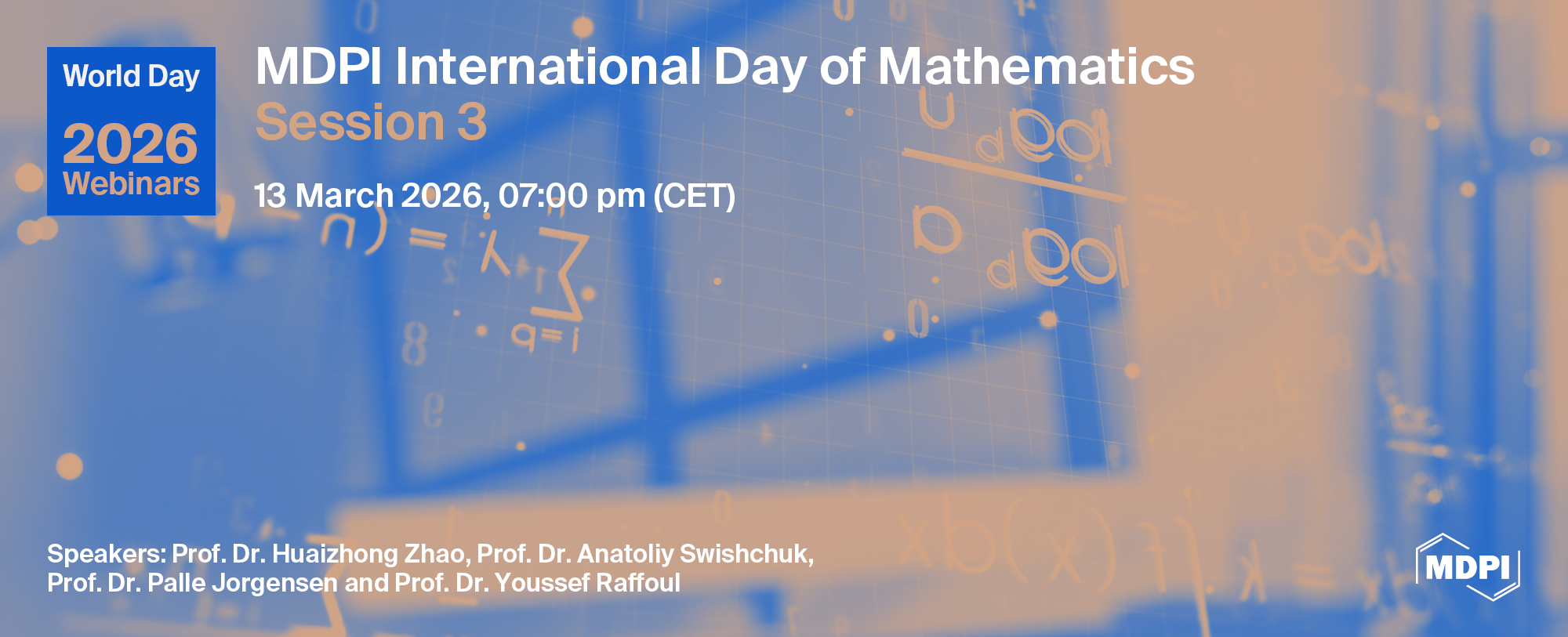
MDPI International Day of Mathematics Webinar 2026 | Session 3
Meet Our Speakers

Durham University, UK;Huaizhong Zhao is currently a Professor in Probability at Durham University. He graduated from Shandong University with BSc in Mathematics, Ph.D. in Dynamical Systems from the Institute of Applied Mathematics, Chinese Academy of Sciences, and Ph.D. in Stochastic Analysis from the Institute of Mathematics, University of Warwick. He held positions at the Institute of Applied Mathematics, Chinese Academy of Sciences, and University of California, Irvine, among others. He was formerly a Professor at Loughborough University and a Visiting Professor at Shanghai Jiaotong University and is a Visiting Professor at Shandong University. He was awarded an EPSRC Established Career Fellowship that enabled him to concentrate on his research in a full-time term for 6 years from January 2019-December 2024. He has published over 70 papers in journals such as Mem. Amer. Math. Soc., Comm. Math. Phys., J. Funct. Anal., J. Differ. Equ., and Ann. Appl. Probab. His main research interests lie in stochastic analysis, particularly the theory of stochastic dynamical systems, and ergodic theory.

University of Calgary, Canada;Prof. Dr. Anatoliy Swishchuk is a professor in mathematical finance at the Department of Mathematics and Statistics, University of Calgary, Calgary, Canada. He attained his B.Sc. and M.Sc. degrees from Kyiv State University, Kyiv, Ukraine. He is a holder of two doctorate degrees in Mathematics and Physics (Ph. D. and D. Sc.) from the prestigious National Academy of Sciences of Ukraine (NASU), Kiev, Ukraine, and is a recipient of NASU award for young scientist with a gold medal for series of research publications in random evolutions and their applications. Dr. Swishchuk is a chair and organizer of finance and energy finance seminar ’Lunch at the Lab’ at the Department of Mathematics and Statistics. Dr. Swishchuk is a Director of Mathematical and Computational Finance Laboratory at the University of Calgary. He was a steering committee member of the Professional Risk Managers International Association (PRMIA), Canada (2006-2015), and is a steering committee member of Global Association of Risk Professionals (GARP), Canada (since 2015). Dr. Swishchuk is a creator of mathematical finance program at the Department of Mathematics and Statistics. He is also a proponent and creator for a new specialization “Financial and Energy Markets Data Modelling” in the Data Science and Analytics program. His research areas include financial mathematics, random evolutions and their applications, insurance, energy markets modelling, biomathematics, stochastic calculus, and he serves on editorial boards for several research journals. He is the author of more than 200 publications, including 17 books and more than 150 articles in peer-reviewed journals. In 2018 he received a Peak Scholar award.

University of Iowa, USA;Jorgensen is a Professor of mathematics at the University of Iowa. He is also a Fellow of the American Math Society. Before University of Iowa, he taught at Stanford University, and at the University of Pennsylvania. His research has received funding from the Natl. Sci. Foundation—his research papers are highly cited, and they have appeared in top international scientific journals, both in pure and applied math—operator algebras, harmonic analysis, probability, stochastic analysis, dynamics, machine learning, and mathematical physics (quantum information). His recent research includes wavelet theory, multi-resolution, subdivision algorithms, image-processing, spectral-tile duality, scaling and fractals.

University of Dayton, USA;Dr. Youssef Raffoul holds the rank of Professor and is the Graduate Program Director in the Department of Mathematics at the University of Dayton. He joined the faculty in 1999. Dr. Raffoul obtained a B.S. and M.S. from the University of Dayton in mathematics in 1987 and 1989, respectively. After receiving his Ph.D. in mathematics from Southern Illinois University at Carbondale in 1996, he joined the faculty of the Mathematics Department at Tougaloo College in Mississippi, where he became the department chair for two years until he came to Dayton. Professor Raffoul has published extensively (more than 160 papers) in the area of functional differential and difference equations and has won several awards for his research, most recently, the Career in Science Award from the Lebanese Government.


To celebrate International Day of Mathematics 2026, MDPI is hosting a special webinar series that brings researchers together to foster collaboration and highlight the essential role that mathematics plays in advancing knowledge across disciplines. From theoretical foundations to applied innovations, this campaign underscores how the exchange of ideas strengthens our collective understanding and drives meaningful real-world impact. Mathematics is not confined to equations on paper; it shapes technology, informs policy, and fuels discovery in every field it touches.
We very much look forward to welcoming you to the International Day of Mathematics Webinar 2026. Through expert-led sessions and dynamic discussions, this event offers a platform to connect with peers, gain new perspectives, and celebrate the global mathematics community. Please find the latest webinar details and programme outline below and join us in marking this important occasion.
Date: 13 March 2026
Time: 7:00pm CET
Webinar ID: 822 1986 2226
Webinar Secretariat: journal.webinar@mdpi.com
In this section, you will find the recordings of this webinar to watch, re-watch and share with your colleagues!