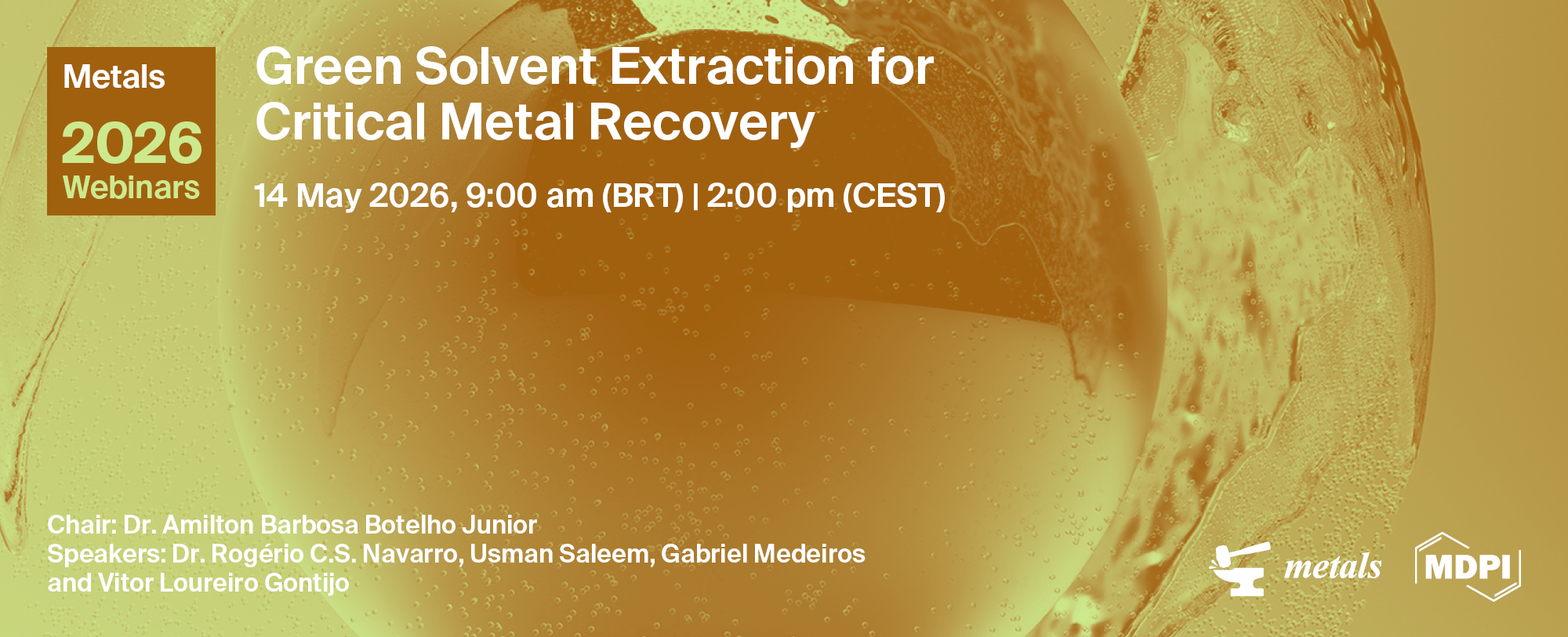
Metals Webinar | Green Solvent Extraction for Critical Metal Recovery
the chair
Welcome to the webinar “Green Solvent Extraction for Critical Metal Recovery”. The search for new critical raw material sources has increased pressure to improve extraction efficiency whilst adhering to sustainable mining demands. As a result, more scientific advances are required to meet technical, economic, and sustainable goals. In this Special Issue, we seek studies that explore scientific developments using green reagents in all steps of the critical raw material extraction process.
In this webinar, we will discuss topics from recycling of Li-ion batteries to recovery of metals from mining process and the development of new separation processes. This webinar aims to bring together scientists and engineers to discuss new solutions and developments for a greener recovery of critical metals.
Meet Our Chair
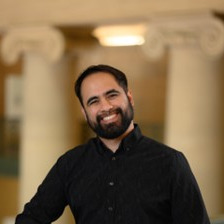
Norwegian University of Science and Technology, Norway;Associate Professor (2026) in Hydrometallurgy in the Department of Chemical Engineering at the Norwegian University of Science and Technology. Postdoc Associate at Massachusetts Institute of Technology in the Department of Materials Science and Engineering (PI Yet-Ming Chiang, 2024-2025). Postdoc fellow at Stanford University in the Department of Chemical Engineering (PI William Tarpeh 2023-2024). Chemical Engineer (2011-2015) with PhD (2019-2021) and MSc (2016-2018) in Chemical Engineering from the Polytechnic School of the University of São Paulo. Visiting Scholar at The University of British Columbia (2017-2018) and The University of Queensland (2019). Professor and supervisor in the graduate program (Chemical Engineering) at the University of São Paulo. Won the Academic Productivity Award (2021), the Best Thesis Award in Environmental Sustainability (2022), the Young Leader Professional Development Award (2025), and the Recycling Award (2025). Among 2% of the most relevant researchers in the world (Stanford/Elsevier). Research interests are focused on sustainable mining towards recovery of critical minerals: electrochemistry, (electro)hydrometallurgy, membrane separation, Li-ion batteries and e-waste recycling, mining waste, synthesis of greener materials, life cycle assessment, and circular economy.
Meet Our Speakers
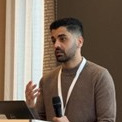
Mr. Usman Saleem
Norwegian University of Science and Technology, Norway;Usman Saleem is a researcher contributing to the HolE-LIB project, which is dedicated to advancing the selective recovery of lithium. Their work focuses on the development and in-depth characterization of novel solvents and sorbents for Direct Lithium Extraction (DLE). Saleem specializes in the experimental evaluation of material selectivity and extraction performance, coupled with feasibility studies and the exploration of material recycling loops. Ultimately, their research aims to innovate processes for lithium recovery, with a key application in recycling lithium-ion batteries from electric vehicles.
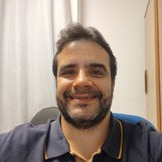
Pontifical Catholic University of Rio de Janeiro (PUC-Rio), Brazil;Siqueira graduated in Chemical Engineering from PUC-Rio in 2002. He obtained his Master's degree in 2005 and his doctorate in 2009 at the same institution, from the Department of Chemical and Materials Engineering (DEQM), working intensively with computational and experimental thermodynamics. Between 2010 and 2013, he worked as a postdoctoral fellow at DEQM/PUC-Rio in the area of pyrometallurgical processes applied to metal extraction, and also focused on the synthesis of oxidized nanocatalysts, and since then he has worked as an adjunct professor and researcher at DEQM/PUC-Rio. Between 2015 and 2017, the professor assumed the role of coordinator of the Chemical Engineering course at PUC-Rio and is currently a member of the management committee of NANOFAB, a multi-user laboratory for the characterization of nanomaterials, under the direction of the Department of Mechanical Engineering at the State University of Rio de Janeiro (UERJ). He has a strong interest in the synthesis of oxidized nanocatalysts using cellulose nanofibers as reactive support, aiming to apply them to green processes, such as H2 generation. He also has a strong interest in the use of bio-based nanocellulose for the removal of metals from aqueous bodies.
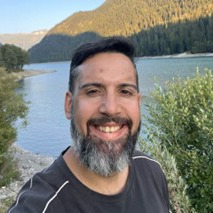
Pontifical Catholic University of Rio de Janeiro (PUC-Rio), Brazil;Gabriel is a Materials Engineer, graduated at PUC-Rio in December 2008, with an MSc from the same institution in 2011. He is specialized in melting, primary and secondary refining of steel, as well as thermodynamics and kinetics of chemical reactions, with experience in electric arc furnace (EAF) technology for steelmaking. His expertise includes both chemical and electrical aspects, as well as alloy addition modeling for ladle furnaces. He is a Steelmaking Technical Manager at Gerdau and enrolled in the doctoral program at DEQM/PUC-Rio, expected to be completed in 2027.
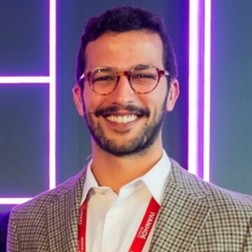
Mr. Vitor Loureiro Gontijo
The University of Queensland, Australia;Vitor Loureiro holds a degree in Mining Engineering from CEFET-MG (2017) and a Master's in Extractive Metallurgy from UFMG, Brazil, where his research focused on the behavior of rare earth elements during sulfuric acid leaching and strategies to minimize impurity dissolution. In 2022, he joined The University of Queensland, Australia, to pursue his PhD, investigating an innovative application of low-cost lanthanides as a solution for arsenic immobilization in industrial effluents—work that bridges resource efficiency with environmental remediation.
In this section, you will find the recordings of this webinar to watch, re-watch and share with your colleagues!
Green Solvent Extraction for Critical Metal Recovery
Edited by Jorge Alberto Soares Tenório and Amilton Barbosa Botelho Junior
Deadline for manuscript submissions: 20 October 2026
Submit to Metals