Molecules Webinar | Chromatography—the Ultimate Tool: Analysis and Sample Preparation
the chair
24th Molecules Webinar
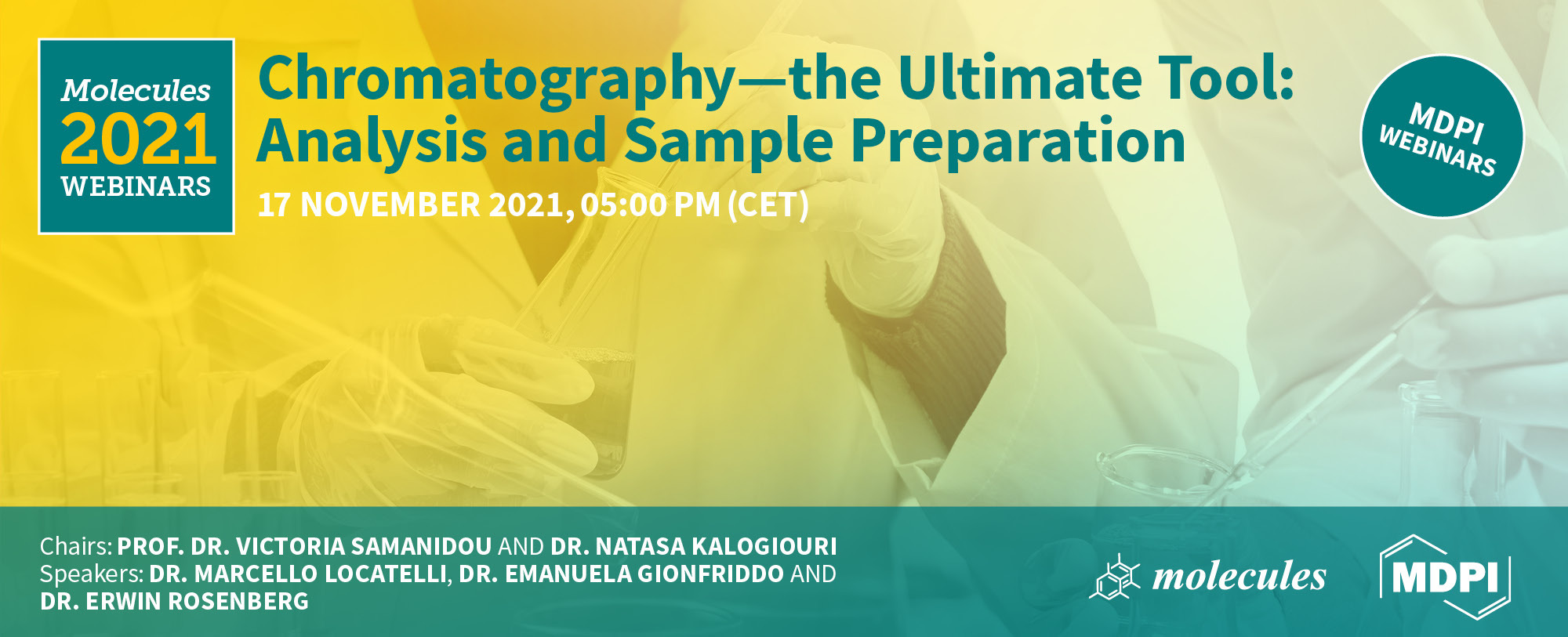
Chromatography—the Ultimate Tool: Analysis and Sample Preparation
Since its introduction by the Russian botanist Mikhail Semyonovich Tsvet, chromatography has been the most powerful analytical tool in Analytical Chemistry. Separation, qualitative analysis, and quantitative analysis can be achieved by choosing the right conditions. Thus, numerous gas chromatographic, liquid chromatographic, and supercritical fluid chromatographic methods have been developed and applied for most types of samples and most kinds of analytes. Not to mention that older varieties like paper chromatography and thin-layer chromatography were pioneer analytical techniques in many laboratories. Especially when hyphenated to spectrometric techniques, chromatography also allows the identification of separated analytes in a single run. Highly sophisticated equipment can answer all analytical problems very quickly. Chromatographers cooperate with many scientific fields and give their lights to medical doctors, veterinarians, food scientists, biologists, dentists, archaeologists, etc. The choice of two-dimensional approaches can expand the power of chromatographic techniques either in heart-cut or comprehensive modes.
In this webinar, experts in the field will present the state of the art in chromatography as a tool in chemical analysis and green sample preparation.
Date: 17 November 2021
Time: 5:00pm CET | 11:00am EST | 12:00am CST Asia (18 November 2021)
Webinar ID: 857 4139 4689
Webinar Secretariat: molecules.webinar@mdpi.com
Meet Our Speakers
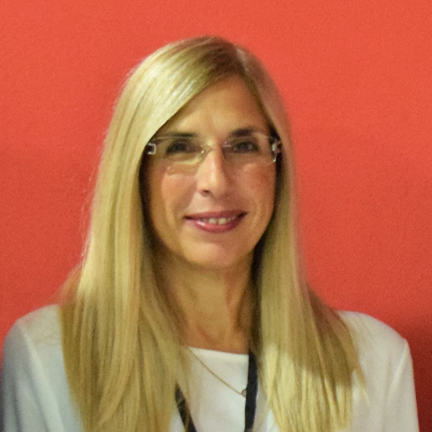
Laboratory of Analytical Chemistry, School of Chemistry, Aristotle University of Thessaloniki, Thessaloniki, Greece;Dr Victoria Samanidou is a Full Professor and Director of the Laboratory of Analytical Chemistry in the Department of Chemistry of Aristotle University of Thessaloniki, Greece. Her research interests focus on the development of sample preparation methods using sorptive extraction prior to chromatographic analysis. She has co-authored 189 original research articles in peer-reviewed journals and 57 reviews, 60 editorials/in view and 50 chapters in scientific books (H-index 39 (Scopus Author ID 7003896015, 5219 citations, Web of Science Researcher ID AAE-4121-2020). She is an editorial board member of more than 29 scientific journals and has been guest editor of more than 25 Special Issues. She has peer-reviewed more than 654 manuscripts for 141 scientific journals. In 2016, she was included in the top 50 power list of women in Analytical Science, as proposed by Texere Publishers. In 2020 she was included in the top 2% of world scientists in the field of Analytical Chemistry (career–2019, as well as single year—2019) published in PLOS Biology based on citations from SCOPUS. She is the Leader of the Working Group 1 Science and Fundamentals of EuChemS-DAC Sample Preparation Study Group and Network (2021).

Laboratory of Analytical Chemistry, School of Chemistry, Aristotle University of Thessaloniki, Thessaloniki, Greece;Dr. Natasa Kalogiouri is an Analytical Chemist. She obtained her PhD degree from the National and Kapodistrian University of Athens and the topic of her thesis was “Development of high resolution mass spectrometric methods for the investigation of food authenticity”. She is a Postdoctoral Researcher in the Laboratory of Analytical Chemistry in the Aristotle University of Thessaloniki and her research on the “Development and validation of green sample preparation methods for the authentication of foods” is currently funded by the State Scholarships Foundation (IKY). Her research interests focus on the development of green innovative micro-extraction methods, chromatographic and elemental analysis, chemometrics and metabolomics. She has authored and co-authored 26 scientific papers published in international peer-reviewed journals, and 2 book chapters. She has served as an Assistant Guest Editor in Molecules and Methods and Protocols (H-index 9, 227 citations, based on Google Scholar. Scopus Author ID 557959940000, ORCID: 0000-0001-6183-7857).

On Wednesday 17 November 2021, MDPI and the Journal Molecules held their 24th webinar entitled “Chromatography—the Ultimate Tool: Analysis and Sample Preparation” and chaired by both Prof. Dr. Victoria Samanidou and Dr. Natasa Kalogiouri from the Laboratory of Analytical Chemistry, School of Chemistry, Aristotle University of Thessaloniki, Thessaloniki, Greece.
The first speaker to kick off this webinar was Dr. Marcello Locatelli from the G. D’Annunzio University in Italy. He talked about innovative sampling procedures in bioanalytical chemistry. His research activity is devoted to the development and validation of chromatographic methods for the qualitative and quantitative determination of biologically active molecules in complex matrices.
Dr. Erwin Rosenberg from the Vienna University of Technology in Austria held the second presentation entitled “Speeding up Chromatographic Analysis by Low Pressure (Vacuum Outlet)-GC/MS. His current fields of interest are the development of sampling and analytical strategies and materials for volatile organic (and notably odorous) compounds in the industrial and environmental context, the development and use of multidimensional chromatographic techniques for environmental and natural substance analysis, and also the analysis of organic materials (binding media, dyestuffs, organic pigments) in cultural heritage materials and works of art.
The last presentation with the title "Talking About Microextraction: Environmental Analysis Made Easy and Green" was held by Dr. Emanuela Gionfriddo from the College of Natural Sciences and Mathematics in the United States. Research work in Dr. Gionfriddo’s lab focuses on the development of advanced analytical separation tools for the analysis of complex biological and environmental matrices, with emphasis on alternative green sample preparation methodologies.
Chromatography-the Ultimate Analytical Tool
Guest Editors: Prof. Dr. Victoria Samanidou & Dr. Natasa Kalogiouri
Deadline for manuscript submissions: 31 January 2022