
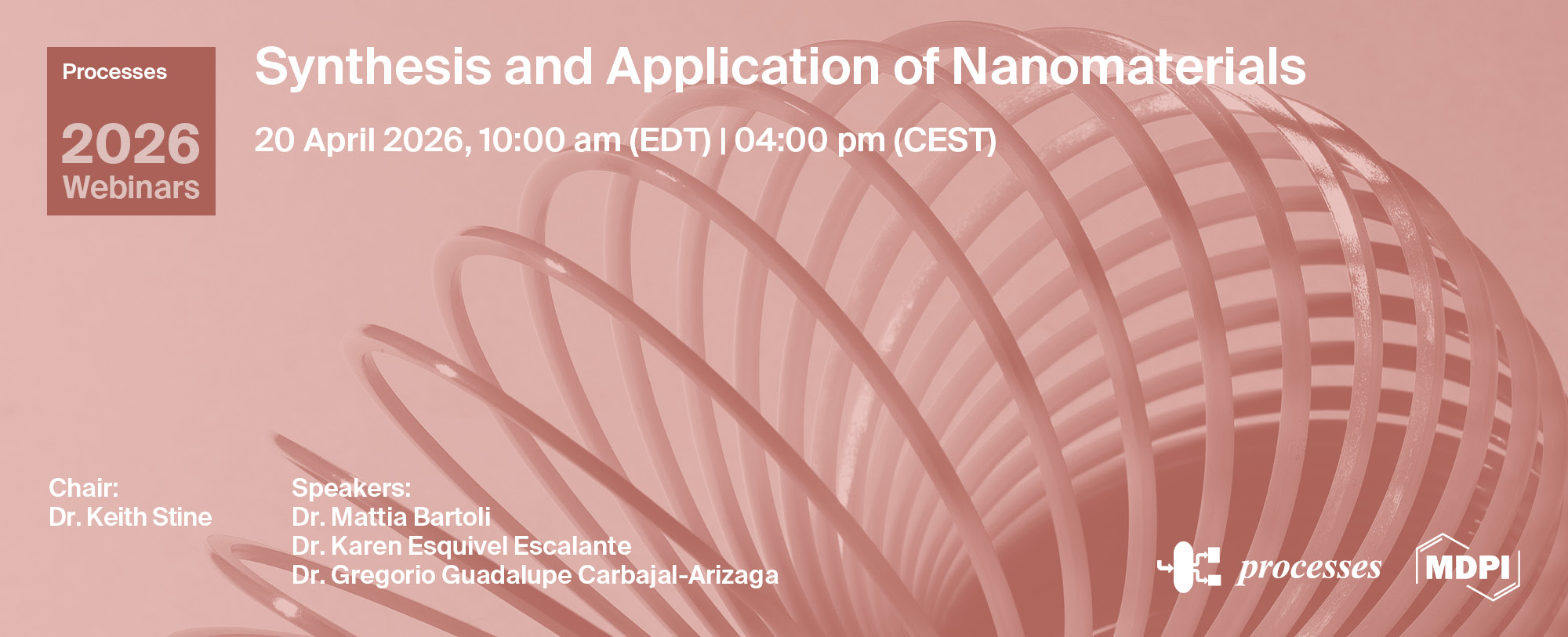
Processes Webinar | Synthesis and Application of Nanomaterials II
the chair
23rd Processes Webinar
Synthesis and Application of Nanomaterials II
Over the past few decades, many fields of science and technology have been revolutionized by the introduction of nanomaterials and new approaches to the creation of nanostructures. These new materials can have entirely unique or improved electronic, chemical, magnetic, catalytic, mechanical, or biological properties, different from bulk forms of the material. Nanomaterials range from nanoparticles of various shapes and compositions to nanostructured films, coatings, and nanoporous bulk materials. Chemical, physical, or biological methods can be used to produce nanomaterials, ranging from precise top-down methods such as nanolithography to bottom-up methods, including self-assembly, and thermal, chemical, and electrochemical processes can all result in the formation of nanomaterials. Additionally, the family of nanomaterials comprises a wide range of materials based on various forms of carbon, silicon, metals or alloys, and polymers. These materials are contributing to revolutionary advances in the fields of medicine, energy, chemical and biological sensing, agriculture, catalysis, and many others. In this webinar, three speakers will cover a selection of topics in nanomaterials research and applications.
Date: 20 April 2026
Time: 10:00 am EDT | 4:00 pm CEST
Webinar ID: 874 7816 7062
Webinar Secretariat: journal.webinar@mdpi.com
Meet Our Chair

Department of Chemistry and Biochemistry, University of Missouri – Saint Louis, Saint Louis, MO, USA <a href="https://www.umsl.edu/chemistry/directory/stine-keith.html">Website</a>;Professor Stine received his BS from Fairleigh Dickinson University in Madison, NJ, and his Ph.D. from MIT. He was a postdoctoral fellow at UCLA and joined the UMSL faculty in 1990. He served as Chair of the Faculty Senate and University Assembly for two years and was appointed Department Chair on August 1, 2019. Dr. Stine's research effort involves studies of modified surfaces and nanostructures. The surface modification of nanostructures is pursued with a focus on their prospective applications in bioanalytical chemistry, such as immunoassays, sensors, or separations. Immobilization of proteins onto nanostructures of gold and other materials is conducted by adsorption or by covalent linkage to self-assembled monolayers, and various forms of microscopy are actively used to characterize these nanostructures (SEM, TEM, AFM). The bioanalytical application of these materials is pursued using primarily electrochemical methods such as impedance spectroscopy and voltammetry. Nanoporous gold and other related materials are of particular interest due to their high surface area and capacity to be surface modified, as well as their support of localized surface plasmon resonance (LSPR). The preparation and characterization of these materials uses a range of electrochemical techniques and other analytical methods, including gas adsorption isotherm analysis for the determination of pore size, distribution, and surface area, and thermogravimetric analysis (TGA) for the analysis of surface loading. Nanoporous gold is being used for the development of electrochemical sensors for small molecules such as pollutants and hormones. Other projects concern the study of lipid monolayers and bilayers as models of processes occurring at the surface of cell membranes, and the use of these monolayers in molecular recognition studies. Monolayers are studied using surface pressure isotherms and atomic force microscopy of transferred layers.
Important Dates
20 Apr
2026
Meet Our Speakers
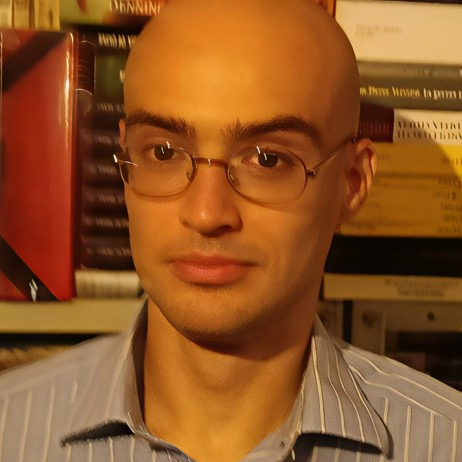
Department of Applied Science and Technology (DISAT), Polytechnic University of Turin, Italy;Italian Institute of Technology, Italy;Dr. Bartoli graduated in Chemistry summa cum laude from the University of Florence (Italy) in 2013 and obtained his Ph.D. in 2016. After receiving his Ph.D., he moved to the Biorefinery Research Group hosted by the University of Alberta, where he contributed to developing new materials for catalytic applications and new technologies. During this period, he also worked as head of R&D for Forge Hydrocarbon, a spin-off company of the University of Alberta, solving several issues of the innovative lipid-to-hydrocarbon technology for renewable hydrocarbon production. In 2018, he joined the Carbon Group hosted by Polytechnic of Turin, working on the reactivity of carbon nanomaterials and inorganic nanoparticles. Since 2021, he has been an adjunct Professor of chemistry and a researcher at the Italian Institute of Technology.

Graduate and Research Division, Engineering Faculty, Autonomous University of Queretaro, Mexico;Dr. Karen Esquivel Escalante is a full-time professor at the Autonomous University of Queretaro in the Nanotechnology department of the Engineering Faculty, where she has worked since 2011. She has been a member of the National System of Researchers (SNI) of the National Science and Technology Council since 2012, and is currently at level 2. Throughout her short career as a research professor, her goal has been to contribute to scientific and technological development and give back to the scientific community through published research. Within her work, different topics of scientific interest stand out, such as the pursuit of new methods for synthesizing nanostructured materials through chemical processes assisted by external energy sources like sonochemistry and microwaves. The materials that have been developed have applications as smart materials, in advanced oxidation processes for the treatment of water and air, as well as for their toxicological and elicitor evaluation in plant species. The results of this research have been published in various high-impact, indexed scientific journals, and her success can also be measured in the notable impact she has had on her undergraduate and graduate students.

Chemistry Department, University of Guadalajara, Mexico;Dr. Gregorio Guadalupe Carbajal Arízaga has been a Tenured Associate Professor at the University of Guadalajara (Mexico) since 2011. He holds a B.Sc. in Chemistry from the University of Guadalajara (2000). He earned his Ph.D. in Chemistry from the Federal University of Paraná, Brazil (2008), and completed a postdoctoral fellowship at the Center for Nanosciences and Nanotechnology, UNAM (2009–2011). His research focuses on solid-state chemistry, especially in the synthesis of multifunctional materials based on layered double hydroxides and carbon dots. Before his academic career, he worked as an analytical chemist in laboratories for asphalt, water, soil, and food analyses (1992–2002), an experience that strengthened his applied approach to research and teaching. Dr. Carbajal Arízaga has co-authored 103 peer-reviewed articles (45% as first or corresponding author) and 5 book chapters. He has supervised 24 master's/doctoral theses, and is the co-inventor of 4 granted patents, including 1 transferred to industry. He serves as a reviewer for 43 international journals and collaborates on R&D projects in the industry. Web of Science ID: I-3548-2013 SCOPUS ID: 9236534000 ORCID: 0000-0003-3120-0243 https://www.researchgate.net/profile/Gregorio-Carbajal-Arizaga http://lattes.cnpq.br/2350583852994186

In this section, you will find the recording of this webinar to watch, re-watch and share with your colleagues!
The webinar has three talks covering different aspects and applications of modern nanomaterials, a field that continues to advance in scope and bring new ideas to the forefront. The first talk by Dr. Bartoli focused on carbon dots, their methods of synthesis, and the variety and richness of structural details and physical properties. The second talk by Dr. Esquivel Escalante reviewed how nanomaterials can be used in modern agriculture as fertilizers, pesticides and deliver systems with discussion of their fate and impact in the environment. The final talk by Dr. Guadalupe Carbajal Arizaga introduced the nanomaterial layered double hydroxides and how trivalent cations such as gadolinium can be introduced into LDH nanoparticles for use in magnetic resonance imaging (MRI).
Synthesis and Applications of Nanomaterials
Guest Editor: Prof. Dr. Keith J. Stine