Biomolecules Webinar series | Recent Advances on Lysosomal Storage Disorders Pathogenesis: An Emerging Gaucher Disease Paradigm Shift

Webinar Series on Biomolecules - an Open Access Journal
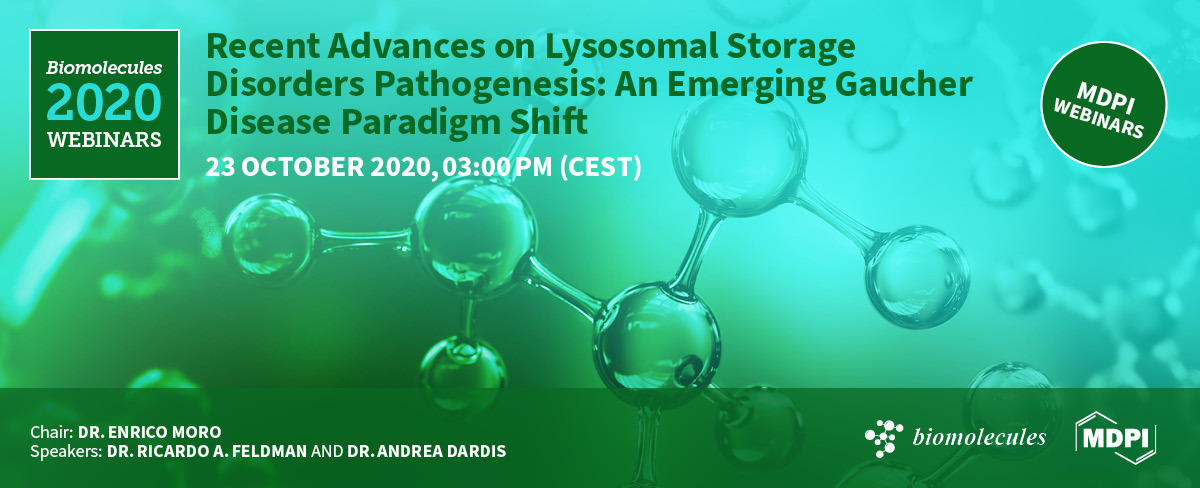
Recent Advances on Lysosomal Storage Disorders Pathogenesis: An Emerging Gaucher Disease Paradigm Shift
Gaucher disease, as the most common lysosomal storage disorder, affects populations worldwide and places a huge economic burden on healthcare systems. Despite the advent of enzyme replacement therapies and the most recent substrate reduction therapy, many phenotypical aspects of the disease, including skeletal abnormalities and central nervous system impairment, cannot be fully treated and remain unsolved clinical issues.
Recent advances in basic research of Gaucher disease pathogenesis have challenged the classical paradigm of lysosomal storage and collected new evidence showing that the loss of glucocerebrosidase activity may affect several key cellular pathways (ER stress, autophagy, signaling transduction, inflammasome). These novel pathways require more extensive research efforts but offer an alternative window of therapeutic strategies.
In this webinar, we will summarize these discoveries and open a fruitful discussion on growing research areas that could pave the way for the development of alternative approaches for Gaucher disease.
This Webinar relates to the Special Issue Lysosomal Storage Disorders: Molecular Basis and Therapeutic Approaches.
Date & Time: 23 October 2020 03:00pm (CEST)
Chair: Dr. Enrico Moro
Speakers: Dr. Ricardo A. Feldman, Dr. Andrea Dardis
Webinar ID: 825 9187 3796
Webinar Secretariat: biomolecules.webinar@mdpi.com
This webinar will include the following experts:


The fourth Biomolecules webinar, entitled “Recent Advances on Lysosomal Storage Disorders Pathogenesis: An Emerging Gaucher Disease Paradigm Shift”, was held on Friday 23 October 2020. This online seminar included the scientific contribution of Dr. Andrea Dardis (Udine, Italy), Prof. Ricardo Feldman (Baltimore, USA) and Prof. Enrico Moro (Padova, Italy), and depicted the current view of Gaucher disease (GD) pathogenesis.
The use of inducible pluripotent stem cells (iPSCs), novel CRISPR-Cas9-based mutant cell lines and experimental models is giving a complex picture of the variety of pathogenic pathways implicated in the tissue-specific related GD abnormalities. The macrophage-centric paradigm of GD pathogenesis is being challenged by the growing idea of concurrent cellular defects occurring because of glucocerebrosidase loss of function. Abnormalities of the mTOR pathway, the canonical Wnt signaling cascade and the ER stress/mitochondrial axis emerge as key drivers in the onset of irreversible damages, which precede the glucosylceramide storage. In addition, there are still unexplored aspects of the disease (implication of epigenetic factors and modifier genes, and the contribution of mitochondrial–lysosomal and ER–endolysosomal defective tethering) that may deserve future investigations.
A shift in the paradigm of GD pathogenesis is taking shape, and it will certainly enable clinicians to better address the development of targeted therapeutic strategies that could prevent the onset of irreversible brain and bone impairments in affected patients.
The webinar was offered via Zoom, and registration was required for attendance. The full recording can be found below.
To stay updated on upcoming Biomolecules webinars organized by MDPI, be sure to sign up for our newsletter by clicking on “Subscribe” at the top of the page.
Special Issues in Biomolecules
Lysosomal Storage Disorders: Molecular Basis and Therapeutic Approaches
Guest Editor: Dr. Enrico Moro
Deadline for manuscript submissions: 30 October 2020.