Nanomaterials Webinar | 2D Materials: From Theory to Applications
the chair
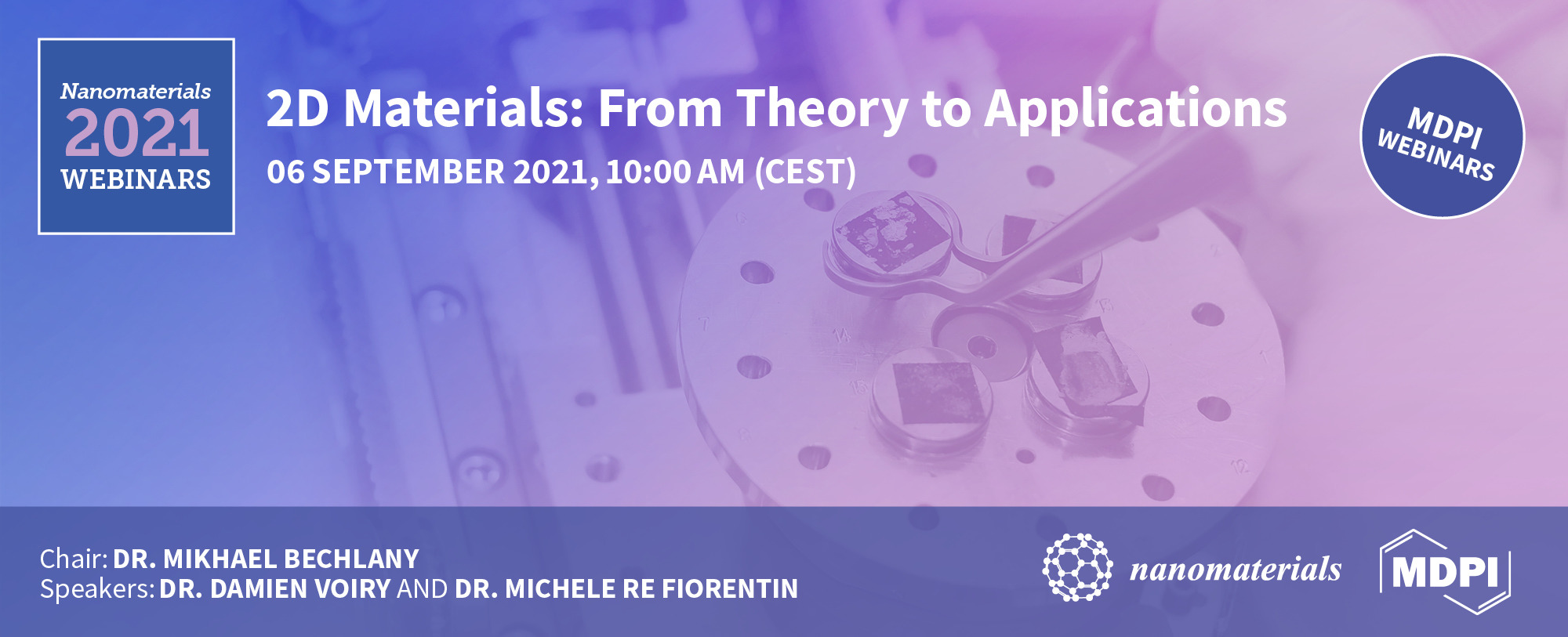
3rd Nanomaterials Webinar
2D Materials: From Theory to Applications
The aim of this webinar is to bring together scientists, researchers and companies to attend and share their visions, experiences and recent research developments in the field of 2D materials.
The theme of webinar is “2D materials: from theory to applications”.
The webinar will provide an interdisciplinary platform to discus and debate the most recent theoretical and experimental works in the field of 2D materials.
2 topics will be extensively debated: (i) Electrosynthesis from exfoliated two-dimensional transition metal dichalcogenides and (ii) Ab initio 2D material design for sustainable applications.
Electrosynthesis from exfoliated two-dimensional transition metal dichalcogenides
Two dimensional (2D) materials have emerged as platforms for the study of heterogeneous catalysis. Thanks to their reduced dimensionality, their properties can largely be adjusted by modifying the elemental composition, the structural phase and the concentration of atomic vacancies1. Besides, 2D materials have also shown promise as single atoms supports used as catalytic active sites for key reactions including the production of hydrogen, the conversion of CO2 and more recently the nitrogen fixation2. Our research aims to develop strategies for designing nanosheets and to explore their catalytic behavior by combining both in-situ and operando investigations. Through several examples, I will review our practical approaches for engineering exfoliated 2D materials via the phase control, the defect concentration or via the inclusion of individual metal.
References:-
Voiry, D., Yang, J. & Chhowalla, M. Recent Strategies for Improving the Catalytic Activity of 2D TMD Nanosheets Toward the Hydrogen Evolution Reaction. Adv. Mater. 2016, 28, 6197
-
Qi, K., Chhowalla, M. & Voiry, D Single atom is not alone: Metal–support interactions in single-atom catalysis, Materials Today, 2020, 40, 1732.
Ab initio 2d material design for sustainable applications
The evolution of technologies for environmentally friendly applications is deeply intertwined with research activities on material exploration and design, both in the laboratory and in silico. I will present key examples in which atomistic simulations proved fruitful in explaining and predicting properties of 2d materials for sustainable technologies. Density Functional Theory and many-body perturbation theory were successfully applied to hot fields such as electrocatalysis, with the development of new 2d carbon-based single atom catalysts, photocatalysis, by studying the exciton lifetimes of graphitic carbon nitride, photovoltaics, with the proposal of new ultrathin heterostructures based on transition metal dichalcogenides and, eventually, water treatment, by expanding the studies on porous graphene membranes. From all these examples, it will emerge how theoretical methods can provide valuable results to better interpret and guide the experimental activity.
Date: 6 September 2021
Time: 10:00am CEST | 4:00am EDT | 4:00pm CST Asia
Webinar ID: 886 6232 6290
Webinar Secretariat: nanomaterials.webinar@mdpi.com
Meet Our Speaker

CNRS;Dr. Mikhael Bechelany (born in March 1979) obtained his Ph.D. in Materials Chemistry from the University of Lyon (France) in 2006. His Ph.D. work was devoted to the synthesis and characterization of silicon- and boron-based 1D nanostructures (nanotubes, nanowires and nanocables). Then, he worked as a post-doc at EMPA (Switzerland). His research included the fabrication of nanomaterials (nanoparticles and nanowires), their organization and their nanomanipulation for applications in different fields such as photovoltaic, robotic, chemical and bio-sensing. In 2010, he became a scientist at CNRS. His current research interests at the Institut Européen des Membranes de Montpellier (the European Institute of Membranes (UMR CNRS 5635) in Montpellier (France) focus on novel synthesis methods for metals and ceramics nanomaterials such as atomic layer deposition (ALD), electrospinning and/or on nanostructuring using nanosphere lithography, graphene and graphene-like materials. His research efforts include the design of nanostructured membranes for health, environmental and renewable energy applications.

On Monday, 6 September 2021, MDPI and the Journal Nanomaterials organized the 3rd webinar on Nanomaterials, entitled "2D Materials: From Theory to Applications".
The introduction was held by the Chair of the webinar, Dr. Mikhael Bechelany. He has received his Ph.D. in Materials Chemistry from the University of Lyon (France). His Ph.D. work was devoted to the synthesis and characterization of silicon- and boron-based 1D nanostructures. He worked as a post-doctorate at EMPA in Switzerland. His research included the fabrication of nanomaterials, their organization and their nanomanipulation for applications in different fields such as photovoltaic, robotic, chemical and bio-sensing. In 2010, he became a scientist at CNRS. His research efforts include the design of nanostructured membranes for health, environmental and renewable energy applications.
The first speaker to quick off this webinar was Dr. Damien Voiry, with his presentation "Electrosynthesis from Exfoliated Two-Dimensional Transition Metal Dichalcogenides". He graduated from the National School of Chemistry and Physics of Bordeaux (ENSCPB). Since February 2016, he has been a CNRS staff scientist at the Institut Européen des Membranes de Montpellier (the European Institute of Membranes in Montpellier). His current research aims to explore the use of low dimensional materials for the fabrication multifunctional membranes for separation application as well as energy applications. After joining CNRS, he oriented his research on 2D materials towards energy conversion and nanofluidics.
The second presentation with the title "Ab Initio 2D Material Design for Sustainable Applications" was held by Dr. Michele Re Fiorentin. He graduated in Physics from the University of Torino in 2012 and completed his Ph.D. in Theoretical Physics in 2016 at the University of Southampton (UK). Since 2017, he has been a researcher at the Center for Sustainable Future Technologies of the Italian Institute of Technology g(IIT) where he works on ab initio simulations of materials for green applications.
Each presentation was followed by a Q&A and a discussion, moderated by the Chair Dr. Mikhael Bechelany. The webinar was offered via Zoom and required registration to attend. The full recording can be found here on Sciforum website. In order to stay updated on the next webinars on Nanomaterials be sure to sign up for our newsletter by clicking on “Subscribe” at the top of the page.
Advances and Applications of 2D Materials
Guest Editor: Dr. Filippo Giannazzo
Deadline for manuscript submissions: 31 March 2022
Guest Editors: Dr. Franco Dinelli, Prof. Dr. Oleg Kolosov & Dr. Pasqualantonio Pingue
Deadline for manuscript submissions: 31 July 2021
Guest Editors: Prof. Dr. Jarosław Mysliwiec, Dr. Konrad Cyprych & Dr. Pawel Karpinski
Deadline for manuscript submissions: 30 September 2021