Event submissions
Published
This submission belongs to the session S1. The Supramolecular Structure and Properties of Gels of the event The 1st International Online Conference on Gels
Published date
28 Nov, 2025
Academic Editor
'%3e%3cpath%20d='M12.6657%2010.9104C12.4185%2010.325%2012.0599%209.79327%2011.6097%209.34482C11.1609%208.89508%2010.6293%208.5365%2010.0442%208.28888C10.0389%208.28626%2010.0337%208.28495%2010.0285%208.28233C10.8446%207.69279%2011.3752%206.73249%2011.3752%205.64904C11.3752%203.8542%209.92103%202.39999%208.1262%202.39999C6.33136%202.39999%204.87715%203.8542%204.87715%205.64904C4.87715%206.73249%205.40774%207.69279%206.22393%208.28364C6.21869%208.28626%206.21345%208.28757%206.20821%208.29019C5.62129%208.5378%205.09463%208.89284%204.64265%209.34613C4.1929%209.79493%203.83432%2010.3266%203.58671%2010.9117C3.34345%2011.4845%203.21226%2012.0987%203.20023%2012.7209C3.19988%2012.7349%203.20233%2012.7488%203.20744%2012.7619C3.21255%2012.7749%203.22022%2012.7867%203.22998%2012.7968C3.23975%2012.8068%203.25142%2012.8147%203.26431%2012.8202C3.2772%2012.8256%203.29105%2012.8284%203.30504%2012.8284H4.09109C4.14874%2012.8284%204.19459%2012.7825%204.1959%2012.7262C4.2221%2011.7148%204.62823%2010.7676%205.34617%2010.0497C6.08899%209.30683%207.0755%208.89808%208.1262%208.89808C9.17689%208.89808%2010.1634%209.30683%2010.9062%2010.0497C11.6242%2010.7676%2012.0303%2011.7148%2012.0565%2012.7262C12.0578%2012.7838%2012.1037%2012.8284%2012.1613%2012.8284H12.9474C12.9613%2012.8284%2012.9752%2012.8256%2012.9881%2012.8202C13.001%2012.8147%2013.0126%2012.8068%2013.0224%2012.7968C13.0322%2012.7867%2013.0398%2012.7749%2013.0449%2012.7619C13.0501%2012.7488%2013.0525%2012.7349%2013.0522%2012.7209C13.0391%2012.0947%2012.9094%2011.4855%2012.6657%2010.9104ZM8.1262%207.9024C7.52486%207.9024%206.9589%207.6679%206.53312%207.24211C6.10733%206.81633%205.87283%206.25037%205.87283%205.64904C5.87283%205.0477%206.10733%204.48174%206.53312%204.05596C6.9589%203.63018%207.52486%203.39567%208.1262%203.39567C8.72753%203.39567%209.29349%203.63018%209.71927%204.05596C10.1451%204.48174%2010.3796%205.0477%2010.3796%205.64904C10.3796%206.25037%2010.1451%206.81633%209.71927%207.24211C9.29349%207.6679%208.72753%207.9024%208.1262%207.9024Z'%20fill='%235D1EE1'/%3e%3c/g%3e%3c/svg%3e) Paula Ferreira
Paula FerreiraCitation
Ipsita Sahu, Priyadarshi Chakraborty, Minimalistic Tryptophan-Based Supramolecular Hydrogel as a Versatile Catalytic Scaffold, in Proceedings of The 1st International Online Conference on Gels, 3 December–5 December 2025, MDPI: Basel, Switzerland
Share
Email
Facebook
Twitter
LinkedIn
Minimalistic Tryptophan-Based Supramolecular Hydrogel as a Versatile Catalytic Scaffold
'%3e%3cpath%20d='M12.6647%2010.9104C12.4176%2010.325%2012.0589%209.7933%2011.6088%209.34485C11.16%208.89511%2010.6283%208.53653%2010.0432%208.28891C10.038%208.28629%2010.0327%208.28498%2010.0275%208.28236C10.8437%207.69282%2011.3743%206.73252%2011.3743%205.64907C11.3743%203.85423%209.92005%202.40002%208.12522%202.40002C6.33038%202.40002%204.87618%203.85423%204.87618%205.64907C4.87618%206.73252%205.40677%207.69282%206.22296%208.28367C6.21772%208.28629%206.21248%208.2876%206.20724%208.29022C5.62031%208.53783%205.09365%208.89287%204.64167%209.34616C4.19192%209.79496%203.83334%2010.3266%203.58573%2010.9117C3.34247%2011.4846%203.21128%2012.0987%203.19925%2012.721C3.1989%2012.735%203.20135%2012.7489%203.20646%2012.7619C3.21157%2012.7749%203.21924%2012.7868%203.22901%2012.7968C3.23877%2012.8068%203.25045%2012.8148%203.26334%2012.8202C3.27623%2012.8256%203.29007%2012.8284%203.30406%2012.8284H4.09012C4.14776%2012.8284%204.19362%2012.7825%204.19493%2012.7262C4.22113%2011.7148%204.62726%2010.7676%205.34519%2010.0497C6.08802%209.30686%207.07452%208.89811%208.12522%208.89811C9.17592%208.89811%2010.1624%209.30686%2010.9052%2010.0497C11.6232%2010.7676%2012.0293%2011.7148%2012.0555%2012.7262C12.0568%2012.7839%2012.1027%2012.8284%2012.1603%2012.8284H12.9464C12.9604%2012.8284%2012.9742%2012.8256%2012.9871%2012.8202C13%2012.8148%2013.0117%2012.8068%2013.0214%2012.7968C13.0312%2012.7868%2013.0389%2012.7749%2013.044%2012.7619C13.0491%2012.7489%2013.0515%2012.735%2013.0512%2012.721C13.0381%2012.0947%2012.9084%2011.4856%2012.6647%2010.9104ZM8.12522%207.90243C7.52388%207.90243%206.95792%207.66793%206.53214%207.24215C6.10636%206.81636%205.87185%206.2504%205.87185%205.64907C5.87185%205.04773%206.10636%204.48177%206.53214%204.05599C6.95792%203.63021%207.52388%203.3957%208.12522%203.3957C8.72655%203.3957%209.29252%203.63021%209.7183%204.05599C10.1441%204.48177%2010.3786%205.04773%2010.3786%205.64907C10.3786%206.2504%2010.1441%206.81636%209.7183%207.24215C9.29252%207.66793%208.72655%207.90243%208.12522%207.90243Z'%20fill='%235D1EE1'/%3e%3c/g%3e%3c/svg%3e)
Ipsita Sahu 1

Priyadarshi Chakraborty 1
1. Department of Chemistry, Indian Institute of Technology Hyderabad, Kandi, Sangareddy 502284, Telangana, India, India
Abstract
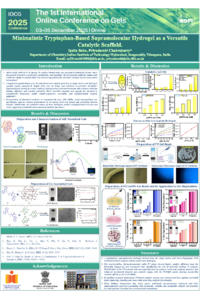
Single amino acids and their derivatives possess a remarkable propensity to self-assemble into ordered nanostructures that can exhibit catalytic functions1,2. Although there are numerous instances of catalysis using peptide nanostructures inspired by amyloid fibres3,4, hydrogel-based catalysts produced from a single amino acid are few. In this study, we demonstrate the self-assembly of N-fluorenylmethyloxycarbonyl-L-tryptophan (FT) into a nanofibrous hydrogel capable of catalyzing the hydrolysis of p-nitrophenyl acetate. The FT hydrogel exhibits pathway complexity, progressing from kinetically trapped nanofibers to thermodynamically stable semicrystalline aggregates with improved catalytic efficiency, as evidenced by comparative studies with the monomers and the gel fibers5. Functional attributes were further improved by nanoengineering the FT network with graphene oxide and graphene quantum dots, yielding composites with enhanced mechanical strength and enzyme-like hydrolase activity, supported by Michaelis–Menten kinetic analysis. Furthermore, in situ reduction of Au3+ within the FT gel scaffold produced AuNPs without external reducing agents, leveraging the reductive capability of the indole moiety. This FT/AuNP nanohybrid gel enables rapid reductive degradation of both cationic and anionic dyes in aqueous media. For enhanced handling and practical applications, we fabricated alginate-supported FT/AuNPs core-shell hydrogel beads, which retained structural integrity and high catalytic efficiency, achieving more than 90% dye removal with a single 20 µL bead5. Altogether, this showcases the potential of single amino acid-derived self-assembled hydrogels/semicrystalline aggregates and their nanohybrids as effective, tunable, and sustainable catalytic systems for both synthetic and environmental applications.
References:
- Makam, S. S. R. K. C Yamijala, V. S. Bhadram, L. J. W. Shimon, B. M. Wong, E. Gazit, Nat. Commun. 2022, 13, 1505.
- V. Makhlynets, I. V. Korendovych, Nat. Catal. 2019, 2, 949−950.
- Chatterjee, A. Reja, S. Pal, D. Das Chem. Soc. Rev. 2022, 51, 3047−3070.
- K. Smith Angew. Chem. 2025, 137, e202502053.
- Sahu, D. Saha, S. Pande, ACS Appl. Mater. Interfaces 2025, (Recently Published)
Keywords
Supramolecular hydrogel
Pathway complexity
Gel nanocomposites
Catalysis
Water remediation
Poster
IOCG 2025_Ipsita Sahu.pdf
Supramolecular gels and their modification for electrochemical application
Supramolecularly Reinforced Hydrogel Scaffolds for Advanced Tissue Engineering