Event submissions
Published
This submission belongs to the session S2. Hydrogels, Organogels, Xerogels, and Aerogels of the event The 1st International Online Conference on Gels
Published date
28 Nov, 2025
Academic Editor
'%3e%3cpath%20d='M12.6657%2010.9104C12.4185%2010.325%2012.0599%209.79327%2011.6097%209.34482C11.1609%208.89508%2010.6293%208.5365%2010.0442%208.28888C10.0389%208.28626%2010.0337%208.28495%2010.0285%208.28233C10.8446%207.69279%2011.3752%206.73249%2011.3752%205.64904C11.3752%203.8542%209.92103%202.39999%208.1262%202.39999C6.33136%202.39999%204.87715%203.8542%204.87715%205.64904C4.87715%206.73249%205.40774%207.69279%206.22393%208.28364C6.21869%208.28626%206.21345%208.28757%206.20821%208.29019C5.62129%208.5378%205.09463%208.89284%204.64265%209.34613C4.1929%209.79493%203.83432%2010.3266%203.58671%2010.9117C3.34345%2011.4845%203.21226%2012.0987%203.20023%2012.7209C3.19988%2012.7349%203.20233%2012.7488%203.20744%2012.7619C3.21255%2012.7749%203.22022%2012.7867%203.22998%2012.7968C3.23975%2012.8068%203.25142%2012.8147%203.26431%2012.8202C3.2772%2012.8256%203.29105%2012.8284%203.30504%2012.8284H4.09109C4.14874%2012.8284%204.19459%2012.7825%204.1959%2012.7262C4.2221%2011.7148%204.62823%2010.7676%205.34617%2010.0497C6.08899%209.30683%207.0755%208.89808%208.1262%208.89808C9.17689%208.89808%2010.1634%209.30683%2010.9062%2010.0497C11.6242%2010.7676%2012.0303%2011.7148%2012.0565%2012.7262C12.0578%2012.7838%2012.1037%2012.8284%2012.1613%2012.8284H12.9474C12.9613%2012.8284%2012.9752%2012.8256%2012.9881%2012.8202C13.001%2012.8147%2013.0126%2012.8068%2013.0224%2012.7968C13.0322%2012.7867%2013.0398%2012.7749%2013.0449%2012.7619C13.0501%2012.7488%2013.0525%2012.7349%2013.0522%2012.7209C13.0391%2012.0947%2012.9094%2011.4855%2012.6657%2010.9104ZM8.1262%207.9024C7.52486%207.9024%206.9589%207.6679%206.53312%207.24211C6.10733%206.81633%205.87283%206.25037%205.87283%205.64904C5.87283%205.0477%206.10733%204.48174%206.53312%204.05596C6.9589%203.63018%207.52486%203.39567%208.1262%203.39567C8.72753%203.39567%209.29349%203.63018%209.71927%204.05596C10.1451%204.48174%2010.3796%205.0477%2010.3796%205.64904C10.3796%206.25037%2010.1451%206.81633%209.71927%207.24211C9.29349%207.6679%208.72753%207.9024%208.1262%207.9024Z'%20fill='%235D1EE1'/%3e%3c/g%3e%3c/svg%3e) SIDI A. BENCHERIF
SIDI A. BENCHERIFCitation
Edgard Alejandro Rivas, Pablo Hector Di Chenna, Phenylalanine-Based Low-Molecular-Weight Gelators: Synthesis, Supramolecular Characterization and Multicomponent Gelation, in Proceedings of The 1st International Online Conference on Gels, 3 December–5 December 2025, MDPI: Basel, Switzerland
Share
Email
Facebook
Twitter
LinkedIn
Phenylalanine-Based Low-Molecular-Weight Gelators: Synthesis, Supramolecular Characterization and Multicomponent Gelation
'%3e%3cpath%20d='M12.6647%2010.9104C12.4176%2010.325%2012.0589%209.7933%2011.6088%209.34485C11.16%208.89511%2010.6283%208.53653%2010.0432%208.28891C10.038%208.28629%2010.0327%208.28498%2010.0275%208.28236C10.8437%207.69282%2011.3743%206.73252%2011.3743%205.64907C11.3743%203.85423%209.92005%202.40002%208.12522%202.40002C6.33038%202.40002%204.87618%203.85423%204.87618%205.64907C4.87618%206.73252%205.40677%207.69282%206.22296%208.28367C6.21772%208.28629%206.21248%208.2876%206.20724%208.29022C5.62031%208.53783%205.09365%208.89287%204.64167%209.34616C4.19192%209.79496%203.83334%2010.3266%203.58573%2010.9117C3.34247%2011.4846%203.21128%2012.0987%203.19925%2012.721C3.1989%2012.735%203.20135%2012.7489%203.20646%2012.7619C3.21157%2012.7749%203.21924%2012.7868%203.22901%2012.7968C3.23877%2012.8068%203.25045%2012.8148%203.26334%2012.8202C3.27623%2012.8256%203.29007%2012.8284%203.30406%2012.8284H4.09012C4.14776%2012.8284%204.19362%2012.7825%204.19493%2012.7262C4.22113%2011.7148%204.62726%2010.7676%205.34519%2010.0497C6.08802%209.30686%207.07452%208.89811%208.12522%208.89811C9.17592%208.89811%2010.1624%209.30686%2010.9052%2010.0497C11.6232%2010.7676%2012.0293%2011.7148%2012.0555%2012.7262C12.0568%2012.7839%2012.1027%2012.8284%2012.1603%2012.8284H12.9464C12.9604%2012.8284%2012.9742%2012.8256%2012.9871%2012.8202C13%2012.8148%2013.0117%2012.8068%2013.0214%2012.7968C13.0312%2012.7868%2013.0389%2012.7749%2013.044%2012.7619C13.0491%2012.7489%2013.0515%2012.735%2013.0512%2012.721C13.0381%2012.0947%2012.9084%2011.4856%2012.6647%2010.9104ZM8.12522%207.90243C7.52388%207.90243%206.95792%207.66793%206.53214%207.24215C6.10636%206.81636%205.87185%206.2504%205.87185%205.64907C5.87185%205.04773%206.10636%204.48177%206.53214%204.05599C6.95792%203.63021%207.52388%203.3957%208.12522%203.3957C8.72655%203.3957%209.29252%203.63021%209.7183%204.05599C10.1441%204.48177%2010.3786%205.04773%2010.3786%205.64907C10.3786%206.2504%2010.1441%206.81636%209.7183%207.24215C9.29252%207.66793%208.72655%207.90243%208.12522%207.90243Z'%20fill='%235D1EE1'/%3e%3c/g%3e%3c/svg%3e)
Edgard Alejandro Rivas 1,2

Pablo Hector Di Chenna 1,2
1. Department of Organic Chemistry, Faculty of Exact and Natural Sciences; University of Buenos Aires; Buenos Aires; C1428EGA; Argentina., Argentina
2. UMYMFOR-Faculty of Exact and Natural Sciences; CONICET-University of Buenos Aires; Buenos Aires; C1428EGA; Argentina.
Abstract
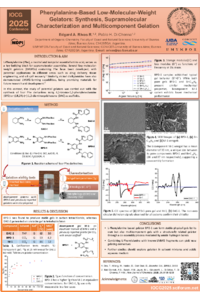
L-Phenylalanine (Phe), a neutral and nonpolar essential amino acid, serves as a key building block for supramolecular assemblies. Several low-molecular-weight gelators (LMWGs) containing Phe have been developed, with potential applications in different areas such as drug delivery, tissue engineering, and oil spill recovery. Similarly, vicinal dialkylamides have also demonstrated LMWG-forming capabilities, being promising materials for future research and development. In this context, the study of potential gelators was carried out with the synthesis of four Phe derivatives using 4,5-bromo-1,2-phenylenediamine (BPD) or (1R,2R)-(−)-1,2-diaminocyclohexane (DAC) as scaffolds. N-tert-butoxycarbonyl (Boc)-protected Phe was reacted with BPD or DAC (2:1 molar ratio) to yield BPD-1 and DAC-1, respectively. Subsequent deprotection afforded BPD-2 and DAC-2. The gelation ability of the synthesized compounds was tested in a range of solvents by means of the inverted test tube method. Minimum gelation concentration (MGC) and sol–gel temperature (Tg) were determined for the resulting gels. Additionally, gels were characterized morphologically (SEM), rheologically, and by circular dichroism (CD) spectroscopy at low concentrations. Although not all derivatives prepared could form any gels in common solvents, BPD-1 was found to produce stable gels in carbon tetrachloride, whereas DAC-2 generated an unstable gel in tetrahydrofuran. A multicomponent stable gel in carbon tetrachloride (M1BDP-1) was also achieved by combining BPD-1 with a previously reported LMWG with the same scaffold. SEM revealed fibrous three-dimensional network structures composed of fibers in BPD-1 and M1BDP-1 xerogels. Also, CD spectra display signals that suggest chiral supramolecular aggregation in BDP-1 gels. The L-Phenylalanine-based gelator BPD-1 can form stable physical gels on its own, as well as multicomponent gels with a structurally related gelator through a co-assembly process mediated by amide hydrogen bonds. The results indicate that combining L-Phenylalanine with known LMWG fragments can yield new gelating derivatives, highlighting their potential for functional material design.
Keywords
Gelator
L-Phenylalanine
Supramolecular chirality
Poster
ER-sciforum-142834.pdf
Conductive Dual-Network Hydrogel for Flexible Sensing Motif
OBTAINING MESH SIZES FOR VISCOELASTIC ALGINATE-BASED HYDROGELS USING FLORY THEORY AND SAXS