Event submissions
Published
This submission belongs to the session S2. Hydrogels, Organogels, Xerogels, and Aerogels of the event The 1st International Online Conference on Gels
Published date
28 Nov, 2025
Academic Editor
'%3e%3cpath%20d='M12.6657%2010.9104C12.4185%2010.325%2012.0599%209.79327%2011.6097%209.34482C11.1609%208.89508%2010.6293%208.5365%2010.0442%208.28888C10.0389%208.28626%2010.0337%208.28495%2010.0285%208.28233C10.8446%207.69279%2011.3752%206.73249%2011.3752%205.64904C11.3752%203.8542%209.92103%202.39999%208.1262%202.39999C6.33136%202.39999%204.87715%203.8542%204.87715%205.64904C4.87715%206.73249%205.40774%207.69279%206.22393%208.28364C6.21869%208.28626%206.21345%208.28757%206.20821%208.29019C5.62129%208.5378%205.09463%208.89284%204.64265%209.34613C4.1929%209.79493%203.83432%2010.3266%203.58671%2010.9117C3.34345%2011.4845%203.21226%2012.0987%203.20023%2012.7209C3.19988%2012.7349%203.20233%2012.7488%203.20744%2012.7619C3.21255%2012.7749%203.22022%2012.7867%203.22998%2012.7968C3.23975%2012.8068%203.25142%2012.8147%203.26431%2012.8202C3.2772%2012.8256%203.29105%2012.8284%203.30504%2012.8284H4.09109C4.14874%2012.8284%204.19459%2012.7825%204.1959%2012.7262C4.2221%2011.7148%204.62823%2010.7676%205.34617%2010.0497C6.08899%209.30683%207.0755%208.89808%208.1262%208.89808C9.17689%208.89808%2010.1634%209.30683%2010.9062%2010.0497C11.6242%2010.7676%2012.0303%2011.7148%2012.0565%2012.7262C12.0578%2012.7838%2012.1037%2012.8284%2012.1613%2012.8284H12.9474C12.9613%2012.8284%2012.9752%2012.8256%2012.9881%2012.8202C13.001%2012.8147%2013.0126%2012.8068%2013.0224%2012.7968C13.0322%2012.7867%2013.0398%2012.7749%2013.0449%2012.7619C13.0501%2012.7488%2013.0525%2012.7349%2013.0522%2012.7209C13.0391%2012.0947%2012.9094%2011.4855%2012.6657%2010.9104ZM8.1262%207.9024C7.52486%207.9024%206.9589%207.6679%206.53312%207.24211C6.10733%206.81633%205.87283%206.25037%205.87283%205.64904C5.87283%205.0477%206.10733%204.48174%206.53312%204.05596C6.9589%203.63018%207.52486%203.39567%208.1262%203.39567C8.72753%203.39567%209.29349%203.63018%209.71927%204.05596C10.1451%204.48174%2010.3796%205.0477%2010.3796%205.64904C10.3796%206.25037%2010.1451%206.81633%209.71927%207.24211C9.29349%207.6679%208.72753%207.9024%208.1262%207.9024Z'%20fill='%235D1EE1'/%3e%3c/g%3e%3c/svg%3e) SIDI A. BENCHERIF
SIDI A. BENCHERIFCitation
Javier Martinez, Francisca Werlinger, Valentino Cárdenas-Toledo, Pablo Uribe, Silvia Oyarzo-Aro, Victor Mayorga, Jose Luis Obando, Anibal Concha-Meyer, Alfredo Pereira, Oleksandra S. Trofymchuk, Mario E. Flores, Biobased Derivatives From Olive Oil for Tuning Physically Crosslinked Poly(Vinyl Alcohol) Hydrogel Properties, in Proceedings of The 1st International Online Conference on Gels, 3 December–5 December 2025, MDPI: Basel, Switzerland
Share
Email
Facebook
Twitter
LinkedIn
Biobased Derivatives From Olive Oil for Tuning Physically Crosslinked Poly(Vinyl Alcohol) Hydrogel Properties
'%3e%3cpath%20d='M12.6647%2010.9104C12.4176%2010.325%2012.0589%209.7933%2011.6088%209.34485C11.16%208.89511%2010.6283%208.53653%2010.0432%208.28891C10.038%208.28629%2010.0327%208.28498%2010.0275%208.28236C10.8437%207.69282%2011.3743%206.73252%2011.3743%205.64907C11.3743%203.85423%209.92005%202.40002%208.12522%202.40002C6.33038%202.40002%204.87618%203.85423%204.87618%205.64907C4.87618%206.73252%205.40677%207.69282%206.22296%208.28367C6.21772%208.28629%206.21248%208.2876%206.20724%208.29022C5.62031%208.53783%205.09365%208.89287%204.64167%209.34616C4.19192%209.79496%203.83334%2010.3266%203.58573%2010.9117C3.34247%2011.4846%203.21128%2012.0987%203.19925%2012.721C3.1989%2012.735%203.20135%2012.7489%203.20646%2012.7619C3.21157%2012.7749%203.21924%2012.7868%203.22901%2012.7968C3.23877%2012.8068%203.25045%2012.8148%203.26334%2012.8202C3.27623%2012.8256%203.29007%2012.8284%203.30406%2012.8284H4.09012C4.14776%2012.8284%204.19362%2012.7825%204.19493%2012.7262C4.22113%2011.7148%204.62726%2010.7676%205.34519%2010.0497C6.08802%209.30686%207.07452%208.89811%208.12522%208.89811C9.17592%208.89811%2010.1624%209.30686%2010.9052%2010.0497C11.6232%2010.7676%2012.0293%2011.7148%2012.0555%2012.7262C12.0568%2012.7839%2012.1027%2012.8284%2012.1603%2012.8284H12.9464C12.9604%2012.8284%2012.9742%2012.8256%2012.9871%2012.8202C13%2012.8148%2013.0117%2012.8068%2013.0214%2012.7968C13.0312%2012.7868%2013.0389%2012.7749%2013.044%2012.7619C13.0491%2012.7489%2013.0515%2012.735%2013.0512%2012.721C13.0381%2012.0947%2012.9084%2011.4856%2012.6647%2010.9104ZM8.12522%207.90243C7.52388%207.90243%206.95792%207.66793%206.53214%207.24215C6.10636%206.81636%205.87185%206.2504%205.87185%205.64907C5.87185%205.04773%206.10636%204.48177%206.53214%204.05599C6.95792%203.63021%207.52388%203.3957%208.12522%203.3957C8.72655%203.3957%209.29252%203.63021%209.7183%204.05599C10.1441%204.48177%2010.3786%205.04773%2010.3786%205.64907C10.3786%206.2504%2010.1441%206.81636%209.7183%207.24215C9.29252%207.66793%208.72655%207.90243%208.12522%207.90243Z'%20fill='%235D1EE1'/%3e%3c/g%3e%3c/svg%3e)
Francisca Werlinger 1
Valentino Cárdenas-Toledo 2
Pablo Uribe 2
Silvia Oyarzo-Aro 2
Victor Mayorga 2
Jose Luis Obando 3
Anibal Concha-Meyer 3
Alfredo Pereira 4
Javier Martinez 5
Oleksandra S. Trofymchuk 5
Mario E. Flores 2
1. Department of Organic Chemistry, Faculty of Chemical Sciences, University of Concepción, Concepción, 4030000, Chile., Chile
2. Institute of Chemical Sciences, Faculty of Sciences, Austral University of Chile, Valdivia, 5090000, Chile., Chile
3. Institute of Food Science and Technology, Faculty of Agricultural and Food Sciences, Austral University of Chile, Valdivia, 5090000, Chile., Chile
4. Faculty of Engineering, University of San Sebastián, Santiago, 8320000, Chile., Chile
5. Department of Organic and Physical Chemistry, Faculty of Chemical and Pharmaceutical Sciences, University of Chile, Santiago, 8380492, Chile., Chile
Abstract
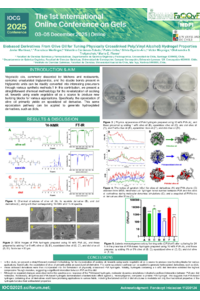
Vegetable oils, commonly discarded by kitchens and restaurants, comprise unsaturated triglycerides, and the double bonds present in triglyceride units can be readily converted into interesting precursors through various synthetic methods. In this contribution, we present a straightforward chemical methodology for the revalorization of cooking oil, towards using waste vegetable oil as a source to produce new building blocks for various applications. Specifically, the epoxidation of olive oil primarily yields an epoxidized oil derivative. This same epoxidation pathway can be applied to generate hydroxylated derivatives, such as diols.
These oil-based derivatives were then incorporated into the formulation of physically crosslinked PVA hydrogels. Notably, hydrogels containing a 5 wt% diol derivative exhibited the highest compressive Young's modulus, suggesting a significant interaction between PVA and the diol.
Although no apparent changes were observed in the spectroscopic response of the PVA-based hydrogels, molecular dynamics simulations indicated a profound interaction between PVA and diol molecules. Additionally, all synthesized PVA-based hydrogels demonstrated a bacteriostatic effect against L. monocytogenes, compared to pristine PVA hydrogel. This suggests that PVA-based hydrogels containing olive oil derivatives could have promising applications in various fields, including the tailored control of diol structures to modulate not only the mechanical properties of the hydrogels but also their antibacterial properties
Keywords
biobased plasticizers
hydrophobic association
molecular dynamics
physical crosslinking
PVA hydrogels
Poster
Poster_Javier Martinez.pdf
An Intelligent Ternary Hydrogel for Rapid Wound Healing
Injectable Thermoresponsive Hyaluronic Acid–GelMA Composite Hydrogel Loaded with Tacrolimus and Tyrosinase-Activating Peptides for Local Immunomodulation and Melanocyte Regeneration in Vitiligo