Event submissions
Published
This submission belongs to the session S3. Gels in Agriculture and Food of the event The 1st International Online Conference on Gels
Published date
28 Nov, 2025
Academic Editor
'%3e%3cpath%20d='M12.6657%2010.9104C12.4185%2010.325%2012.0599%209.79327%2011.6097%209.34482C11.1609%208.89508%2010.6293%208.5365%2010.0442%208.28888C10.0389%208.28626%2010.0337%208.28495%2010.0285%208.28233C10.8446%207.69279%2011.3752%206.73249%2011.3752%205.64904C11.3752%203.8542%209.92103%202.39999%208.1262%202.39999C6.33136%202.39999%204.87715%203.8542%204.87715%205.64904C4.87715%206.73249%205.40774%207.69279%206.22393%208.28364C6.21869%208.28626%206.21345%208.28757%206.20821%208.29019C5.62129%208.5378%205.09463%208.89284%204.64265%209.34613C4.1929%209.79493%203.83432%2010.3266%203.58671%2010.9117C3.34345%2011.4845%203.21226%2012.0987%203.20023%2012.7209C3.19988%2012.7349%203.20233%2012.7488%203.20744%2012.7619C3.21255%2012.7749%203.22022%2012.7867%203.22998%2012.7968C3.23975%2012.8068%203.25142%2012.8147%203.26431%2012.8202C3.2772%2012.8256%203.29105%2012.8284%203.30504%2012.8284H4.09109C4.14874%2012.8284%204.19459%2012.7825%204.1959%2012.7262C4.2221%2011.7148%204.62823%2010.7676%205.34617%2010.0497C6.08899%209.30683%207.0755%208.89808%208.1262%208.89808C9.17689%208.89808%2010.1634%209.30683%2010.9062%2010.0497C11.6242%2010.7676%2012.0303%2011.7148%2012.0565%2012.7262C12.0578%2012.7838%2012.1037%2012.8284%2012.1613%2012.8284H12.9474C12.9613%2012.8284%2012.9752%2012.8256%2012.9881%2012.8202C13.001%2012.8147%2013.0126%2012.8068%2013.0224%2012.7968C13.0322%2012.7867%2013.0398%2012.7749%2013.0449%2012.7619C13.0501%2012.7488%2013.0525%2012.7349%2013.0522%2012.7209C13.0391%2012.0947%2012.9094%2011.4855%2012.6657%2010.9104ZM8.1262%207.9024C7.52486%207.9024%206.9589%207.6679%206.53312%207.24211C6.10733%206.81633%205.87283%206.25037%205.87283%205.64904C5.87283%205.0477%206.10733%204.48174%206.53312%204.05596C6.9589%203.63018%207.52486%203.39567%208.1262%203.39567C8.72753%203.39567%209.29349%203.63018%209.71927%204.05596C10.1451%204.48174%2010.3796%205.0477%2010.3796%205.64904C10.3796%206.25037%2010.1451%206.81633%209.71927%207.24211C9.29349%207.6679%208.72753%207.9024%208.1262%207.9024Z'%20fill='%235D1EE1'/%3e%3c/g%3e%3c/svg%3e) Luis Alfonso Trujillo-Cayado
Luis Alfonso Trujillo-CayadoCitation
Osama Maklad, Bandita Banergee, Vahid Baeghbali, Parag Acharya, Probing Nonlinear Rheological Behavior of Protein–Pectin Crosslinked Networks via Large Amplitude Oscillatory Shear (LAOS), in Proceedings of The 1st International Online Conference on Gels, 3 December–5 December 2025, MDPI: Basel, Switzerland
Share
Email
Facebook
Twitter
LinkedIn
Probing Nonlinear Rheological Behavior of Protein–Pectin Crosslinked Networks via Large Amplitude Oscillatory Shear (LAOS)

Osama Maklad 1,2
'%3e%3cpath%20d='M12.6647%2010.9104C12.4176%2010.325%2012.0589%209.7933%2011.6088%209.34485C11.16%208.89511%2010.6283%208.53653%2010.0432%208.28891C10.038%208.28629%2010.0327%208.28498%2010.0275%208.28236C10.8437%207.69282%2011.3743%206.73252%2011.3743%205.64907C11.3743%203.85423%209.92005%202.40002%208.12522%202.40002C6.33038%202.40002%204.87618%203.85423%204.87618%205.64907C4.87618%206.73252%205.40677%207.69282%206.22296%208.28367C6.21772%208.28629%206.21248%208.2876%206.20724%208.29022C5.62031%208.53783%205.09365%208.89287%204.64167%209.34616C4.19192%209.79496%203.83334%2010.3266%203.58573%2010.9117C3.34247%2011.4846%203.21128%2012.0987%203.19925%2012.721C3.1989%2012.735%203.20135%2012.7489%203.20646%2012.7619C3.21157%2012.7749%203.21924%2012.7868%203.22901%2012.7968C3.23877%2012.8068%203.25045%2012.8148%203.26334%2012.8202C3.27623%2012.8256%203.29007%2012.8284%203.30406%2012.8284H4.09012C4.14776%2012.8284%204.19362%2012.7825%204.19493%2012.7262C4.22113%2011.7148%204.62726%2010.7676%205.34519%2010.0497C6.08802%209.30686%207.07452%208.89811%208.12522%208.89811C9.17592%208.89811%2010.1624%209.30686%2010.9052%2010.0497C11.6232%2010.7676%2012.0293%2011.7148%2012.0555%2012.7262C12.0568%2012.7839%2012.1027%2012.8284%2012.1603%2012.8284H12.9464C12.9604%2012.8284%2012.9742%2012.8256%2012.9871%2012.8202C13%2012.8148%2013.0117%2012.8068%2013.0214%2012.7968C13.0312%2012.7868%2013.0389%2012.7749%2013.044%2012.7619C13.0491%2012.7489%2013.0515%2012.735%2013.0512%2012.721C13.0381%2012.0947%2012.9084%2011.4856%2012.6647%2010.9104ZM8.12522%207.90243C7.52388%207.90243%206.95792%207.66793%206.53214%207.24215C6.10636%206.81636%205.87185%206.2504%205.87185%205.64907C5.87185%205.04773%206.10636%204.48177%206.53214%204.05599C6.95792%203.63021%207.52388%203.3957%208.12522%203.3957C8.72655%203.3957%209.29252%203.63021%209.7183%204.05599C10.1441%204.48177%2010.3786%205.04773%2010.3786%205.64907C10.3786%206.2504%2010.1441%206.81636%209.7183%207.24215C9.29252%207.66793%208.72655%207.90243%208.12522%207.90243Z'%20fill='%235D1EE1'/%3e%3c/g%3e%3c/svg%3e)
Bandita Banergee 2,3

Vahid Baeghbali 2,3
Parag Acharya 2,3
1. Centre for Advanced Manufacturing and Materials, University of Greenwich, London, UK
2. Bezos Centre for Sustainable Protein, Imperial College London, London, UK
3. Natural Resources Institute, University of Greenwich, London, UK
Abstract
Protein–pectin crosslinked networks are increasingly utilized in food science, biomedical engineering, and soft material design due to their biocompatibility, tunable mechanical properties, and functional versatility. While small amplitude oscillatory shear (SAOS) provides insights into linear viscoelasticity, understanding their nonlinear behavior under large deformations is essential for applications involving processing, mastication, or mechanical loading. In this study, we employ Large Amplitude Oscillatory Shear (LAOS) rheology to systematically investigate the nonlinear viscoelastic response of protein–pectin gels formed via enzymatic (e.g., transglutaminase), covalent (Maillard-induced), and ionic crosslinking mechanisms. By combining Lissajous–Bowditch plots with Fourier transform (FT) rheology and Chebyshev harmonic decomposition, we resolve the contributions of elastic energy storage (G′) and viscous dissipation (G″) across strain amplitudes (γ₀ = 0.1–500%). Key nonlinear signatures, including strain-stiffening, yielding, and shear-induced network breakdown, are quantified through the framework of intracycle (elastic/viscous nonlinearities) and intercycle (thixotropic/recovery) dynamics. Our results demonstrate that crosslinking density and polymer ratio dictate the transition from linear to nonlinear regimes, with Maillard-crosslinked networks exhibiting pronounced intercycle softening due to irreversible bond rupture, while ionically crosslinked gels show reversible plasticity. Furthermore, we correlate LAOS-derived parameters (e.g., I₃/I₁ ratio, Q₀) with microstructural changes observed via confocal microscopy or scattering techniques. These findings provide a structure–rheology relationship critical for designing protein–pectin composites with tailored mechanical performance in applications such as 3D bioprinting, controlled release systems, or texture-modified foods. The methodology establishes LAOS as a powerful tool for probing the functional limits of soft biological networks under physiologically and industrially relevant deformations.
Keywords
LAOS
protein-pectin gels
nonlinear viscoelasticity
crosslinking
rheology
soft materials
Maillard reaction
harmonic decomposition
Poster
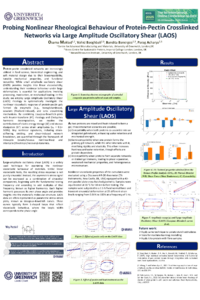
Probing Nonlinear Rheological Behavior of Protein-Pectin Crosslinked Networks via Large Amplitude Oscillatory Shear (LAOS).pdf
Poly(vinyl alcohol) cryogels as carriers of phytohormones
Design of Alginate/Gelatin Hydrogels for Craniofacial Bone Tissue Engineering: Optimizing Osteogenesis in Dental Pulp Stem Cells Without Compromising Other Cellular Functions