Event submissions
Published
This submission belongs to the session S3. Gels in Agriculture and Food of the event The 1st International Online Conference on Gels
Published date
28 Nov, 2025
Academic Editor
'%3e%3cpath%20d='M12.6657%2010.9104C12.4185%2010.325%2012.0599%209.79327%2011.6097%209.34482C11.1609%208.89508%2010.6293%208.5365%2010.0442%208.28888C10.0389%208.28626%2010.0337%208.28495%2010.0285%208.28233C10.8446%207.69279%2011.3752%206.73249%2011.3752%205.64904C11.3752%203.8542%209.92103%202.39999%208.1262%202.39999C6.33136%202.39999%204.87715%203.8542%204.87715%205.64904C4.87715%206.73249%205.40774%207.69279%206.22393%208.28364C6.21869%208.28626%206.21345%208.28757%206.20821%208.29019C5.62129%208.5378%205.09463%208.89284%204.64265%209.34613C4.1929%209.79493%203.83432%2010.3266%203.58671%2010.9117C3.34345%2011.4845%203.21226%2012.0987%203.20023%2012.7209C3.19988%2012.7349%203.20233%2012.7488%203.20744%2012.7619C3.21255%2012.7749%203.22022%2012.7867%203.22998%2012.7968C3.23975%2012.8068%203.25142%2012.8147%203.26431%2012.8202C3.2772%2012.8256%203.29105%2012.8284%203.30504%2012.8284H4.09109C4.14874%2012.8284%204.19459%2012.7825%204.1959%2012.7262C4.2221%2011.7148%204.62823%2010.7676%205.34617%2010.0497C6.08899%209.30683%207.0755%208.89808%208.1262%208.89808C9.17689%208.89808%2010.1634%209.30683%2010.9062%2010.0497C11.6242%2010.7676%2012.0303%2011.7148%2012.0565%2012.7262C12.0578%2012.7838%2012.1037%2012.8284%2012.1613%2012.8284H12.9474C12.9613%2012.8284%2012.9752%2012.8256%2012.9881%2012.8202C13.001%2012.8147%2013.0126%2012.8068%2013.0224%2012.7968C13.0322%2012.7867%2013.0398%2012.7749%2013.0449%2012.7619C13.0501%2012.7488%2013.0525%2012.7349%2013.0522%2012.7209C13.0391%2012.0947%2012.9094%2011.4855%2012.6657%2010.9104ZM8.1262%207.9024C7.52486%207.9024%206.9589%207.6679%206.53312%207.24211C6.10733%206.81633%205.87283%206.25037%205.87283%205.64904C5.87283%205.0477%206.10733%204.48174%206.53312%204.05596C6.9589%203.63018%207.52486%203.39567%208.1262%203.39567C8.72753%203.39567%209.29349%203.63018%209.71927%204.05596C10.1451%204.48174%2010.3796%205.0477%2010.3796%205.64904C10.3796%206.25037%2010.1451%206.81633%209.71927%207.24211C9.29349%207.6679%208.72753%207.9024%208.1262%207.9024Z'%20fill='%235D1EE1'/%3e%3c/g%3e%3c/svg%3e) Luis Alfonso Trujillo-Cayado
Luis Alfonso Trujillo-CayadoCitation
Zarina Taganbekova, Vadim Ivanovich Markin, Preparation and Investigation of Starch-Based Hydrogels Crosslinked with Citric Acid, in Proceedings of The 1st International Online Conference on Gels, 3 December–5 December 2025, MDPI: Basel, Switzerland
Share
Email
Facebook
Twitter
LinkedIn
Preparation and Investigation of Starch-Based Hydrogels Crosslinked with Citric Acid
'%3e%3cpath%20d='M12.6647%2010.9104C12.4176%2010.325%2012.0589%209.7933%2011.6088%209.34485C11.16%208.89511%2010.6283%208.53653%2010.0432%208.28891C10.038%208.28629%2010.0327%208.28498%2010.0275%208.28236C10.8437%207.69282%2011.3743%206.73252%2011.3743%205.64907C11.3743%203.85423%209.92005%202.40002%208.12522%202.40002C6.33038%202.40002%204.87618%203.85423%204.87618%205.64907C4.87618%206.73252%205.40677%207.69282%206.22296%208.28367C6.21772%208.28629%206.21248%208.2876%206.20724%208.29022C5.62031%208.53783%205.09365%208.89287%204.64167%209.34616C4.19192%209.79496%203.83334%2010.3266%203.58573%2010.9117C3.34247%2011.4846%203.21128%2012.0987%203.19925%2012.721C3.1989%2012.735%203.20135%2012.7489%203.20646%2012.7619C3.21157%2012.7749%203.21924%2012.7868%203.22901%2012.7968C3.23877%2012.8068%203.25045%2012.8148%203.26334%2012.8202C3.27623%2012.8256%203.29007%2012.8284%203.30406%2012.8284H4.09012C4.14776%2012.8284%204.19362%2012.7825%204.19493%2012.7262C4.22113%2011.7148%204.62726%2010.7676%205.34519%2010.0497C6.08802%209.30686%207.07452%208.89811%208.12522%208.89811C9.17592%208.89811%2010.1624%209.30686%2010.9052%2010.0497C11.6232%2010.7676%2012.0293%2011.7148%2012.0555%2012.7262C12.0568%2012.7839%2012.1027%2012.8284%2012.1603%2012.8284H12.9464C12.9604%2012.8284%2012.9742%2012.8256%2012.9871%2012.8202C13%2012.8148%2013.0117%2012.8068%2013.0214%2012.7968C13.0312%2012.7868%2013.0389%2012.7749%2013.044%2012.7619C13.0491%2012.7489%2013.0515%2012.735%2013.0512%2012.721C13.0381%2012.0947%2012.9084%2011.4856%2012.6647%2010.9104ZM8.12522%207.90243C7.52388%207.90243%206.95792%207.66793%206.53214%207.24215C6.10636%206.81636%205.87185%206.2504%205.87185%205.64907C5.87185%205.04773%206.10636%204.48177%206.53214%204.05599C6.95792%203.63021%207.52388%203.3957%208.12522%203.3957C8.72655%203.3957%209.29252%203.63021%209.7183%204.05599C10.1441%204.48177%2010.3786%205.04773%2010.3786%205.64907C10.3786%206.2504%2010.1441%206.81636%209.7183%207.24215C9.29252%207.66793%208.72655%207.90243%208.12522%207.90243Z'%20fill='%235D1EE1'/%3e%3c/g%3e%3c/svg%3e)
Zarina Taganbekova 1
Vadim Ivanovich Markin 1
1. Institute of Chemistry and Chemical and Pharmaceutical Technologies, Altai State University, 61 Lenin Avenue, Barnaul, 656015, Russia, Russia
Abstract
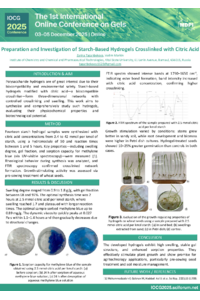
Introduction. Polysaccharide hydrogels are of great interest due to their biocompatibility and environmental safety. Starch-based hydrogels modified with citric acid—a biocompatible crosslinker—form three-dimensional networks with controlled crosslinking and swelling. This work aims to synthesize and comprehensively study such hydrogels, evaluating their physicochemical properties and biotechnological potential.
Methods. Fourteen starch hydrogel samples were synthesized with citric acid concentrations from 2.4 to 42 mmol per kmol of starch, using a hydromodule of 50 and reaction times between 1 and 5 hours. Key properties—including swelling degree, gel fraction, and sorption capacity for methylene blue (via UV–visible spectroscopy)—were measured [1]. Rheological behavior during synthesis was analyzed, and FTIR spectroscopy confirmed crosslinked network formation. Growth-stimulating activity was assessed via pre-sowing treatment of wheat seeds.
Results. Swelling degree ranged from 0.9 to 1.8 g/g, with gel fraction between 68 and 97%. The optimal synthesis time was 2 hours at 2.5 mmol citric acid per kmol starch, where swelling reached 1.7 and plateaued with longer reaction times. The optimal sample sorbed methylene blue up to 0.89 mg/g. The dynamic viscosity quickly peaks at 0.027 Pa·s within 1.1–1.4 hours and then gradually decreases due to structural changes. FTIR spectra showed intense bands at 1790–1650 cm⁻¹, indicating ester bond formation; band intensity increased with citric acid concentration, confirming higher crosslinking.
Growth stimulation varied by conditions: stems grew better in sandy soil, while root development and biomass were higher in Petri dish cultures. Hydrogel-treated seeds showed 10–25% greater germination than controls in both cases.
Conclusion. The developed hydrogels exhibit high swelling, stable gel structure, and enhanced sorption properties. They effectively stimulate plant growth and show promise for agritechnology applications, particularly pre-sowing seed treatment and soil moisture management.
Keywords
hydrogels
starch
crosslinking agent
swelling degree
sorbent
growth stimulation
Poster
poster_pdf (poster TaganbekovaZK.pdf).pdf
Antifreeze, Conductive and Flexible Ternary PVA/PVP/SA Hydrogels
Sulfidation-MnO₂ Dual-Modified Cu-Co-MOFs for Flexible Supercapacitors with Hydrogel Electrolyte