Event submissions
Published
This submission belongs to the session C. Veterinary Epidemiology of the event The 1st International Online Conference on Veterinary Sciences
Published date
28 Nov, 2025
Academic Editor
'%3e%3cpath%20d='M12.6657%2010.9104C12.4185%2010.325%2012.0599%209.79327%2011.6097%209.34482C11.1609%208.89508%2010.6293%208.5365%2010.0442%208.28888C10.0389%208.28626%2010.0337%208.28495%2010.0285%208.28233C10.8446%207.69279%2011.3752%206.73249%2011.3752%205.64904C11.3752%203.8542%209.92103%202.39999%208.1262%202.39999C6.33136%202.39999%204.87715%203.8542%204.87715%205.64904C4.87715%206.73249%205.40774%207.69279%206.22393%208.28364C6.21869%208.28626%206.21345%208.28757%206.20821%208.29019C5.62129%208.5378%205.09463%208.89284%204.64265%209.34613C4.1929%209.79493%203.83432%2010.3266%203.58671%2010.9117C3.34345%2011.4845%203.21226%2012.0987%203.20023%2012.7209C3.19988%2012.7349%203.20233%2012.7488%203.20744%2012.7619C3.21255%2012.7749%203.22022%2012.7867%203.22998%2012.7968C3.23975%2012.8068%203.25142%2012.8147%203.26431%2012.8202C3.2772%2012.8256%203.29105%2012.8284%203.30504%2012.8284H4.09109C4.14874%2012.8284%204.19459%2012.7825%204.1959%2012.7262C4.2221%2011.7148%204.62823%2010.7676%205.34617%2010.0497C6.08899%209.30683%207.0755%208.89808%208.1262%208.89808C9.17689%208.89808%2010.1634%209.30683%2010.9062%2010.0497C11.6242%2010.7676%2012.0303%2011.7148%2012.0565%2012.7262C12.0578%2012.7838%2012.1037%2012.8284%2012.1613%2012.8284H12.9474C12.9613%2012.8284%2012.9752%2012.8256%2012.9881%2012.8202C13.001%2012.8147%2013.0126%2012.8068%2013.0224%2012.7968C13.0322%2012.7867%2013.0398%2012.7749%2013.0449%2012.7619C13.0501%2012.7488%2013.0525%2012.7349%2013.0522%2012.7209C13.0391%2012.0947%2012.9094%2011.4855%2012.6657%2010.9104ZM8.1262%207.9024C7.52486%207.9024%206.9589%207.6679%206.53312%207.24211C6.10733%206.81633%205.87283%206.25037%205.87283%205.64904C5.87283%205.0477%206.10733%204.48174%206.53312%204.05596C6.9589%203.63018%207.52486%203.39567%208.1262%203.39567C8.72753%203.39567%209.29349%203.63018%209.71927%204.05596C10.1451%204.48174%2010.3796%205.0477%2010.3796%205.64904C10.3796%206.25037%2010.1451%206.81633%209.71927%207.24211C9.29349%207.6679%208.72753%207.9024%208.1262%207.9024Z'%20fill='%235D1EE1'/%3e%3c/g%3e%3c/svg%3e) Yingyu Chen
Yingyu ChenCitation
Santina Di Bella, Davide Pepe, Valeria Blanda, Vincenza Cannella, Annalisa Guercio, Domenico Vicari, Introduction of Non-Autochthonous Cattle into a Farm in the Madonie Park (Sicily, Italy) and the Impact of Endemic Tick-Borne Diseases: A Serological, Molecular, and Entomological Study, in Proceedings of The 1st International Online Conference on Veterinary Sciences, 3 December–5 December 2025, MDPI: Basel, Switzerland
Share
Email
Facebook
Twitter
LinkedIn
Introduction of Non-Autochthonous Cattle into a Farm in the Madonie Park (Sicily, Italy) and the Impact of Endemic Tick-Borne Diseases: A Serological, Molecular, and Entomological Study
'%3e%3cpath%20d='M12.6647%2010.9104C12.4176%2010.325%2012.0589%209.7933%2011.6088%209.34485C11.16%208.89511%2010.6283%208.53653%2010.0432%208.28891C10.038%208.28629%2010.0327%208.28498%2010.0275%208.28236C10.8437%207.69282%2011.3743%206.73252%2011.3743%205.64907C11.3743%203.85423%209.92005%202.40002%208.12522%202.40002C6.33038%202.40002%204.87618%203.85423%204.87618%205.64907C4.87618%206.73252%205.40677%207.69282%206.22296%208.28367C6.21772%208.28629%206.21248%208.2876%206.20724%208.29022C5.62031%208.53783%205.09365%208.89287%204.64167%209.34616C4.19192%209.79496%203.83334%2010.3266%203.58573%2010.9117C3.34247%2011.4846%203.21128%2012.0987%203.19925%2012.721C3.1989%2012.735%203.20135%2012.7489%203.20646%2012.7619C3.21157%2012.7749%203.21924%2012.7868%203.22901%2012.7968C3.23877%2012.8068%203.25045%2012.8148%203.26334%2012.8202C3.27623%2012.8256%203.29007%2012.8284%203.30406%2012.8284H4.09012C4.14776%2012.8284%204.19362%2012.7825%204.19493%2012.7262C4.22113%2011.7148%204.62726%2010.7676%205.34519%2010.0497C6.08802%209.30686%207.07452%208.89811%208.12522%208.89811C9.17592%208.89811%2010.1624%209.30686%2010.9052%2010.0497C11.6232%2010.7676%2012.0293%2011.7148%2012.0555%2012.7262C12.0568%2012.7839%2012.1027%2012.8284%2012.1603%2012.8284H12.9464C12.9604%2012.8284%2012.9742%2012.8256%2012.9871%2012.8202C13%2012.8148%2013.0117%2012.8068%2013.0214%2012.7968C13.0312%2012.7868%2013.0389%2012.7749%2013.044%2012.7619C13.0491%2012.7489%2013.0515%2012.735%2013.0512%2012.721C13.0381%2012.0947%2012.9084%2011.4856%2012.6647%2010.9104ZM8.12522%207.90243C7.52388%207.90243%206.95792%207.66793%206.53214%207.24215C6.10636%206.81636%205.87185%206.2504%205.87185%205.64907C5.87185%205.04773%206.10636%204.48177%206.53214%204.05599C6.95792%203.63021%207.52388%203.3957%208.12522%203.3957C8.72655%203.3957%209.29252%203.63021%209.7183%204.05599C10.1441%204.48177%2010.3786%205.04773%2010.3786%205.64907C10.3786%206.2504%2010.1441%206.81636%209.7183%207.24215C9.29252%207.66793%208.72655%207.90243%208.12522%207.90243Z'%20fill='%235D1EE1'/%3e%3c/g%3e%3c/svg%3e)
Davide Pepe 1
Santina Di Bella 1
Valeria Blanda 1
Vincenza Cannella 1
Domenico Vicari 1
Annalisa Guercio 1
1. Istituto Zooprofilattico Sperimentale della Sicilia "A.Mirri", Palermo, Italy, Italy
Abstract
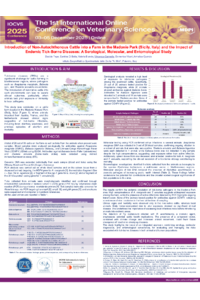
Tick-borne diseases pose a serious challenge to cattle farming in Mediterranean endemic areas. In Sicily, pathogens such as Anaplasma marginale, Babesia spp., and Theileria annulata are widespread and can impact herd health and productivity. This study was conducted on a farm in Sicily, Italy, where non-native cattle imported from Austria, the Netherlands, and France showed severe clinical signs likely related to tick-borne infections.
Among the 35 cattle on the farm, 26 were tested for antibodies to A. marginale, Babesia bigemina, and Crimean-Congo Hemorrhagic Fever virus (CCHFV) by ELISA, and for Babesia bovis and T. annulata by indirect immunofluorescence assay (IFA). PCR was performed on whole blood and spleen (from one dead animal) for A. marginale, B. bigemina, B. bovis, and T. annulata. Ticks were identified morphologically and molecularly and screened for Rickettsia spp. Amplicons were sequenced and compared to GenBank.
Serology showed 21/26 positive for A. marginale, 20/26 for B. bovis, 3/26 for B. bigemina, and 14/26 for T. annulata; none were positive for CCHFV. PCR confirmed A. marginale (9/26), B. bigemina (1/26), and T. annulata (1/26); B. bovis was not detected. The spleen tested positive for A. marginale and T. annulata. Ticks were identified as Hyalomma lusitanicum, PCR-positive for Rickettsia aeschlimannii.
The introduction of non-native cattle into tick-endemic areas increases the risk of disease. High seroprevalence of A. marginale and T. annulata indicates widespread exposure. Differences between serology and PCR reflect past exposure versus active infection. H. lusitanicum is a known CCHFV vector in Mediterranean regions. However, no CCHFV seropositivity was detected, suggesting no active viral circulation in the herd. Still, the established presence of this tick species in Sicily, along with climate change and animal movement, could favor local emergence. Enhanced surveillance is recommended to support early outbreak detection and protect animal and public health.
Keywords
Tick-borne diseases
Anaplasma marginale
Babesia bigemina
Theileria annulata
Crimean-Congo Hemorrhagic Fever virus
Hyalomma lusitanicum
Rickettsia aeschlimannii
cattle
Poster
Pepe et al., 2025.pdf
Prevalence and Resistance profiling of Methicillin Resistance Staphylococcus aureus in crustacean seafood in Lagos, Nigeria
Polyphenol-Mediated Inhibition of SIGLEC15 to Block Newcastle Disease Virus Binding and Enhance Immunity in Chickens