Event submissions
Published
This submission belongs to the session C. Veterinary Epidemiology of the event The 1st International Online Conference on Veterinary Sciences
Published date
01 Dec, 2025
Academic Editor
'%3e%3cpath%20d='M12.6657%2010.9104C12.4185%2010.325%2012.0599%209.79327%2011.6097%209.34482C11.1609%208.89508%2010.6293%208.5365%2010.0442%208.28888C10.0389%208.28626%2010.0337%208.28495%2010.0285%208.28233C10.8446%207.69279%2011.3752%206.73249%2011.3752%205.64904C11.3752%203.8542%209.92103%202.39999%208.1262%202.39999C6.33136%202.39999%204.87715%203.8542%204.87715%205.64904C4.87715%206.73249%205.40774%207.69279%206.22393%208.28364C6.21869%208.28626%206.21345%208.28757%206.20821%208.29019C5.62129%208.5378%205.09463%208.89284%204.64265%209.34613C4.1929%209.79493%203.83432%2010.3266%203.58671%2010.9117C3.34345%2011.4845%203.21226%2012.0987%203.20023%2012.7209C3.19988%2012.7349%203.20233%2012.7488%203.20744%2012.7619C3.21255%2012.7749%203.22022%2012.7867%203.22998%2012.7968C3.23975%2012.8068%203.25142%2012.8147%203.26431%2012.8202C3.2772%2012.8256%203.29105%2012.8284%203.30504%2012.8284H4.09109C4.14874%2012.8284%204.19459%2012.7825%204.1959%2012.7262C4.2221%2011.7148%204.62823%2010.7676%205.34617%2010.0497C6.08899%209.30683%207.0755%208.89808%208.1262%208.89808C9.17689%208.89808%2010.1634%209.30683%2010.9062%2010.0497C11.6242%2010.7676%2012.0303%2011.7148%2012.0565%2012.7262C12.0578%2012.7838%2012.1037%2012.8284%2012.1613%2012.8284H12.9474C12.9613%2012.8284%2012.9752%2012.8256%2012.9881%2012.8202C13.001%2012.8147%2013.0126%2012.8068%2013.0224%2012.7968C13.0322%2012.7867%2013.0398%2012.7749%2013.0449%2012.7619C13.0501%2012.7488%2013.0525%2012.7349%2013.0522%2012.7209C13.0391%2012.0947%2012.9094%2011.4855%2012.6657%2010.9104ZM8.1262%207.9024C7.52486%207.9024%206.9589%207.6679%206.53312%207.24211C6.10733%206.81633%205.87283%206.25037%205.87283%205.64904C5.87283%205.0477%206.10733%204.48174%206.53312%204.05596C6.9589%203.63018%207.52486%203.39567%208.1262%203.39567C8.72753%203.39567%209.29349%203.63018%209.71927%204.05596C10.1451%204.48174%2010.3796%205.0477%2010.3796%205.64904C10.3796%206.25037%2010.1451%206.81633%209.71927%207.24211C9.29349%207.6679%208.72753%207.9024%208.1262%207.9024Z'%20fill='%235D1EE1'/%3e%3c/g%3e%3c/svg%3e) Wentao Li
Wentao LiCitation
Andreia Manuela Vieira Garces, Isabel Pires, Cutaneous Papillomaviruses in Cervids: A Hidden Threat to Wildlife Health and Conservation, in Proceedings of The 1st International Online Conference on Veterinary Sciences, 3 December–5 December 2025, MDPI: Basel, Switzerland
Share
Email
Facebook
Twitter
LinkedIn
Cutaneous Papillomaviruses in Cervids: A Hidden Threat to Wildlife Health and Conservation

Andreia Manuela Vieira Garces 1

Isabel Pires 2
1. Department of Veterinary Science, University of Trás os Montes and Alto Dourom Quinta dos Prados 5000-801, Vila Real, Portugal, Portugal
2. Animal and Veterinary Research Centre (CECAV), Associate Laboratory for Animal and Veterinary Sciences (AL4AnimalS), University of Trás-os-Montes e Alto Douro (UTAD), 5000-801 Vila Real, Portugal, Portugal
Abstract
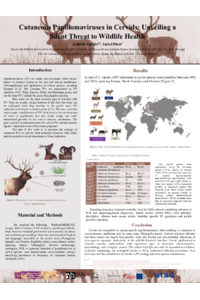
Cutaneous papillomaviruses (PVs) are small, non-enveloped DNA viruses with strict host specificity and the capacity to induce proliferative epithelial lesions in a wide range of vertebrates. In wild cervids—including red deer (Cervus elaphus), moose (Alces alces), roe deer (Capreolus capreolus), white-tailed deer (Odocoileus virginianus), and reindeer (Rangifer tarandus)—multiple species-specific PVs have been identified, including CePV1, AaPV1, CcaPV1, OvPV1, and RtPV1. These viruses typically cause papillomas and fibro papillomas on the skin and mucous membranes, presenting as rough, verrucous, and sometimes ulcerated lesions. Although often benign, PV-induced lesions can compromise animal welfare by affecting feeding, vision, mobility, or mating behaviours. In high-prevalence populations, especially among juveniles and immunocompromised individuals, these infections may have broader population-level impacts. Histopathological findings typically include epidermal hyperplasia, koilocytosis, and papillomatosis, with replication confined to keratinocytes. Transmission occurs via direct contact, microtraumas, and potentially through hematophagous ectoparasites. From a conservation perspective, PV infections in cervids are significant for several reasons. First, lesions may reduce individual fitness and contribute to population stress, particularly in fragmented or vulnerable populations. Second, the presence of papillomaviruses in cervid species cohabiting with livestock or other wildlife raises concerns about cross-species transmission, including spillover from bovine PVs. Third, these lesions may be misidentified as more serious conditions (e.g., sarcoids or neoplasia), complicating health assessments in the field. With cervids playing crucial ecological roles and serving as sentinel species in many ecosystems, understanding PV diversity, transmission dynamics, and pathology is essential for wildlife health monitoring and conservation planning. Ongoing molecular surveillance, pathology, and ecological studies are critical to assess the true burden of PV infections and to support evidence-based conservation medicine practices
Keywords
Papillomavirus
cervids
red deer
cutaneous lesions
fibropapilloma
wildlife pathology
veterinary virology
Poster
poster_deer papiloma.pdf
Emerging Technologies for Virus Detection in Livestock: From CRISPR-Based Diagnostics to Portable Genomic Sequencing