Event submissions
Published
This submission belongs to the session E. Virology in One Health of the event The 1st International Online Conference on Veterinary Sciences
Published date
28 Nov, 2025
Academic Editor
'%3e%3cpath%20d='M12.6657%2010.9104C12.4185%2010.325%2012.0599%209.79327%2011.6097%209.34482C11.1609%208.89508%2010.6293%208.5365%2010.0442%208.28888C10.0389%208.28626%2010.0337%208.28495%2010.0285%208.28233C10.8446%207.69279%2011.3752%206.73249%2011.3752%205.64904C11.3752%203.8542%209.92103%202.39999%208.1262%202.39999C6.33136%202.39999%204.87715%203.8542%204.87715%205.64904C4.87715%206.73249%205.40774%207.69279%206.22393%208.28364C6.21869%208.28626%206.21345%208.28757%206.20821%208.29019C5.62129%208.5378%205.09463%208.89284%204.64265%209.34613C4.1929%209.79493%203.83432%2010.3266%203.58671%2010.9117C3.34345%2011.4845%203.21226%2012.0987%203.20023%2012.7209C3.19988%2012.7349%203.20233%2012.7488%203.20744%2012.7619C3.21255%2012.7749%203.22022%2012.7867%203.22998%2012.7968C3.23975%2012.8068%203.25142%2012.8147%203.26431%2012.8202C3.2772%2012.8256%203.29105%2012.8284%203.30504%2012.8284H4.09109C4.14874%2012.8284%204.19459%2012.7825%204.1959%2012.7262C4.2221%2011.7148%204.62823%2010.7676%205.34617%2010.0497C6.08899%209.30683%207.0755%208.89808%208.1262%208.89808C9.17689%208.89808%2010.1634%209.30683%2010.9062%2010.0497C11.6242%2010.7676%2012.0303%2011.7148%2012.0565%2012.7262C12.0578%2012.7838%2012.1037%2012.8284%2012.1613%2012.8284H12.9474C12.9613%2012.8284%2012.9752%2012.8256%2012.9881%2012.8202C13.001%2012.8147%2013.0126%2012.8068%2013.0224%2012.7968C13.0322%2012.7867%2013.0398%2012.7749%2013.0449%2012.7619C13.0501%2012.7488%2013.0525%2012.7349%2013.0522%2012.7209C13.0391%2012.0947%2012.9094%2011.4855%2012.6657%2010.9104ZM8.1262%207.9024C7.52486%207.9024%206.9589%207.6679%206.53312%207.24211C6.10733%206.81633%205.87283%206.25037%205.87283%205.64904C5.87283%205.0477%206.10733%204.48174%206.53312%204.05596C6.9589%203.63018%207.52486%203.39567%208.1262%203.39567C8.72753%203.39567%209.29349%203.63018%209.71927%204.05596C10.1451%204.48174%2010.3796%205.0477%2010.3796%205.64904C10.3796%206.25037%2010.1451%206.81633%209.71927%207.24211C9.29349%207.6679%208.72753%207.9024%208.1262%207.9024Z'%20fill='%235D1EE1'/%3e%3c/g%3e%3c/svg%3e) Elsayed Mohammed Abdel Whab
Elsayed Mohammed Abdel WhabCitation
Marko Popovic, Biothermodynamics of virus–host interactions: The role of Gibbs energy in antigen-receptor binding and virus multiplication in host cells, in Proceedings of The 1st International Online Conference on Veterinary Sciences, 3 December–5 December 2025, MDPI: Basel, Switzerland
Share
Email
Facebook
Twitter
LinkedIn
Biothermodynamics of virus–host interactions: The role of Gibbs energy in antigen-receptor binding and virus multiplication in host cells

Marko Popovic 1
1. Institute of Chemistry, Technology and Metallurgy, University of Belgrade, Njegoševa 12, 11000 Belgrade, Serbia, Serbia
Abstract
Viruses are among the simplest pathogens and rely on host cell metabolic machinery for multiplication. However, viruses also represent complex macromolecular assemblies and can therefore be analyzed as biothermodynamic systems. This means that virus–host interactions represent processes that proceed in accordance with the laws of physics and chemistry. The biothermodynamic methodology has been extensively applied in science and engineering to analyze microorganisms, which include bacteria, yeasts, filamentous fungi, and algae. Gibbs energy represents the driving force of metabolism and multiplication of microorganisms. In this research, the computational and theoretical methodology of biothermodynamics is applied to analyze virus particles, which include the atom counting method, Patel–Erickson–Battley model, and biosynthesis reactions. Based on the determined chemical and thermodynamic properties of virus particles, a mechanistic model of virus–host interactions is developed, based on chemical and nonequilibrium thermodynamics. Virus–host interactions at the cell membrane (antigen-receptor binding) and in the cytoplasm (virus multiplication) are analyzed. Antigen-receptor binding represents a chemical reaction that is driven by Gibbs energy. Virus multiplication can be analyzed as a chemical reaction in which precursors like amino acids are combined to form new virus particles. This process is performed by the metabolic machinery, which is also used by the host cell for reparation. This means that the processes of virus replication and host cell reparation are competitive chemical reactions. According to phenomenological equations of nonequilbrium thermodynamics, the reaction with a more negative Gibbs energy change will dominate in the competition. Therefore, a more negative Gibbs energy of biosynthesis contributes to the ability of viruses to hijack the metabolism of their host cells and multiply. Furthermore, the methodology of biothermodynamics is applied to analyze virus evolution.
Keywords
Biothermodynamics
Gibbs energy
Virus
Virus-host interaction
Antigen-receptor binding
Virus multiplication
Evolution
Chemical thermodynamics
Nonequilibrium thermodynamics
Infection
Poster
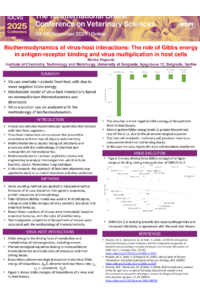
Veterinary virology poster sciforum-136285.pdf
Hemagglutinin–Esterase Gene Variations Drive Adaptive Evolution in Bovine Coronavirus (BCoV)
Circulating Bovine Leukemia Virus Cell-Free DNA as a Promising Biomarker for Enzootic Bovine Leukosis