Event submissions
Published
This submission belongs to the session S3. Animal Taxonomy of the event The 1st International Online Conference on Taxonomy
Published date
01 Dec, 2025
Academic Editor
'%3e%3cpath%20d='M12.6657%2010.9104C12.4185%2010.325%2012.0599%209.79327%2011.6097%209.34482C11.1609%208.89508%2010.6293%208.5365%2010.0442%208.28888C10.0389%208.28626%2010.0337%208.28495%2010.0285%208.28233C10.8446%207.69279%2011.3752%206.73249%2011.3752%205.64904C11.3752%203.8542%209.92103%202.39999%208.1262%202.39999C6.33136%202.39999%204.87715%203.8542%204.87715%205.64904C4.87715%206.73249%205.40774%207.69279%206.22393%208.28364C6.21869%208.28626%206.21345%208.28757%206.20821%208.29019C5.62129%208.5378%205.09463%208.89284%204.64265%209.34613C4.1929%209.79493%203.83432%2010.3266%203.58671%2010.9117C3.34345%2011.4845%203.21226%2012.0987%203.20023%2012.7209C3.19988%2012.7349%203.20233%2012.7488%203.20744%2012.7619C3.21255%2012.7749%203.22022%2012.7867%203.22998%2012.7968C3.23975%2012.8068%203.25142%2012.8147%203.26431%2012.8202C3.2772%2012.8256%203.29105%2012.8284%203.30504%2012.8284H4.09109C4.14874%2012.8284%204.19459%2012.7825%204.1959%2012.7262C4.2221%2011.7148%204.62823%2010.7676%205.34617%2010.0497C6.08899%209.30683%207.0755%208.89808%208.1262%208.89808C9.17689%208.89808%2010.1634%209.30683%2010.9062%2010.0497C11.6242%2010.7676%2012.0303%2011.7148%2012.0565%2012.7262C12.0578%2012.7838%2012.1037%2012.8284%2012.1613%2012.8284H12.9474C12.9613%2012.8284%2012.9752%2012.8256%2012.9881%2012.8202C13.001%2012.8147%2013.0126%2012.8068%2013.0224%2012.7968C13.0322%2012.7867%2013.0398%2012.7749%2013.0449%2012.7619C13.0501%2012.7488%2013.0525%2012.7349%2013.0522%2012.7209C13.0391%2012.0947%2012.9094%2011.4855%2012.6657%2010.9104ZM8.1262%207.9024C7.52486%207.9024%206.9589%207.6679%206.53312%207.24211C6.10733%206.81633%205.87283%206.25037%205.87283%205.64904C5.87283%205.0477%206.10733%204.48174%206.53312%204.05596C6.9589%203.63018%207.52486%203.39567%208.1262%203.39567C8.72753%203.39567%209.29349%203.63018%209.71927%204.05596C10.1451%204.48174%2010.3796%205.0477%2010.3796%205.64904C10.3796%206.25037%2010.1451%206.81633%209.71927%207.24211C9.29349%207.6679%208.72753%207.9024%208.1262%207.9024Z'%20fill='%235D1EE1'/%3e%3c/g%3e%3c/svg%3e) Mathias Harzhauser
Mathias HarzhauserCitation
Maria Irene Deserti, Diego M. A. Guerin, Fabian Horacio Acuña, Sergio Nascimento Stampar, First Molecular Records and Genetic Links among Craspedacusta sowerbii (Cnidaria; Hydrozoa) Populations in Argentina and Brazil, in Proceedings of The 1st International Online Conference on Taxonomy, 3 December–4 December 2025, MDPI: Basel, Switzerland
Share
Email
Facebook
Twitter
LinkedIn
First Molecular Records and Genetic Links among Craspedacusta sowerbii (Cnidaria; Hydrozoa) Populations in Argentina and Brazil
'%3e%3cpath%20d='M12.6647%2010.9104C12.4176%2010.325%2012.0589%209.7933%2011.6088%209.34485C11.16%208.89511%2010.6283%208.53653%2010.0432%208.28891C10.038%208.28629%2010.0327%208.28498%2010.0275%208.28236C10.8437%207.69282%2011.3743%206.73252%2011.3743%205.64907C11.3743%203.85423%209.92005%202.40002%208.12522%202.40002C6.33038%202.40002%204.87618%203.85423%204.87618%205.64907C4.87618%206.73252%205.40677%207.69282%206.22296%208.28367C6.21772%208.28629%206.21248%208.2876%206.20724%208.29022C5.62031%208.53783%205.09365%208.89287%204.64167%209.34616C4.19192%209.79496%203.83334%2010.3266%203.58573%2010.9117C3.34247%2011.4846%203.21128%2012.0987%203.19925%2012.721C3.1989%2012.735%203.20135%2012.7489%203.20646%2012.7619C3.21157%2012.7749%203.21924%2012.7868%203.22901%2012.7968C3.23877%2012.8068%203.25045%2012.8148%203.26334%2012.8202C3.27623%2012.8256%203.29007%2012.8284%203.30406%2012.8284H4.09012C4.14776%2012.8284%204.19362%2012.7825%204.19493%2012.7262C4.22113%2011.7148%204.62726%2010.7676%205.34519%2010.0497C6.08802%209.30686%207.07452%208.89811%208.12522%208.89811C9.17592%208.89811%2010.1624%209.30686%2010.9052%2010.0497C11.6232%2010.7676%2012.0293%2011.7148%2012.0555%2012.7262C12.0568%2012.7839%2012.1027%2012.8284%2012.1603%2012.8284H12.9464C12.9604%2012.8284%2012.9742%2012.8256%2012.9871%2012.8202C13%2012.8148%2013.0117%2012.8068%2013.0214%2012.7968C13.0312%2012.7868%2013.0389%2012.7749%2013.044%2012.7619C13.0491%2012.7489%2013.0515%2012.735%2013.0512%2012.721C13.0381%2012.0947%2012.9084%2011.4856%2012.6647%2010.9104ZM8.12522%207.90243C7.52388%207.90243%206.95792%207.66793%206.53214%207.24215C6.10636%206.81636%205.87185%206.2504%205.87185%205.64907C5.87185%205.04773%206.10636%204.48177%206.53214%204.05599C6.95792%203.63021%207.52388%203.3957%208.12522%203.3957C8.72655%203.3957%209.29252%203.63021%209.7183%204.05599C10.1441%204.48177%2010.3786%205.04773%2010.3786%205.64907C10.3786%206.2504%2010.1441%206.81636%209.7183%207.24215C9.29252%207.66793%208.72655%207.90243%208.12522%207.90243Z'%20fill='%235D1EE1'/%3e%3c/g%3e%3c/svg%3e)
Maria Irene Deserti 1,2
Diego M. A. Guerin 3

Fabian Horacio Acuña 1,2
Sergio Nascimento Stampar 4
1. Institute of Marine and Coastal Research (IIMyC-CONICET), Faculty of Exact and Natural Sciences, National University of Mar del Plata, Deán Funes 3350, B7602AYL Mar del Plata, Buenos Aires, Argentina, Argentina
2. Coiba Scientific Station (Coiba-AIP), Avenida Omar Torrijos Herrera, Ciudad del Saber, Calle. Gustavo Lara, Oficina 145B, Ciudad de Panamá, Panamá
3. School of Philosophy, Faculty of Philosophy and Humanities, National University of Córdoba, France Pavilion, Córdoba 5000, Argentina, Argentina
4. Laboratory of Evolution and Aquatic Diversity (LEDALab), Av. Eng. Luiz Edmundo Carrijo Coube, 14-01, Bauru, São Paulo 17033-360, Brazil, Brazil
Abstract
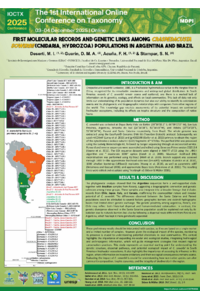
In this study, we present the first molecular records of the freshwater jellyfish Craspedacusta sowerbii (Cnidaria, Hydrozoa) for Argentina and Brazil, obtained from specimens collected at Dique Berta Vidal de Battini (San Luis Province), Ariranha do Ivaí (Paraná State), and Videira (Santa Catarina State), respectively. These results are highly relevant, as previous reports in both countries are scarce and lack genetic confirmation.
The phylogenetic analysis, based on the mitochondrial COI marker, showed that the Argentine sequences form a well-supported clade together with Brazilian samples from Paraná, suggesting a biogeographic connection and genetic cohesion among these groups. These samples also integrate into a broader lineage that includes records from Chile, Japan, Italy, and Canada, reaffirming the cosmopolitan nature and invasive potential of C. sowerbii.
The differences observed between the Santa Catarina and Paraná populations could be attributed to several factors: geographic barriers and distinct hydrographic basins that limited direct genetic exchange. The genetic proximity among Argentina, Paraná, and Chile may reflect both historical dispersal and human-mediated colonization. In contrast, the genetic divergence observed in the Santa Catarina population could be explained not only by its isolation due to naturals barriers but also by following a dispersal route different from Paraná and Argentina, which has kept it more genetically separated.
These preliminary results should be interpreted with caution, as they are based on a single marker and a limited number of samples. However, given the ecological impact of the species, monitoring its presence is crucial to understanding potential alterations in local communities. This context highlights the importance of expanding molecular and ecological studies, integrating hydrological and anthropogenic information, which will guide management strategies that respect regional conservation practices.
This study represents an essential starting point for understanding the genetic structure, dispersal pathways, and potential ecological impact of C. sowerbii in local freshwater ecosystems.
Keywords
invasive species
freshwater jellyfish
phylogenetic analysis
Poster
Deserti et al IOCTX 25 Poster.pdf
Phylogenetic relationships of a new schizorhynch genus refute the monophyly of Schizochilus Boaden, 1963 (Platyhelminthes, Rhabdocoela)
Genetic Divergence and Phylogeographic Structuring in Lethrinus (Osteichthyes: Lethrinidae): Evidence of Species Complexes and Regional Lineages