Event submissions
Published
This submission belongs to the session S3. Animal Taxonomy of the event The 1st International Online Conference on Taxonomy
Published date
01 Dec, 2025
Academic Editor
'%3e%3cpath%20d='M12.6657%2010.9104C12.4185%2010.325%2012.0599%209.79327%2011.6097%209.34482C11.1609%208.89508%2010.6293%208.5365%2010.0442%208.28888C10.0389%208.28626%2010.0337%208.28495%2010.0285%208.28233C10.8446%207.69279%2011.3752%206.73249%2011.3752%205.64904C11.3752%203.8542%209.92103%202.39999%208.1262%202.39999C6.33136%202.39999%204.87715%203.8542%204.87715%205.64904C4.87715%206.73249%205.40774%207.69279%206.22393%208.28364C6.21869%208.28626%206.21345%208.28757%206.20821%208.29019C5.62129%208.5378%205.09463%208.89284%204.64265%209.34613C4.1929%209.79493%203.83432%2010.3266%203.58671%2010.9117C3.34345%2011.4845%203.21226%2012.0987%203.20023%2012.7209C3.19988%2012.7349%203.20233%2012.7488%203.20744%2012.7619C3.21255%2012.7749%203.22022%2012.7867%203.22998%2012.7968C3.23975%2012.8068%203.25142%2012.8147%203.26431%2012.8202C3.2772%2012.8256%203.29105%2012.8284%203.30504%2012.8284H4.09109C4.14874%2012.8284%204.19459%2012.7825%204.1959%2012.7262C4.2221%2011.7148%204.62823%2010.7676%205.34617%2010.0497C6.08899%209.30683%207.0755%208.89808%208.1262%208.89808C9.17689%208.89808%2010.1634%209.30683%2010.9062%2010.0497C11.6242%2010.7676%2012.0303%2011.7148%2012.0565%2012.7262C12.0578%2012.7838%2012.1037%2012.8284%2012.1613%2012.8284H12.9474C12.9613%2012.8284%2012.9752%2012.8256%2012.9881%2012.8202C13.001%2012.8147%2013.0126%2012.8068%2013.0224%2012.7968C13.0322%2012.7867%2013.0398%2012.7749%2013.0449%2012.7619C13.0501%2012.7488%2013.0525%2012.7349%2013.0522%2012.7209C13.0391%2012.0947%2012.9094%2011.4855%2012.6657%2010.9104ZM8.1262%207.9024C7.52486%207.9024%206.9589%207.6679%206.53312%207.24211C6.10733%206.81633%205.87283%206.25037%205.87283%205.64904C5.87283%205.0477%206.10733%204.48174%206.53312%204.05596C6.9589%203.63018%207.52486%203.39567%208.1262%203.39567C8.72753%203.39567%209.29349%203.63018%209.71927%204.05596C10.1451%204.48174%2010.3796%205.0477%2010.3796%205.64904C10.3796%206.25037%2010.1451%206.81633%209.71927%207.24211C9.29349%207.6679%208.72753%207.9024%208.1262%207.9024Z'%20fill='%235D1EE1'/%3e%3c/g%3e%3c/svg%3e) Mathias Harzhauser
Mathias HarzhauserCitation
Najmul Hasan, Harij Uddin, Md. Rafiqul Islam, Md. Asir Uddin, Md Habib Ullah, Konok Roy, Erich Köck, Christoph Andrijczuk, Mohammad Abdul Wahed Chowdhury, Ibrahim Khalil Al Haidar, New country record of globally threatened Uperodon assamensis (Amphibia: Microhylidae) from Bangladesh, with an updated global distribution and taxonomic analysis, in Proceedings of The 1st International Online Conference on Taxonomy, 3 December–4 December 2025, MDPI: Basel, Switzerland
Share
Email
Facebook
Twitter
LinkedIn
New country record of globally threatened Uperodon assamensis (Amphibia: Microhylidae) from Bangladesh, with an updated global distribution and taxonomic analysis

Najmul Hasan 1,2
'%3e%3cpath%20d='M12.6647%2010.9104C12.4176%2010.325%2012.0589%209.7933%2011.6088%209.34485C11.16%208.89511%2010.6283%208.53653%2010.0432%208.28891C10.038%208.28629%2010.0327%208.28498%2010.0275%208.28236C10.8437%207.69282%2011.3743%206.73252%2011.3743%205.64907C11.3743%203.85423%209.92005%202.40002%208.12522%202.40002C6.33038%202.40002%204.87618%203.85423%204.87618%205.64907C4.87618%206.73252%205.40677%207.69282%206.22296%208.28367C6.21772%208.28629%206.21248%208.2876%206.20724%208.29022C5.62031%208.53783%205.09365%208.89287%204.64167%209.34616C4.19192%209.79496%203.83334%2010.3266%203.58573%2010.9117C3.34247%2011.4846%203.21128%2012.0987%203.19925%2012.721C3.1989%2012.735%203.20135%2012.7489%203.20646%2012.7619C3.21157%2012.7749%203.21924%2012.7868%203.22901%2012.7968C3.23877%2012.8068%203.25045%2012.8148%203.26334%2012.8202C3.27623%2012.8256%203.29007%2012.8284%203.30406%2012.8284H4.09012C4.14776%2012.8284%204.19362%2012.7825%204.19493%2012.7262C4.22113%2011.7148%204.62726%2010.7676%205.34519%2010.0497C6.08802%209.30686%207.07452%208.89811%208.12522%208.89811C9.17592%208.89811%2010.1624%209.30686%2010.9052%2010.0497C11.6232%2010.7676%2012.0293%2011.7148%2012.0555%2012.7262C12.0568%2012.7839%2012.1027%2012.8284%2012.1603%2012.8284H12.9464C12.9604%2012.8284%2012.9742%2012.8256%2012.9871%2012.8202C13%2012.8148%2013.0117%2012.8068%2013.0214%2012.7968C13.0312%2012.7868%2013.0389%2012.7749%2013.044%2012.7619C13.0491%2012.7489%2013.0515%2012.735%2013.0512%2012.721C13.0381%2012.0947%2012.9084%2011.4856%2012.6647%2010.9104ZM8.12522%207.90243C7.52388%207.90243%206.95792%207.66793%206.53214%207.24215C6.10636%206.81636%205.87185%206.2504%205.87185%205.64907C5.87185%205.04773%206.10636%204.48177%206.53214%204.05599C6.95792%203.63021%207.52388%203.3957%208.12522%203.3957C8.72655%203.3957%209.29252%203.63021%209.7183%204.05599C10.1441%204.48177%2010.3786%205.04773%2010.3786%205.64907C10.3786%206.2504%2010.1441%206.81636%209.7183%207.24215C9.29252%207.66793%208.72655%207.90243%208.12522%207.90243Z'%20fill='%235D1EE1'/%3e%3c/g%3e%3c/svg%3e)
Harij Uddin 1,2
Md. Rafiqul Islam 3
Md. Asir Uddin 3
Md Habib Ullah 2,4
Konok Roy 5
Erich Köck 6
Christoph Andrijczuk 7

Mohammad Abdul Wahed Chowdhury 2,4,8,9
Ibrahim Khalil Al Haidar 2,4,8,9
1. Eco-climate Lab, Department of Zoology, University of Chittagong, Chattogram 4331, Bangladesh, Bangladesh
2. Animal Immunization Lab, Department of Zoology, University of Chittagong, Chattogram 4331, Bangladesh
3. Venom Research Centre, Chittagong Medical College, Chattogram 4203, Bangladesh, Bangladesh
4. Department of Zoology, University of Chittagong, Chattogram 4331, Bangladesh, Bangladesh
5. Forensic Lab, Wildlife Crime Control Unit, Bangladesh Forest Department, Dhaka 1207, Bangladesh, Bangladesh
6. Independent Researcher, Quellengasse 15, 4072 Alkoven, Austria, Austria
7. Department of Surgery, Evidensia Veterinary Clinic for Small Animals, Kabels Stieg 41, 22850 Norderstedt, Germany, Germany
8. Eco-climate Lab, Department of Zoology, University of Chittagong, Chattogram 4331, Bangladesh
9. Venom Research Centre, Chittagong Medical College, Chattogram 4203, Bangladesh
Abstract
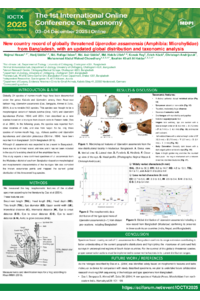
We report a new country record of Uperodon assamensis (a globally threatened species, previously considered endemic to India), with a taxonomic description, from south-central Bangladesh. The newly recorded specimen was identified by having a distinct yellowish dorsal vertebral stripe, an absent or non-visible tympanum, rounded and moderately large choanae, an absence of vomerine teeth, an oval tongue with rounded tips and papillae, and a distinct supratympanic fold that extends from the eyes' posterior corner to the supra-axillary region. The boxplot of the morphometric measurements of the type specimens from distant geo-locations reveals substantial variability in snout–vent length, head width, head depth, tibia length, and axillary–groin distance. In contrast, the eye diameter, internarial distance, eye-to-nostril distance, and eye-to-snout distance show less variability. Besides this, we compiled its known occurrence records and confirmed the current global distribution in three South Asian countries: India, Nepal, and Bangladesh. This study contributes to understanding the geographic distribution of U. assamensis and intraspecific morphological and morphometric diversity, highlighting the importance of continued field surveys in uncovering the biodiversity of underexplored regions in South Asia.
Keywords
Assamese balloon frog
geographical distribution
Microhylidae
morphology
new country record
Oral Presentation
Presentation_Uperodon_assamensis.pdf
Poster
Poster_Uperodon_assamensis.pdf
Exploring Machine Learning for Species Delimitation in the Trimerotropis pallidipennis Complex (Othoptera: Acrididae)
Catalogue of the Auchenorrhyncha of the Iberian Peninsula and Macaronesia: A Bibliographic Analysis from Linnaeus to the Present