Event submissions
Published
This submission belongs to the session S3. Animal Taxonomy of the event The 1st International Online Conference on Taxonomy
Published date
01 Dec, 2025
Academic Editor
'%3e%3cpath%20d='M12.6657%2010.9104C12.4185%2010.325%2012.0599%209.79327%2011.6097%209.34482C11.1609%208.89508%2010.6293%208.5365%2010.0442%208.28888C10.0389%208.28626%2010.0337%208.28495%2010.0285%208.28233C10.8446%207.69279%2011.3752%206.73249%2011.3752%205.64904C11.3752%203.8542%209.92103%202.39999%208.1262%202.39999C6.33136%202.39999%204.87715%203.8542%204.87715%205.64904C4.87715%206.73249%205.40774%207.69279%206.22393%208.28364C6.21869%208.28626%206.21345%208.28757%206.20821%208.29019C5.62129%208.5378%205.09463%208.89284%204.64265%209.34613C4.1929%209.79493%203.83432%2010.3266%203.58671%2010.9117C3.34345%2011.4845%203.21226%2012.0987%203.20023%2012.7209C3.19988%2012.7349%203.20233%2012.7488%203.20744%2012.7619C3.21255%2012.7749%203.22022%2012.7867%203.22998%2012.7968C3.23975%2012.8068%203.25142%2012.8147%203.26431%2012.8202C3.2772%2012.8256%203.29105%2012.8284%203.30504%2012.8284H4.09109C4.14874%2012.8284%204.19459%2012.7825%204.1959%2012.7262C4.2221%2011.7148%204.62823%2010.7676%205.34617%2010.0497C6.08899%209.30683%207.0755%208.89808%208.1262%208.89808C9.17689%208.89808%2010.1634%209.30683%2010.9062%2010.0497C11.6242%2010.7676%2012.0303%2011.7148%2012.0565%2012.7262C12.0578%2012.7838%2012.1037%2012.8284%2012.1613%2012.8284H12.9474C12.9613%2012.8284%2012.9752%2012.8256%2012.9881%2012.8202C13.001%2012.8147%2013.0126%2012.8068%2013.0224%2012.7968C13.0322%2012.7867%2013.0398%2012.7749%2013.0449%2012.7619C13.0501%2012.7488%2013.0525%2012.7349%2013.0522%2012.7209C13.0391%2012.0947%2012.9094%2011.4855%2012.6657%2010.9104ZM8.1262%207.9024C7.52486%207.9024%206.9589%207.6679%206.53312%207.24211C6.10733%206.81633%205.87283%206.25037%205.87283%205.64904C5.87283%205.0477%206.10733%204.48174%206.53312%204.05596C6.9589%203.63018%207.52486%203.39567%208.1262%203.39567C8.72753%203.39567%209.29349%203.63018%209.71927%204.05596C10.1451%204.48174%2010.3796%205.0477%2010.3796%205.64904C10.3796%206.25037%2010.1451%206.81633%209.71927%207.24211C9.29349%207.6679%208.72753%207.9024%208.1262%207.9024Z'%20fill='%235D1EE1'/%3e%3c/g%3e%3c/svg%3e) Mathias Harzhauser
Mathias HarzhauserCitation
Gabriel Augusto Saad Hatanaka, Vagner Cavarzere, Does the Brazilian disjunct population of Embernagra platensis (Aves, Thraupidae) merit taxonomic status?, in Proceedings of The 1st International Online Conference on Taxonomy, 3 December–4 December 2025, MDPI: Basel, Switzerland
Share
Email
Facebook
Twitter
LinkedIn
Does the Brazilian disjunct population of Embernagra platensis (Aves, Thraupidae) merit taxonomic status?
'%3e%3cpath%20d='M12.6647%2010.9104C12.4176%2010.325%2012.0589%209.7933%2011.6088%209.34485C11.16%208.89511%2010.6283%208.53653%2010.0432%208.28891C10.038%208.28629%2010.0327%208.28498%2010.0275%208.28236C10.8437%207.69282%2011.3743%206.73252%2011.3743%205.64907C11.3743%203.85423%209.92005%202.40002%208.12522%202.40002C6.33038%202.40002%204.87618%203.85423%204.87618%205.64907C4.87618%206.73252%205.40677%207.69282%206.22296%208.28367C6.21772%208.28629%206.21248%208.2876%206.20724%208.29022C5.62031%208.53783%205.09365%208.89287%204.64167%209.34616C4.19192%209.79496%203.83334%2010.3266%203.58573%2010.9117C3.34247%2011.4846%203.21128%2012.0987%203.19925%2012.721C3.1989%2012.735%203.20135%2012.7489%203.20646%2012.7619C3.21157%2012.7749%203.21924%2012.7868%203.22901%2012.7968C3.23877%2012.8068%203.25045%2012.8148%203.26334%2012.8202C3.27623%2012.8256%203.29007%2012.8284%203.30406%2012.8284H4.09012C4.14776%2012.8284%204.19362%2012.7825%204.19493%2012.7262C4.22113%2011.7148%204.62726%2010.7676%205.34519%2010.0497C6.08802%209.30686%207.07452%208.89811%208.12522%208.89811C9.17592%208.89811%2010.1624%209.30686%2010.9052%2010.0497C11.6232%2010.7676%2012.0293%2011.7148%2012.0555%2012.7262C12.0568%2012.7839%2012.1027%2012.8284%2012.1603%2012.8284H12.9464C12.9604%2012.8284%2012.9742%2012.8256%2012.9871%2012.8202C13%2012.8148%2013.0117%2012.8068%2013.0214%2012.7968C13.0312%2012.7868%2013.0389%2012.7749%2013.044%2012.7619C13.0491%2012.7489%2013.0515%2012.735%2013.0512%2012.721C13.0381%2012.0947%2012.9084%2011.4856%2012.6647%2010.9104ZM8.12522%207.90243C7.52388%207.90243%206.95792%207.66793%206.53214%207.24215C6.10636%206.81636%205.87185%206.2504%205.87185%205.64907C5.87185%205.04773%206.10636%204.48177%206.53214%204.05599C6.95792%203.63021%207.52388%203.3957%208.12522%203.3957C8.72655%203.3957%209.29252%203.63021%209.7183%204.05599C10.1441%204.48177%2010.3786%205.04773%2010.3786%205.64907C10.3786%206.2504%2010.1441%206.81636%209.7183%207.24215C9.29252%207.66793%208.72655%207.90243%208.12522%207.90243Z'%20fill='%235D1EE1'/%3e%3c/g%3e%3c/svg%3e)
Gabriel Augusto Saad Hatanaka 1
Vagner Cavarzere 1
1. Department of Biodiversity and Biostatistics, Institute of Biosciences, São Paulo State University, Botucatu 18618-689, Brazil, Brazil
Abstract
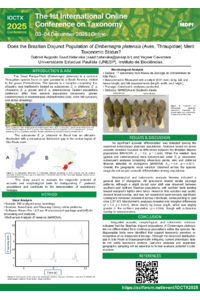
Embernagra platensis is a widely distributed South American thraupid comprising four allopatric taxa traditionally treated as subspecies, with documented morphological and vocal variation. Taxonomic boundaries within the group remain uncertain, and anecdotal reports of vocal differences among populations lack quantitative investigation. This study aimed to evaluate the diagnostic potential of acoustic traits for distinguishing E. platensis populations, with particular focus on the nominate subspecies E. p. platensis, whose range spans Uruguay, central Argentina, eastern Paraguay, and southeastern Brazil, with a conspicuous distribution gap in the central São Paulo state. We analyzed 97 recordings sourced from Xeno-Canto and the Macaulay Library, processed in Raven Pro 1.6.5. We measured morphological traits of all 17 specimens at Museu de Zoologia da Universidade de São Paulo with a caliper (0.01 mm), including wing, tail, and tarsus length, as well as bill measurements (length, width, and height). Additionally, we conducted colorimetric plumage analyses. Multivariate analysis of variance (MANOVA) was employed to test for differentiation in continuous variables among populations, supplemented by Student’s t-tests for comparisons within populations. Statistical analyses were conducted in R. The disjunct population in northeastern São Paulo, Minas Gerais, Rio de Janeiro, and Espírito Santo states—omitted from current species distribution maps—was investigated for geographic variations. Among the seven variables examined (song duration, maximum, minimum and peak frequencies, 50% and 90% bandwidths, and maximum entropy), no significant differences were detected (F1,2=0.8; p=0.568). All specimens exhibit uniform coloration across their body: the upperparts, nape, and tail are characterized by olive 2.5Y 4/4, while the underparts display pale olive 2.5Y 6/3, with no discernible differences between populations. Morphometric analyses revealed marginal differences between populations (F=5.4; p=0.011), except for tarsus length (p=0.006), which was larger for the northern population, though with overlapping values. All evidence suggests no morphological or vocal divergence between Brazilian populations.
Keywords
Bioacoustics
Great Pampa-Finch
morphology
subspecies variation.
Poster
IOCTX Poster.pdf
Morpho-anatomical taxonomic delimitation of Astragalus bruguieri and A. baba-alliar subsp. nudicarpus
Fabaceae in the Morro do Macaco Environmental Protection Area (EPA), Iporá, Goiás, Brazil