Event submissions
Published
This submission belongs to the session S3. Animal Taxonomy of the event The 1st International Online Conference on Taxonomy
Published date
01 Dec, 2025
Academic Editor
'%3e%3cpath%20d='M12.6657%2010.9104C12.4185%2010.325%2012.0599%209.79327%2011.6097%209.34482C11.1609%208.89508%2010.6293%208.5365%2010.0442%208.28888C10.0389%208.28626%2010.0337%208.28495%2010.0285%208.28233C10.8446%207.69279%2011.3752%206.73249%2011.3752%205.64904C11.3752%203.8542%209.92103%202.39999%208.1262%202.39999C6.33136%202.39999%204.87715%203.8542%204.87715%205.64904C4.87715%206.73249%205.40774%207.69279%206.22393%208.28364C6.21869%208.28626%206.21345%208.28757%206.20821%208.29019C5.62129%208.5378%205.09463%208.89284%204.64265%209.34613C4.1929%209.79493%203.83432%2010.3266%203.58671%2010.9117C3.34345%2011.4845%203.21226%2012.0987%203.20023%2012.7209C3.19988%2012.7349%203.20233%2012.7488%203.20744%2012.7619C3.21255%2012.7749%203.22022%2012.7867%203.22998%2012.7968C3.23975%2012.8068%203.25142%2012.8147%203.26431%2012.8202C3.2772%2012.8256%203.29105%2012.8284%203.30504%2012.8284H4.09109C4.14874%2012.8284%204.19459%2012.7825%204.1959%2012.7262C4.2221%2011.7148%204.62823%2010.7676%205.34617%2010.0497C6.08899%209.30683%207.0755%208.89808%208.1262%208.89808C9.17689%208.89808%2010.1634%209.30683%2010.9062%2010.0497C11.6242%2010.7676%2012.0303%2011.7148%2012.0565%2012.7262C12.0578%2012.7838%2012.1037%2012.8284%2012.1613%2012.8284H12.9474C12.9613%2012.8284%2012.9752%2012.8256%2012.9881%2012.8202C13.001%2012.8147%2013.0126%2012.8068%2013.0224%2012.7968C13.0322%2012.7867%2013.0398%2012.7749%2013.0449%2012.7619C13.0501%2012.7488%2013.0525%2012.7349%2013.0522%2012.7209C13.0391%2012.0947%2012.9094%2011.4855%2012.6657%2010.9104ZM8.1262%207.9024C7.52486%207.9024%206.9589%207.6679%206.53312%207.24211C6.10733%206.81633%205.87283%206.25037%205.87283%205.64904C5.87283%205.0477%206.10733%204.48174%206.53312%204.05596C6.9589%203.63018%207.52486%203.39567%208.1262%203.39567C8.72753%203.39567%209.29349%203.63018%209.71927%204.05596C10.1451%204.48174%2010.3796%205.0477%2010.3796%205.64904C10.3796%206.25037%2010.1451%206.81633%209.71927%207.24211C9.29349%207.6679%208.72753%207.9024%208.1262%207.9024Z'%20fill='%235D1EE1'/%3e%3c/g%3e%3c/svg%3e) Mathias Harzhauser
Mathias HarzhauserCitation
Eric Bruschi Haddad, Tatiana Moura Barroca, Fábio Vieira, The taxonomic status of Phalloceros uai (Poeciliidae: Cyprinodontiformes) in the Quadrilátero Ferrífero, Brazil, in Proceedings of The 1st International Online Conference on Taxonomy, 3 December–4 December 2025, MDPI: Basel, Switzerland
Share
Email
Facebook
Twitter
LinkedIn
The taxonomic status of Phalloceros uai (Poeciliidae: Cyprinodontiformes) in the Quadrilátero Ferrífero, Brazil
'%3e%3cpath%20d='M12.6647%2010.9104C12.4176%2010.325%2012.0589%209.7933%2011.6088%209.34485C11.16%208.89511%2010.6283%208.53653%2010.0432%208.28891C10.038%208.28629%2010.0327%208.28498%2010.0275%208.28236C10.8437%207.69282%2011.3743%206.73252%2011.3743%205.64907C11.3743%203.85423%209.92005%202.40002%208.12522%202.40002C6.33038%202.40002%204.87618%203.85423%204.87618%205.64907C4.87618%206.73252%205.40677%207.69282%206.22296%208.28367C6.21772%208.28629%206.21248%208.2876%206.20724%208.29022C5.62031%208.53783%205.09365%208.89287%204.64167%209.34616C4.19192%209.79496%203.83334%2010.3266%203.58573%2010.9117C3.34247%2011.4846%203.21128%2012.0987%203.19925%2012.721C3.1989%2012.735%203.20135%2012.7489%203.20646%2012.7619C3.21157%2012.7749%203.21924%2012.7868%203.22901%2012.7968C3.23877%2012.8068%203.25045%2012.8148%203.26334%2012.8202C3.27623%2012.8256%203.29007%2012.8284%203.30406%2012.8284H4.09012C4.14776%2012.8284%204.19362%2012.7825%204.19493%2012.7262C4.22113%2011.7148%204.62726%2010.7676%205.34519%2010.0497C6.08802%209.30686%207.07452%208.89811%208.12522%208.89811C9.17592%208.89811%2010.1624%209.30686%2010.9052%2010.0497C11.6232%2010.7676%2012.0293%2011.7148%2012.0555%2012.7262C12.0568%2012.7839%2012.1027%2012.8284%2012.1603%2012.8284H12.9464C12.9604%2012.8284%2012.9742%2012.8256%2012.9871%2012.8202C13%2012.8148%2013.0117%2012.8068%2013.0214%2012.7968C13.0312%2012.7868%2013.0389%2012.7749%2013.044%2012.7619C13.0491%2012.7489%2013.0515%2012.735%2013.0512%2012.721C13.0381%2012.0947%2012.9084%2011.4856%2012.6647%2010.9104ZM8.12522%207.90243C7.52388%207.90243%206.95792%207.66793%206.53214%207.24215C6.10636%206.81636%205.87185%206.2504%205.87185%205.64907C5.87185%205.04773%206.10636%204.48177%206.53214%204.05599C6.95792%203.63021%207.52388%203.3957%208.12522%203.3957C8.72655%203.3957%209.29252%203.63021%209.7183%204.05599C10.1441%204.48177%2010.3786%205.04773%2010.3786%205.64907C10.3786%206.2504%2010.1441%206.81636%209.7183%207.24215C9.29252%207.66793%208.72655%207.90243%208.12522%207.90243Z'%20fill='%235D1EE1'/%3e%3c/g%3e%3c/svg%3e)
Eric Bruschi Haddad 1
Tatiana Moura Barroca 2
Fábio Vieira 3
1. School of Biological Sciences, University of Louisiana at Lafayette, Lafayette, LA 70501, USA, USA
2. Development Foundation, Federal University of Minas Gerais, Belo Horizonte, MG 31270-901, Brazil, Brazil
3. Department of Zoology, Institute of Biological Sciences, Federal University of Minas Gerais, Belo Horizonte, MG 31270-901, Brazil, Brazil
Abstract
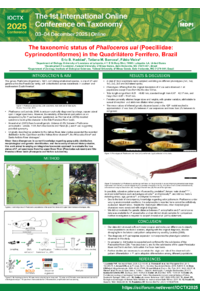
The genus Phalloceros Eigenmann, 1907 is 1 of the 27 valid and described members of the Poeciliidae family, representing 22 small-sized species distributed in South America. Among these species, Phalloceros uai Lucinda, 2008, is an endemic species to the Rio das Velhas basin, diagnosed autapomorphically by a distinctive large square lateral spot in larger specimens. However, subsequent studies have reported its occurrence in adjacent sub-basins, such as Piracicaba and Santo Antônio basins, and noted the presence of various phenotypes. Given these discrepancies in the current understanding of its geographic distribution, morphological and genetic recognition, and the paucity of natural history data, this study aimed to assess the taxonomic status of Phalloceros uai specimens from the Quadrilátero Ferrífero using an integrative taxonomic approach. Specimens were collected between 2018 and 2021 from four localities across the upper Doce and São Francisco River basins. Morphological measurements included total and standard length, height, and gonopodium length in males. Osteological structures were examined via diaphanization and compared to the holotype, and molecular analyses were conducted using the COI gene. Stomach content and gonads analyses were performed on randomly selected individuals. We identified six distinct lateral spot phenotypes, five of which were divergent from the original diagnosis. No significant differences were observed in diet, reproductive characteristics, size, or gonopodium structure among specimens of varying phenotypes, sexes, or populations. Genetic sequences showed less than 2% divergence among Phalloceros uai sequences. Females exhibited viviparity and superfetation. The species' diet primarily consisted of autochthonous animal items. In conclusion, the studied populations did not present sufficient morphological or molecular distinctions to warrant species differentiation, aligning with the diagnosis of Phalloceros uai, despite partial deviations from the large square lateral spot autapomorphy. Therefore, we recommend expanding the diagnosis of Phalloceros uai to include the phenotypic and geographic variation found in this work.
Keywords
Carnivore
Integrative taxonomy
Phenotype
Superfetation
Viviparity.
Poster
sciforum-143552.pdf
The systematics of Nemesia Vent. (Scrophulariaceae): The current status and New Insights
Apteronotus albifrons (Otophysi: Gymnotiformes): limitations of pigmentation patterns for the taxonomy of a species complex