Event submissions
Published
This submission belongs to the session S4. Plant Taxonomy of the event The 1st International Online Conference on Taxonomy
Published date
01 Dec, 2025
Academic Editor
'%3e%3cpath%20d='M12.6657%2010.9104C12.4185%2010.325%2012.0599%209.79327%2011.6097%209.34482C11.1609%208.89508%2010.6293%208.5365%2010.0442%208.28888C10.0389%208.28626%2010.0337%208.28495%2010.0285%208.28233C10.8446%207.69279%2011.3752%206.73249%2011.3752%205.64904C11.3752%203.8542%209.92103%202.39999%208.1262%202.39999C6.33136%202.39999%204.87715%203.8542%204.87715%205.64904C4.87715%206.73249%205.40774%207.69279%206.22393%208.28364C6.21869%208.28626%206.21345%208.28757%206.20821%208.29019C5.62129%208.5378%205.09463%208.89284%204.64265%209.34613C4.1929%209.79493%203.83432%2010.3266%203.58671%2010.9117C3.34345%2011.4845%203.21226%2012.0987%203.20023%2012.7209C3.19988%2012.7349%203.20233%2012.7488%203.20744%2012.7619C3.21255%2012.7749%203.22022%2012.7867%203.22998%2012.7968C3.23975%2012.8068%203.25142%2012.8147%203.26431%2012.8202C3.2772%2012.8256%203.29105%2012.8284%203.30504%2012.8284H4.09109C4.14874%2012.8284%204.19459%2012.7825%204.1959%2012.7262C4.2221%2011.7148%204.62823%2010.7676%205.34617%2010.0497C6.08899%209.30683%207.0755%208.89808%208.1262%208.89808C9.17689%208.89808%2010.1634%209.30683%2010.9062%2010.0497C11.6242%2010.7676%2012.0303%2011.7148%2012.0565%2012.7262C12.0578%2012.7838%2012.1037%2012.8284%2012.1613%2012.8284H12.9474C12.9613%2012.8284%2012.9752%2012.8256%2012.9881%2012.8202C13.001%2012.8147%2013.0126%2012.8068%2013.0224%2012.7968C13.0322%2012.7867%2013.0398%2012.7749%2013.0449%2012.7619C13.0501%2012.7488%2013.0525%2012.7349%2013.0522%2012.7209C13.0391%2012.0947%2012.9094%2011.4855%2012.6657%2010.9104ZM8.1262%207.9024C7.52486%207.9024%206.9589%207.6679%206.53312%207.24211C6.10733%206.81633%205.87283%206.25037%205.87283%205.64904C5.87283%205.0477%206.10733%204.48174%206.53312%204.05596C6.9589%203.63018%207.52486%203.39567%208.1262%203.39567C8.72753%203.39567%209.29349%203.63018%209.71927%204.05596C10.1451%204.48174%2010.3796%205.0477%2010.3796%205.64904C10.3796%206.25037%2010.1451%206.81633%209.71927%207.24211C9.29349%207.6679%208.72753%207.9024%208.1262%207.9024Z'%20fill='%235D1EE1'/%3e%3c/g%3e%3c/svg%3e) Mathias Harzhauser
Mathias HarzhauserCitation
Elham Hatami, Taxonomic remarks on genus Ramaliella (Scorzonerinae, Cichorieae, Asteraceae) considering Iranian flora, in Proceedings of The 1st International Online Conference on Taxonomy, 3 December–4 December 2025, MDPI: Basel, Switzerland
Share
Email
Facebook
Twitter
LinkedIn
Taxonomic remarks on genus Ramaliella (Scorzonerinae, Cichorieae, Asteraceae) considering Iranian flora
'%3e%3cpath%20d='M12.6647%2010.9104C12.4176%2010.325%2012.0589%209.7933%2011.6088%209.34485C11.16%208.89511%2010.6283%208.53653%2010.0432%208.28891C10.038%208.28629%2010.0327%208.28498%2010.0275%208.28236C10.8437%207.69282%2011.3743%206.73252%2011.3743%205.64907C11.3743%203.85423%209.92005%202.40002%208.12522%202.40002C6.33038%202.40002%204.87618%203.85423%204.87618%205.64907C4.87618%206.73252%205.40677%207.69282%206.22296%208.28367C6.21772%208.28629%206.21248%208.2876%206.20724%208.29022C5.62031%208.53783%205.09365%208.89287%204.64167%209.34616C4.19192%209.79496%203.83334%2010.3266%203.58573%2010.9117C3.34247%2011.4846%203.21128%2012.0987%203.19925%2012.721C3.1989%2012.735%203.20135%2012.7489%203.20646%2012.7619C3.21157%2012.7749%203.21924%2012.7868%203.22901%2012.7968C3.23877%2012.8068%203.25045%2012.8148%203.26334%2012.8202C3.27623%2012.8256%203.29007%2012.8284%203.30406%2012.8284H4.09012C4.14776%2012.8284%204.19362%2012.7825%204.19493%2012.7262C4.22113%2011.7148%204.62726%2010.7676%205.34519%2010.0497C6.08802%209.30686%207.07452%208.89811%208.12522%208.89811C9.17592%208.89811%2010.1624%209.30686%2010.9052%2010.0497C11.6232%2010.7676%2012.0293%2011.7148%2012.0555%2012.7262C12.0568%2012.7839%2012.1027%2012.8284%2012.1603%2012.8284H12.9464C12.9604%2012.8284%2012.9742%2012.8256%2012.9871%2012.8202C13%2012.8148%2013.0117%2012.8068%2013.0214%2012.7968C13.0312%2012.7868%2013.0389%2012.7749%2013.044%2012.7619C13.0491%2012.7489%2013.0515%2012.735%2013.0512%2012.721C13.0381%2012.0947%2012.9084%2011.4856%2012.6647%2010.9104ZM8.12522%207.90243C7.52388%207.90243%206.95792%207.66793%206.53214%207.24215C6.10636%206.81636%205.87185%206.2504%205.87185%205.64907C5.87185%205.04773%206.10636%204.48177%206.53214%204.05599C6.95792%203.63021%207.52388%203.3957%208.12522%203.3957C8.72655%203.3957%209.29252%203.63021%209.7183%204.05599C10.1441%204.48177%2010.3786%205.04773%2010.3786%205.64907C10.3786%206.2504%2010.1441%206.81636%209.7183%207.24215C9.29252%207.66793%208.72655%207.90243%208.12522%207.90243Z'%20fill='%235D1EE1'/%3e%3c/g%3e%3c/svg%3e)
Elham Hatami 1
1. Department of Biology, Faculty of Science, Razi University, Kermanshah, Post code: 6714414971, Iran., Iran
Abstract
Based on the recent comprehensive taxonomic reassessment of the subtribe Scorzonerinae (Cichorieae, Asteraceae) using molecular, morphological, and carpological data, the genus Scorzonera s.l. was divided into six distinct genera. Each of the species belonging to these new genera received new combination names in accordance with the international plant nomenclature rules. Ramaliella, with seven species in the world, is one of these new genera. This genus comprised the species that previously belonged to the section Intricatae of Scorzonera subg. Scorzonera. The name Ramaliella was derived from the fact that most of the species belonging to this genus have semi-shrub to cushion-like habitats, otherwise known as brushwood (rāmālia: brushwood). Morphologically, members of this genus are characterized by possessing a subshrub or cushion-like vegetative form, numerous intricately or divaricately branched stems, few numbers of filiform basal leaves, reduced and curved cauline leaves, terminal capitula with 3-12 florets, and pollen with 24 lacunae. Furthermore, previous karyological studies on this genus represented the basic chromosome number of n=7 and also demonstrated the presence of different ploidy (2n, 3n, 4n, 6n) and aneuploidy (3n-1) levels. In general, the species belonging to this genus are geographically distributed in southwest Asia, with high species richness in the eastern and southern regions of the Irano-Turanian region. Among these regions, Iran has high species diversity, including five species such as R. tortuosissima, R. microcalathia, R. intricata, R. koelopinioides, and R. longipapposa. Members of this genus are mainly found in steppes or semi-desert areas in the east and south of Iran, indicating that the species can tolerate semi-dry or dry climates. Among the species distributed in Iran, R. intricata and R. microcalathia are endemic to Iran. Moreover, R. longipapposa and R. koelpinioides are considered rare species, since only limited numbers of individuals were observed in the Khalij-Omani region in south of Iran. Moreover, to define the species delimitation in this genus, based on morphological characteristics, we distinguished between traits such as cushion- or not cushion-like life forms, the thickness of infloresence pedunle relative to the stem, the density of hairs on the stems, and the length of the capitula, achene, and pappus.
Keywords
Ramaliella
taxonomy
Iran
morphology
Poster
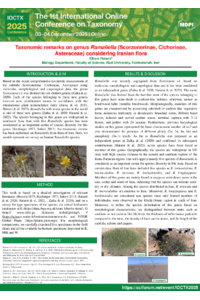
Elham-Hatami-Ramaliella-Poster-OCTX.pdf
Taxonomic Complexity and Ecological Adaptability of Lantana camara L. in India: A Morphological and Molecular Approach
A new species of Jacaratia (Caricaceae) from the Brazilian drylands, with nomenclatural notes on the South American J. corumbensis