Event submissions
Published
This submission belongs to the session S5. "Paleotaxonomy" of the event The 1st International Online Conference on Taxonomy
Published date
01 Dec, 2025
Academic Editor
'%3e%3cpath%20d='M12.6657%2010.9104C12.4185%2010.325%2012.0599%209.79327%2011.6097%209.34482C11.1609%208.89508%2010.6293%208.5365%2010.0442%208.28888C10.0389%208.28626%2010.0337%208.28495%2010.0285%208.28233C10.8446%207.69279%2011.3752%206.73249%2011.3752%205.64904C11.3752%203.8542%209.92103%202.39999%208.1262%202.39999C6.33136%202.39999%204.87715%203.8542%204.87715%205.64904C4.87715%206.73249%205.40774%207.69279%206.22393%208.28364C6.21869%208.28626%206.21345%208.28757%206.20821%208.29019C5.62129%208.5378%205.09463%208.89284%204.64265%209.34613C4.1929%209.79493%203.83432%2010.3266%203.58671%2010.9117C3.34345%2011.4845%203.21226%2012.0987%203.20023%2012.7209C3.19988%2012.7349%203.20233%2012.7488%203.20744%2012.7619C3.21255%2012.7749%203.22022%2012.7867%203.22998%2012.7968C3.23975%2012.8068%203.25142%2012.8147%203.26431%2012.8202C3.2772%2012.8256%203.29105%2012.8284%203.30504%2012.8284H4.09109C4.14874%2012.8284%204.19459%2012.7825%204.1959%2012.7262C4.2221%2011.7148%204.62823%2010.7676%205.34617%2010.0497C6.08899%209.30683%207.0755%208.89808%208.1262%208.89808C9.17689%208.89808%2010.1634%209.30683%2010.9062%2010.0497C11.6242%2010.7676%2012.0303%2011.7148%2012.0565%2012.7262C12.0578%2012.7838%2012.1037%2012.8284%2012.1613%2012.8284H12.9474C12.9613%2012.8284%2012.9752%2012.8256%2012.9881%2012.8202C13.001%2012.8147%2013.0126%2012.8068%2013.0224%2012.7968C13.0322%2012.7867%2013.0398%2012.7749%2013.0449%2012.7619C13.0501%2012.7488%2013.0525%2012.7349%2013.0522%2012.7209C13.0391%2012.0947%2012.9094%2011.4855%2012.6657%2010.9104ZM8.1262%207.9024C7.52486%207.9024%206.9589%207.6679%206.53312%207.24211C6.10733%206.81633%205.87283%206.25037%205.87283%205.64904C5.87283%205.0477%206.10733%204.48174%206.53312%204.05596C6.9589%203.63018%207.52486%203.39567%208.1262%203.39567C8.72753%203.39567%209.29349%203.63018%209.71927%204.05596C10.1451%204.48174%2010.3796%205.0477%2010.3796%205.64904C10.3796%206.25037%2010.1451%206.81633%209.71927%207.24211C9.29349%207.6679%208.72753%207.9024%208.1262%207.9024Z'%20fill='%235D1EE1'/%3e%3c/g%3e%3c/svg%3e) Davit Vasilyan
Davit VasilyanCitation
Michael Steenhuyse-Vandevelde, Robert Speijer, The morphology, phylogeny, and applications of Oligocene–Miocene Asterigerinoides (Foraminifera), in Proceedings of The 1st International Online Conference on Taxonomy, 3 December–4 December 2025, MDPI: Basel, Switzerland
Share
Email
Facebook
Twitter
LinkedIn
The morphology, phylogeny, and applications of Oligocene–Miocene Asterigerinoides (Foraminifera)
'%3e%3cpath%20d='M12.6647%2010.9104C12.4176%2010.325%2012.0589%209.7933%2011.6088%209.34485C11.16%208.89511%2010.6283%208.53653%2010.0432%208.28891C10.038%208.28629%2010.0327%208.28498%2010.0275%208.28236C10.8437%207.69282%2011.3743%206.73252%2011.3743%205.64907C11.3743%203.85423%209.92005%202.40002%208.12522%202.40002C6.33038%202.40002%204.87618%203.85423%204.87618%205.64907C4.87618%206.73252%205.40677%207.69282%206.22296%208.28367C6.21772%208.28629%206.21248%208.2876%206.20724%208.29022C5.62031%208.53783%205.09365%208.89287%204.64167%209.34616C4.19192%209.79496%203.83334%2010.3266%203.58573%2010.9117C3.34247%2011.4846%203.21128%2012.0987%203.19925%2012.721C3.1989%2012.735%203.20135%2012.7489%203.20646%2012.7619C3.21157%2012.7749%203.21924%2012.7868%203.22901%2012.7968C3.23877%2012.8068%203.25045%2012.8148%203.26334%2012.8202C3.27623%2012.8256%203.29007%2012.8284%203.30406%2012.8284H4.09012C4.14776%2012.8284%204.19362%2012.7825%204.19493%2012.7262C4.22113%2011.7148%204.62726%2010.7676%205.34519%2010.0497C6.08802%209.30686%207.07452%208.89811%208.12522%208.89811C9.17592%208.89811%2010.1624%209.30686%2010.9052%2010.0497C11.6232%2010.7676%2012.0293%2011.7148%2012.0555%2012.7262C12.0568%2012.7839%2012.1027%2012.8284%2012.1603%2012.8284H12.9464C12.9604%2012.8284%2012.9742%2012.8256%2012.9871%2012.8202C13%2012.8148%2013.0117%2012.8068%2013.0214%2012.7968C13.0312%2012.7868%2013.0389%2012.7749%2013.044%2012.7619C13.0491%2012.7489%2013.0515%2012.735%2013.0512%2012.721C13.0381%2012.0947%2012.9084%2011.4856%2012.6647%2010.9104ZM8.12522%207.90243C7.52388%207.90243%206.95792%207.66793%206.53214%207.24215C6.10636%206.81636%205.87185%206.2504%205.87185%205.64907C5.87185%205.04773%206.10636%204.48177%206.53214%204.05599C6.95792%203.63021%207.52388%203.3957%208.12522%203.3957C8.72655%203.3957%209.29252%203.63021%209.7183%204.05599C10.1441%204.48177%2010.3786%205.04773%2010.3786%205.64907C10.3786%206.2504%2010.1441%206.81636%209.7183%207.24215C9.29252%207.66793%208.72655%207.90243%208.12522%207.90243Z'%20fill='%235D1EE1'/%3e%3c/g%3e%3c/svg%3e)
Michael Steenhuyse-Vandevelde 1
Robert Speijer 1
1. Department of Earth & Environmental Sciences, KU Leuven, Celestijnenlaan 200E, Heverlee, Belgium
Abstract
Asterigerinoides guerichi guerichi (Franke 1912) is a well-known benthic foraminifer from the Chattian (upper Oligocene) of the North Sea Basin. The base of this classic Chattian is marked by an extensive bloom of A. g. guerichi, historically the ‘Asterigerina Horizon’ (recently the ‘Asterigerinoides guerichi guerichi acme event’). Despite its wide usage for stratigraphic purposes, the taxonomy and paleoecology of Asterigerinoides are quite obscure.
This study aims at identifying ecological traits, such as feeding strategies, which can elucidate the prolific abundance of A. g. guerichi during the Chattian and of A. guerichi staeschei during the Miocene, while simultaneously providing more insight into the phylogenetic relationships between A. g. guerichi, A. g. staeschei and Asterigerinoides frankei (mostly referred to as Asterigerina frankei) through literature study and comparison with collection material. We compared the morphology of A. g. guerichi, A. g. staeschei and A. frankei through optical microscopy and SEM, highlighting different features of these species. Ultimately, we also aim to create a revised taxonomy of Asterigerinoides and improve the utilization of A. g. guerichi as a stratigraphic marker.
Our observations on the morphological features of the three Asterigerinoides (sub)species, such as the equally biconvex test and teeth-like granules near the aperture, point towards a shallow marine habitat and epibenthic lifestyle with an endosymbiotic and potentially multitrophic feeding strategy. Stable isotope analyses are ongoing to evaluate these paleoecological interpretations towards paleotemperatures and possible vital effects caused by photosymbionts. The presence of keel pores, slit-like apertures surrounded by teeth-like granules and similar arrangements of secondary chambers observed in A. frankei, as well as A. g. guerichi and A. g. staeschei, led us to conclude that A. frankei is a member of the genus Asterigerinoides rather than Asterigerina. The insights presented here will improve our understanding of these species and their use as biostratigraphic markers.
Keywords
paleoecology
paleotaxonomy
morphology
phylogeny
Asterigerinoides
Chattian
Oligocene
Poster
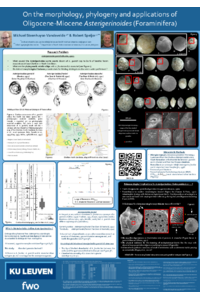
Poster_IOCTX_2025_Michael_Steenhuyse-Vandevelde.pdf
Taxonomic paleodiversity of the Marizal Formation (Aptian), Tucano Basin (NE Brazil)
The plant–insect interactions in a newly discovered Middle Miocene locality in Kos island, Greece