Event submissions
Published
This submission belongs to the session S6. Energy, Environmental and Earth Science of the event The 6th International Electronic Conference on Applied Sciences
Published date
03 Dec, 2025
Academic Editor
'%3e%3cpath%20d='M12.6657%2010.9104C12.4185%2010.325%2012.0599%209.79327%2011.6097%209.34482C11.1609%208.89508%2010.6293%208.5365%2010.0442%208.28888C10.0389%208.28626%2010.0337%208.28495%2010.0285%208.28233C10.8446%207.69279%2011.3752%206.73249%2011.3752%205.64904C11.3752%203.8542%209.92103%202.39999%208.1262%202.39999C6.33136%202.39999%204.87715%203.8542%204.87715%205.64904C4.87715%206.73249%205.40774%207.69279%206.22393%208.28364C6.21869%208.28626%206.21345%208.28757%206.20821%208.29019C5.62129%208.5378%205.09463%208.89284%204.64265%209.34613C4.1929%209.79493%203.83432%2010.3266%203.58671%2010.9117C3.34345%2011.4845%203.21226%2012.0987%203.20023%2012.7209C3.19988%2012.7349%203.20233%2012.7488%203.20744%2012.7619C3.21255%2012.7749%203.22022%2012.7867%203.22998%2012.7968C3.23975%2012.8068%203.25142%2012.8147%203.26431%2012.8202C3.2772%2012.8256%203.29105%2012.8284%203.30504%2012.8284H4.09109C4.14874%2012.8284%204.19459%2012.7825%204.1959%2012.7262C4.2221%2011.7148%204.62823%2010.7676%205.34617%2010.0497C6.08899%209.30683%207.0755%208.89808%208.1262%208.89808C9.17689%208.89808%2010.1634%209.30683%2010.9062%2010.0497C11.6242%2010.7676%2012.0303%2011.7148%2012.0565%2012.7262C12.0578%2012.7838%2012.1037%2012.8284%2012.1613%2012.8284H12.9474C12.9613%2012.8284%2012.9752%2012.8256%2012.9881%2012.8202C13.001%2012.8147%2013.0126%2012.8068%2013.0224%2012.7968C13.0322%2012.7867%2013.0398%2012.7749%2013.0449%2012.7619C13.0501%2012.7488%2013.0525%2012.7349%2013.0522%2012.7209C13.0391%2012.0947%2012.9094%2011.4855%2012.6657%2010.9104ZM8.1262%207.9024C7.52486%207.9024%206.9589%207.6679%206.53312%207.24211C6.10733%206.81633%205.87283%206.25037%205.87283%205.64904C5.87283%205.0477%206.10733%204.48174%206.53312%204.05596C6.9589%203.63018%207.52486%203.39567%208.1262%203.39567C8.72753%203.39567%209.29349%203.63018%209.71927%204.05596C10.1451%204.48174%2010.3796%205.0477%2010.3796%205.64904C10.3796%206.25037%2010.1451%206.81633%209.71927%207.24211C9.29349%207.6679%208.72753%207.9024%208.1262%207.9024Z'%20fill='%235D1EE1'/%3e%3c/g%3e%3c/svg%3e) Simeone Chianese
Simeone ChianeseCitation
Lasitha Madhusanka, Lakshan Priyankara, Isuranga Abejeewa, Rumesha Thathsarani, Helitha Nilmalgoda, Ashan Induranga, Chanaka Galpaya, Kaveenga Koswattage, Purification of Cooking Oil Waste Using Coconut Shell-Derived Activated Carbon: Reduction in Free Fatty Acids and Quality Enhancement, in Proceedings of The 6th International Electronic Conference on Applied Sciences, 9 December–11 December 2025, MDPI: Basel, Switzerland
Share
Email
Facebook
Twitter
LinkedIn
Purification of Cooking Oil Waste Using Coconut Shell-Derived Activated Carbon: Reduction in Free Fatty Acids and Quality Enhancement

Lasitha Madhusanka 1
'%3e%3cpath%20d='M12.6647%2010.9104C12.4176%2010.325%2012.0589%209.7933%2011.6088%209.34485C11.16%208.89511%2010.6283%208.53653%2010.0432%208.28891C10.038%208.28629%2010.0327%208.28498%2010.0275%208.28236C10.8437%207.69282%2011.3743%206.73252%2011.3743%205.64907C11.3743%203.85423%209.92005%202.40002%208.12522%202.40002C6.33038%202.40002%204.87618%203.85423%204.87618%205.64907C4.87618%206.73252%205.40677%207.69282%206.22296%208.28367C6.21772%208.28629%206.21248%208.2876%206.20724%208.29022C5.62031%208.53783%205.09365%208.89287%204.64167%209.34616C4.19192%209.79496%203.83334%2010.3266%203.58573%2010.9117C3.34247%2011.4846%203.21128%2012.0987%203.19925%2012.721C3.1989%2012.735%203.20135%2012.7489%203.20646%2012.7619C3.21157%2012.7749%203.21924%2012.7868%203.22901%2012.7968C3.23877%2012.8068%203.25045%2012.8148%203.26334%2012.8202C3.27623%2012.8256%203.29007%2012.8284%203.30406%2012.8284H4.09012C4.14776%2012.8284%204.19362%2012.7825%204.19493%2012.7262C4.22113%2011.7148%204.62726%2010.7676%205.34519%2010.0497C6.08802%209.30686%207.07452%208.89811%208.12522%208.89811C9.17592%208.89811%2010.1624%209.30686%2010.9052%2010.0497C11.6232%2010.7676%2012.0293%2011.7148%2012.0555%2012.7262C12.0568%2012.7839%2012.1027%2012.8284%2012.1603%2012.8284H12.9464C12.9604%2012.8284%2012.9742%2012.8256%2012.9871%2012.8202C13%2012.8148%2013.0117%2012.8068%2013.0214%2012.7968C13.0312%2012.7868%2013.0389%2012.7749%2013.044%2012.7619C13.0491%2012.7489%2013.0515%2012.735%2013.0512%2012.721C13.0381%2012.0947%2012.9084%2011.4856%2012.6647%2010.9104ZM8.12522%207.90243C7.52388%207.90243%206.95792%207.66793%206.53214%207.24215C6.10636%206.81636%205.87185%206.2504%205.87185%205.64907C5.87185%205.04773%206.10636%204.48177%206.53214%204.05599C6.95792%203.63021%207.52388%203.3957%208.12522%203.3957C8.72655%203.3957%209.29252%203.63021%209.7183%204.05599C10.1441%204.48177%2010.3786%205.04773%2010.3786%205.64907C10.3786%206.2504%2010.1441%206.81636%209.7183%207.24215C9.29252%207.66793%208.72655%207.90243%208.12522%207.90243Z'%20fill='%235D1EE1'/%3e%3c/g%3e%3c/svg%3e)
Lakshan Priyankara 1
Isuranga Abejeewa 1
Rumesha Thathsarani 2

Helitha Nilmalgoda 2
Ashan Induranga 1
Chanaka Galpaya 1
Kaveenga Koswattage 3
1. Center for Nanodevice Fabrication and Characterization,Faculty of Technology,Sabaragamuwa University of Sri Lanka,Belihuloya 70140,Sri Lanka, Sri Lanka
2. Department of Biosystems Technology,Faculty of Technology,Sabaragamuwa University of Sri Lanka,Belihuloya 70140,Sri Lanka, Sri Lanka
3. Department of Engineering Technology,Faculty of Technology,Sabaragamuwa University of Sri Lanka,Belihuloya 70140,Sri Lanka, Sri Lanka
Abstract
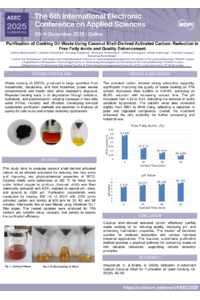
Cooking oil waste is a common by-product from households, restaurants, and food industries, and its improper disposal can cause severe environmental pollution. Repeated use of cooking oil leads to chemical degradation through oxidation, hydrolysis, and polymerization, resulting in darkening, off-odors, elevated free fatty acids (FFAs), and increased peroxide values, posing potential health and environmental risks. This study aimed to investigate the purification efficiency of coconut shell-derived activated carbon in reducing free fatty acid contents and improving oil quality parameters, including pH, calorific value, viscosity, and density. Activated carbon was produced by carbonizing coconut shells at 450 °C for 3 hours under limited oxygen using a lab-scale pyrolysis reactor. The resulting charcoal was then chemically activated with KOH, washed to a neutral pH, dried, and ground to ≤250 µm. Adsorption experiments were performed by adding 2.5% (w/w) activated carbon to 450 ml of cooking oil waste and stirring at 600 rpm for contact times of 30, 60, and 90 minutes. The treated oil was filtered using Whatman No. 1 filter paper (110mm diameter) and analyzed for FFA, pH, calorific value, viscosity, and density. Our results showed that the FFA content decreased significantly from 0.286% to 0.049% (82.9% reduction) with increasing contact time, while the pH improved from 4.62 to 5.91, indicating effective removal of acidic degradation products. The calorific value increased slightly from 8981 to 9019 Cal/g, suggesting removal of oxidized and polar compounds. The purified waste cooking oil, with reduced acidity and improved pH, is suitable for biodiesel production and non-food industrial applications, demonstrating potential for circular economy implementation.
Keywords
Waste cooking oil
Coconut shell activated carbon
Free fatty acids
Purification
Circular economy
Poster
POSTER NEW.pdf
Linking Wastewater Treatment Performance to River Ecosystem Health: insights from the Atlantis WWTW (Wesfleur) in Western Cape
Unsteady-state thermal analysis of insulated slab-on-ground foundations: impact of edge insulation on ground temperature distribution