Event submissions
Published
This submission belongs to the session S2. Nanosciences, Chemistry and Materials Science of the event The 6th International Electronic Conference on Applied Sciences
Published date
03 Dec, 2025
Academic Editor
'%3e%3cpath%20d='M12.6657%2010.9104C12.4185%2010.325%2012.0599%209.79327%2011.6097%209.34482C11.1609%208.89508%2010.6293%208.5365%2010.0442%208.28888C10.0389%208.28626%2010.0337%208.28495%2010.0285%208.28233C10.8446%207.69279%2011.3752%206.73249%2011.3752%205.64904C11.3752%203.8542%209.92103%202.39999%208.1262%202.39999C6.33136%202.39999%204.87715%203.8542%204.87715%205.64904C4.87715%206.73249%205.40774%207.69279%206.22393%208.28364C6.21869%208.28626%206.21345%208.28757%206.20821%208.29019C5.62129%208.5378%205.09463%208.89284%204.64265%209.34613C4.1929%209.79493%203.83432%2010.3266%203.58671%2010.9117C3.34345%2011.4845%203.21226%2012.0987%203.20023%2012.7209C3.19988%2012.7349%203.20233%2012.7488%203.20744%2012.7619C3.21255%2012.7749%203.22022%2012.7867%203.22998%2012.7968C3.23975%2012.8068%203.25142%2012.8147%203.26431%2012.8202C3.2772%2012.8256%203.29105%2012.8284%203.30504%2012.8284H4.09109C4.14874%2012.8284%204.19459%2012.7825%204.1959%2012.7262C4.2221%2011.7148%204.62823%2010.7676%205.34617%2010.0497C6.08899%209.30683%207.0755%208.89808%208.1262%208.89808C9.17689%208.89808%2010.1634%209.30683%2010.9062%2010.0497C11.6242%2010.7676%2012.0303%2011.7148%2012.0565%2012.7262C12.0578%2012.7838%2012.1037%2012.8284%2012.1613%2012.8284H12.9474C12.9613%2012.8284%2012.9752%2012.8256%2012.9881%2012.8202C13.001%2012.8147%2013.0126%2012.8068%2013.0224%2012.7968C13.0322%2012.7867%2013.0398%2012.7749%2013.0449%2012.7619C13.0501%2012.7488%2013.0525%2012.7349%2013.0522%2012.7209C13.0391%2012.0947%2012.9094%2011.4855%2012.6657%2010.9104ZM8.1262%207.9024C7.52486%207.9024%206.9589%207.6679%206.53312%207.24211C6.10733%206.81633%205.87283%206.25037%205.87283%205.64904C5.87283%205.0477%206.10733%204.48174%206.53312%204.05596C6.9589%203.63018%207.52486%203.39567%208.1262%203.39567C8.72753%203.39567%209.29349%203.63018%209.71927%204.05596C10.1451%204.48174%2010.3796%205.0477%2010.3796%205.64904C10.3796%206.25037%2010.1451%206.81633%209.71927%207.24211C9.29349%207.6679%208.72753%207.9024%208.1262%207.9024Z'%20fill='%235D1EE1'/%3e%3c/g%3e%3c/svg%3e) Alberto Jiménez Suárez
Alberto Jiménez SuárezCitation
Pavlo V. Zadorozhnii, Yelyzaveta R. Lomynoha, Pavlo V. Romanenko, Vadym V. Kiselev, Oxana V. Okhtina, Aleksandr V. Kharchenko, Synthesis, spectral characteristics, and molecular structure of N-(2,2,2-trichloro-1-((4-phenylthiazol-2-yl)amino)ethyl)carboxamides, in Proceedings of The 6th International Electronic Conference on Applied Sciences, 9 December–11 December 2025, MDPI: Basel, Switzerland
Share
Email
Facebook
Twitter
LinkedIn
Synthesis, spectral characteristics, and molecular structure of N-(2,2,2-trichloro-1-((4-phenylthiazol-2-yl)amino)ethyl)carboxamides
'%3e%3cpath%20d='M12.6647%2010.9104C12.4176%2010.325%2012.0589%209.7933%2011.6088%209.34485C11.16%208.89511%2010.6283%208.53653%2010.0432%208.28891C10.038%208.28629%2010.0327%208.28498%2010.0275%208.28236C10.8437%207.69282%2011.3743%206.73252%2011.3743%205.64907C11.3743%203.85423%209.92005%202.40002%208.12522%202.40002C6.33038%202.40002%204.87618%203.85423%204.87618%205.64907C4.87618%206.73252%205.40677%207.69282%206.22296%208.28367C6.21772%208.28629%206.21248%208.2876%206.20724%208.29022C5.62031%208.53783%205.09365%208.89287%204.64167%209.34616C4.19192%209.79496%203.83334%2010.3266%203.58573%2010.9117C3.34247%2011.4846%203.21128%2012.0987%203.19925%2012.721C3.1989%2012.735%203.20135%2012.7489%203.20646%2012.7619C3.21157%2012.7749%203.21924%2012.7868%203.22901%2012.7968C3.23877%2012.8068%203.25045%2012.8148%203.26334%2012.8202C3.27623%2012.8256%203.29007%2012.8284%203.30406%2012.8284H4.09012C4.14776%2012.8284%204.19362%2012.7825%204.19493%2012.7262C4.22113%2011.7148%204.62726%2010.7676%205.34519%2010.0497C6.08802%209.30686%207.07452%208.89811%208.12522%208.89811C9.17592%208.89811%2010.1624%209.30686%2010.9052%2010.0497C11.6232%2010.7676%2012.0293%2011.7148%2012.0555%2012.7262C12.0568%2012.7839%2012.1027%2012.8284%2012.1603%2012.8284H12.9464C12.9604%2012.8284%2012.9742%2012.8256%2012.9871%2012.8202C13%2012.8148%2013.0117%2012.8068%2013.0214%2012.7968C13.0312%2012.7868%2013.0389%2012.7749%2013.044%2012.7619C13.0491%2012.7489%2013.0515%2012.735%2013.0512%2012.721C13.0381%2012.0947%2012.9084%2011.4856%2012.6647%2010.9104ZM8.12522%207.90243C7.52388%207.90243%206.95792%207.66793%206.53214%207.24215C6.10636%206.81636%205.87185%206.2504%205.87185%205.64907C5.87185%205.04773%206.10636%204.48177%206.53214%204.05599C6.95792%203.63021%207.52388%203.3957%208.12522%203.3957C8.72655%203.3957%209.29252%203.63021%209.7183%204.05599C10.1441%204.48177%2010.3786%205.04773%2010.3786%205.64907C10.3786%206.2504%2010.1441%206.81636%209.7183%207.24215C9.29252%207.66793%208.72655%207.90243%208.12522%207.90243Z'%20fill='%235D1EE1'/%3e%3c/g%3e%3c/svg%3e)
Yelyzaveta R. Lomynoha 1
Pavlo V. Zadorozhnii 1
Pavlo V. Romanenko 1
Vadym V. Kiselev 1
Oxana V. Okhtina 1
Aleksandr V. Kharchenko 1
1. Department of Pharmacy, Chemistry and Technologies, Ukrainian State University of Science and Technologies, Lazariana St., 2, Dnipro, 49010, Ukraine, Ukraine
Abstract
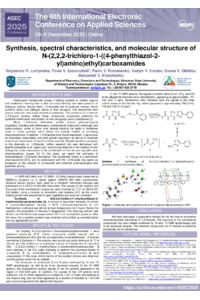
1,3-Thiazole derivatives are of considerable interest in pharmacy, medicine, and agriculture as potential biologically active compounds. In this work, we report for the first time a convenient and efficient method for the synthesis of N-amidoalkylated derivatives of 2-amino-1,3-thiazole. The starting N-(2,2,2-trichloro-1-thioureidoethyl)carboxamides readily react with α-bromoacetophenone in ethanol at 20 °C in the presence of equimolar triethylamine, which serves to neutralize the released hydrogen bromide. Under these conditions, the desired N-amidoalkylated 1,3-thiazole derivatives were obtained in 68–75 % yields. Attempts to perform the counter-synthesis by direct amidoalkylation of 4-phenylthiazol-2-amine resulted in severe tarring of the reaction mass and did not lead to product isolation. The structures of the synthesized compounds were confirmed by ¹H and ¹³C NMR spectroscopy. In the ¹H NMR spectra, two characteristic doublet signals of the NH protons were observed at 9.25–8.39 ppm, while the CH signals of the thiazole and alkylamide fragments appeared at 7.24–7.19 ppm and 7.03–6.84 ppm, respectively. The ¹³C NMR spectra exhibited diagnostic signals of C=O (≈167 ppm), CCl₃ (≈102 ppm), and CH (≈71 ppm) carbons, as well as three thiazole carbon signals at ≈166, 149, and 103 ppm. The structure of compound 3a was unambiguously confirmed by single-crystal X-ray diffraction analysis, which revealed its nearly coplanar molecular geometry and a hydrogen-bonded chain motif along the [001] direction, stabilized by bifurcated N–H…O interactions.
Keywords
1,3-thiazole
thiourea
molecular structure
synthesis
Oral Presentation
Zadorozhnii_Poster.pptx
Poster
Zadorozhnii_Poster.pdf
Optimization of Ultrasound-Assisted Solvothermal Synthesis of N-doped Carbon Dots derived from Water Hyacinth (Pontederia crassipes) for Carbon Monoxide Sensing
Molecular Dynamics of Water Desalination Through Sub‑Nanometer Graphene Nanopores