Event submissions
Published
This submission belongs to the session S6. Energy, Environmental and Earth Science of the event The 6th International Electronic Conference on Applied Sciences
Published date
03 Dec, 2025
Academic Editor
'%3e%3cpath%20d='M12.6657%2010.9104C12.4185%2010.325%2012.0599%209.79327%2011.6097%209.34482C11.1609%208.89508%2010.6293%208.5365%2010.0442%208.28888C10.0389%208.28626%2010.0337%208.28495%2010.0285%208.28233C10.8446%207.69279%2011.3752%206.73249%2011.3752%205.64904C11.3752%203.8542%209.92103%202.39999%208.1262%202.39999C6.33136%202.39999%204.87715%203.8542%204.87715%205.64904C4.87715%206.73249%205.40774%207.69279%206.22393%208.28364C6.21869%208.28626%206.21345%208.28757%206.20821%208.29019C5.62129%208.5378%205.09463%208.89284%204.64265%209.34613C4.1929%209.79493%203.83432%2010.3266%203.58671%2010.9117C3.34345%2011.4845%203.21226%2012.0987%203.20023%2012.7209C3.19988%2012.7349%203.20233%2012.7488%203.20744%2012.7619C3.21255%2012.7749%203.22022%2012.7867%203.22998%2012.7968C3.23975%2012.8068%203.25142%2012.8147%203.26431%2012.8202C3.2772%2012.8256%203.29105%2012.8284%203.30504%2012.8284H4.09109C4.14874%2012.8284%204.19459%2012.7825%204.1959%2012.7262C4.2221%2011.7148%204.62823%2010.7676%205.34617%2010.0497C6.08899%209.30683%207.0755%208.89808%208.1262%208.89808C9.17689%208.89808%2010.1634%209.30683%2010.9062%2010.0497C11.6242%2010.7676%2012.0303%2011.7148%2012.0565%2012.7262C12.0578%2012.7838%2012.1037%2012.8284%2012.1613%2012.8284H12.9474C12.9613%2012.8284%2012.9752%2012.8256%2012.9881%2012.8202C13.001%2012.8147%2013.0126%2012.8068%2013.0224%2012.7968C13.0322%2012.7867%2013.0398%2012.7749%2013.0449%2012.7619C13.0501%2012.7488%2013.0525%2012.7349%2013.0522%2012.7209C13.0391%2012.0947%2012.9094%2011.4855%2012.6657%2010.9104ZM8.1262%207.9024C7.52486%207.9024%206.9589%207.6679%206.53312%207.24211C6.10733%206.81633%205.87283%206.25037%205.87283%205.64904C5.87283%205.0477%206.10733%204.48174%206.53312%204.05596C6.9589%203.63018%207.52486%203.39567%208.1262%203.39567C8.72753%203.39567%209.29349%203.63018%209.71927%204.05596C10.1451%204.48174%2010.3796%205.0477%2010.3796%205.64904C10.3796%206.25037%2010.1451%206.81633%209.71927%207.24211C9.29349%207.6679%208.72753%207.9024%208.1262%207.9024Z'%20fill='%235D1EE1'/%3e%3c/g%3e%3c/svg%3e) Simeone Chianese
Simeone ChianeseCitation
Yusuf Kepir, Holger Seidlitz, Lars Ulke-Winter, Felix Kuke, Geometric Optimization and Advanced Material Integration for Enhanced Thermal Performance of Compact Cross-Flow Heat Exchangers in High-Temperature Applications, in Proceedings of The 6th International Electronic Conference on Applied Sciences, 9 December–11 December 2025, MDPI: Basel, Switzerland
Share
Email
Facebook
Twitter
LinkedIn
Geometric Optimization and Advanced Material Integration for Enhanced Thermal Performance of Compact Cross-Flow Heat Exchangers in High-Temperature Applications

Yusuf Kepir 1
'%3e%3cpath%20d='M12.6647%2010.9104C12.4176%2010.325%2012.0589%209.7933%2011.6088%209.34485C11.16%208.89511%2010.6283%208.53653%2010.0432%208.28891C10.038%208.28629%2010.0327%208.28498%2010.0275%208.28236C10.8437%207.69282%2011.3743%206.73252%2011.3743%205.64907C11.3743%203.85423%209.92005%202.40002%208.12522%202.40002C6.33038%202.40002%204.87618%203.85423%204.87618%205.64907C4.87618%206.73252%205.40677%207.69282%206.22296%208.28367C6.21772%208.28629%206.21248%208.2876%206.20724%208.29022C5.62031%208.53783%205.09365%208.89287%204.64167%209.34616C4.19192%209.79496%203.83334%2010.3266%203.58573%2010.9117C3.34247%2011.4846%203.21128%2012.0987%203.19925%2012.721C3.1989%2012.735%203.20135%2012.7489%203.20646%2012.7619C3.21157%2012.7749%203.21924%2012.7868%203.22901%2012.7968C3.23877%2012.8068%203.25045%2012.8148%203.26334%2012.8202C3.27623%2012.8256%203.29007%2012.8284%203.30406%2012.8284H4.09012C4.14776%2012.8284%204.19362%2012.7825%204.19493%2012.7262C4.22113%2011.7148%204.62726%2010.7676%205.34519%2010.0497C6.08802%209.30686%207.07452%208.89811%208.12522%208.89811C9.17592%208.89811%2010.1624%209.30686%2010.9052%2010.0497C11.6232%2010.7676%2012.0293%2011.7148%2012.0555%2012.7262C12.0568%2012.7839%2012.1027%2012.8284%2012.1603%2012.8284H12.9464C12.9604%2012.8284%2012.9742%2012.8256%2012.9871%2012.8202C13%2012.8148%2013.0117%2012.8068%2013.0214%2012.7968C13.0312%2012.7868%2013.0389%2012.7749%2013.044%2012.7619C13.0491%2012.7489%2013.0515%2012.735%2013.0512%2012.721C13.0381%2012.0947%2012.9084%2011.4856%2012.6647%2010.9104ZM8.12522%207.90243C7.52388%207.90243%206.95792%207.66793%206.53214%207.24215C6.10636%206.81636%205.87185%206.2504%205.87185%205.64907C5.87185%205.04773%206.10636%204.48177%206.53214%204.05599C6.95792%203.63021%207.52388%203.3957%208.12522%203.3957C8.72655%203.3957%209.29252%203.63021%209.7183%204.05599C10.1441%204.48177%2010.3786%205.04773%2010.3786%205.64907C10.3786%206.2504%2010.1441%206.81636%209.7183%207.24215C9.29252%207.66793%208.72655%207.90243%208.12522%207.90243Z'%20fill='%235D1EE1'/%3e%3c/g%3e%3c/svg%3e)
Holger Seidlitz 1
Lars Ulke-Winter 1
Felix Kuke 1,2
1. Chair of Polymer‑based Lightweight Design, Brandenburg University of Technology Cottbus–Senftenberg (BTU), Cottbus, Germany
2. Research Division Polymeric Materials and Composites PYCO, Fraunhofer Institute for Applied Polymer Research IAP, Wildau, Germany
Abstract
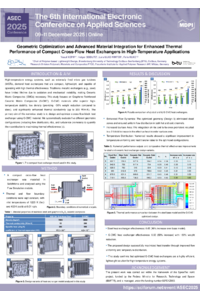
Introduction: Heat exchangers used in high-temperature environments require lightweight designs with high thermal resistance and efficiency. This study numerically investigates the thermal performance of a multi-channel compact cross-flow heat exchanger, focusing on geometric configurations and material selection.
Methods: Simulations were performed under steady-state conditions to reflect the operating conditions in typical micro gas turbine recuperators. The model featured a total mass flow rate of 0.01 kg/s, with hot air at 1223 K and cold air at 453 K. Five geometric configurations (baseline, conical flow diffuser, ramped ribs, semi-circular bumps, and turbulence promoters) and two materials (stainless steel and graphene-reinforced alumina ceramic composite) were compared.
Results: The implementation of these designs resulted in a 30.8% increase in efficiency for steel heat exchangers and a 33.4% increase for ceramic composite heat exchangers. A material change from steel to ceramic in the baseline geometry yielded an 11.3% effectiveness increase. However, geometric enhancements proved more impactful, with effectiveness increasing exponentially for both materials from baseline to the most complex geometry. This highlights geometric optimization as the primary driver of performance gains. Additionally, the ceramic material's 50% lighter weight offers advantages in weight-constrained applications.
Conclusion: These findings confirm that significant performance improvements in compact heat exchangers are achievable through geometric optimization and advanced materials. Geometric augmentations substantially boosted thermal effectiveness, with gains predominantly linked to geometric optimization. This study suggests that optimized flow channels and integrated internal features, facilitated by additive manufacturing, will be crucial for future high-performance heat exchanger designs.
Keywords
Compact heat exchanger
Geometric optimization
Thermal performance
Turbulence promoters
Lightweight design
Poster
ASEC_2025_Poster.pdf
Phosphorus-Tuned Co-P Alloy Coatings for High-Performance Water Splitting and Hydrogen Production
Improved Retrieval and Forecast of Surface Air Quality based on Source Analysis, Numerical Modeling and Hybrid Statistical Dynamic Model