Event submissions
Published
This submission belongs to the session S2. Nanosciences, Chemistry and Materials Science of the event The 6th International Electronic Conference on Applied Sciences
Published date
03 Dec, 2025
Academic Editor
'%3e%3cpath%20d='M12.6657%2010.9104C12.4185%2010.325%2012.0599%209.79327%2011.6097%209.34482C11.1609%208.89508%2010.6293%208.5365%2010.0442%208.28888C10.0389%208.28626%2010.0337%208.28495%2010.0285%208.28233C10.8446%207.69279%2011.3752%206.73249%2011.3752%205.64904C11.3752%203.8542%209.92103%202.39999%208.1262%202.39999C6.33136%202.39999%204.87715%203.8542%204.87715%205.64904C4.87715%206.73249%205.40774%207.69279%206.22393%208.28364C6.21869%208.28626%206.21345%208.28757%206.20821%208.29019C5.62129%208.5378%205.09463%208.89284%204.64265%209.34613C4.1929%209.79493%203.83432%2010.3266%203.58671%2010.9117C3.34345%2011.4845%203.21226%2012.0987%203.20023%2012.7209C3.19988%2012.7349%203.20233%2012.7488%203.20744%2012.7619C3.21255%2012.7749%203.22022%2012.7867%203.22998%2012.7968C3.23975%2012.8068%203.25142%2012.8147%203.26431%2012.8202C3.2772%2012.8256%203.29105%2012.8284%203.30504%2012.8284H4.09109C4.14874%2012.8284%204.19459%2012.7825%204.1959%2012.7262C4.2221%2011.7148%204.62823%2010.7676%205.34617%2010.0497C6.08899%209.30683%207.0755%208.89808%208.1262%208.89808C9.17689%208.89808%2010.1634%209.30683%2010.9062%2010.0497C11.6242%2010.7676%2012.0303%2011.7148%2012.0565%2012.7262C12.0578%2012.7838%2012.1037%2012.8284%2012.1613%2012.8284H12.9474C12.9613%2012.8284%2012.9752%2012.8256%2012.9881%2012.8202C13.001%2012.8147%2013.0126%2012.8068%2013.0224%2012.7968C13.0322%2012.7867%2013.0398%2012.7749%2013.0449%2012.7619C13.0501%2012.7488%2013.0525%2012.7349%2013.0522%2012.7209C13.0391%2012.0947%2012.9094%2011.4855%2012.6657%2010.9104ZM8.1262%207.9024C7.52486%207.9024%206.9589%207.6679%206.53312%207.24211C6.10733%206.81633%205.87283%206.25037%205.87283%205.64904C5.87283%205.0477%206.10733%204.48174%206.53312%204.05596C6.9589%203.63018%207.52486%203.39567%208.1262%203.39567C8.72753%203.39567%209.29349%203.63018%209.71927%204.05596C10.1451%204.48174%2010.3796%205.0477%2010.3796%205.64904C10.3796%206.25037%2010.1451%206.81633%209.71927%207.24211C9.29349%207.6679%208.72753%207.9024%208.1262%207.9024Z'%20fill='%235D1EE1'/%3e%3c/g%3e%3c/svg%3e) Mimimorena Seggio
Mimimorena SeggioCitation
Antonio Peña-Fernández, Hazem Matar, Robert P. Chilcott, Borja Martínez-Alonso, Victor Guarnizo, Antonio Juberías, María de los Ángeles Peña, Norma S. Torres, Guillermo Torrado, Development and validation of a novel detergent formulation for dermal decontamination: from phorate screening to VX efficacy testing, in Proceedings of The 6th International Electronic Conference on Applied Sciences, 9 December–11 December 2025, MDPI: Basel, Switzerland
Share
Email
Facebook
Twitter
LinkedIn
Development and validation of a novel detergent formulation for dermal decontamination: from phorate screening to VX efficacy testing

Antonio Peña-Fernández 1
'%3e%3cpath%20d='M12.6647%2010.9104C12.4176%2010.325%2012.0589%209.7933%2011.6088%209.34485C11.16%208.89511%2010.6283%208.53653%2010.0432%208.28891C10.038%208.28629%2010.0327%208.28498%2010.0275%208.28236C10.8437%207.69282%2011.3743%206.73252%2011.3743%205.64907C11.3743%203.85423%209.92005%202.40002%208.12522%202.40002C6.33038%202.40002%204.87618%203.85423%204.87618%205.64907C4.87618%206.73252%205.40677%207.69282%206.22296%208.28367C6.21772%208.28629%206.21248%208.2876%206.20724%208.29022C5.62031%208.53783%205.09365%208.89287%204.64167%209.34616C4.19192%209.79496%203.83334%2010.3266%203.58573%2010.9117C3.34247%2011.4846%203.21128%2012.0987%203.19925%2012.721C3.1989%2012.735%203.20135%2012.7489%203.20646%2012.7619C3.21157%2012.7749%203.21924%2012.7868%203.22901%2012.7968C3.23877%2012.8068%203.25045%2012.8148%203.26334%2012.8202C3.27623%2012.8256%203.29007%2012.8284%203.30406%2012.8284H4.09012C4.14776%2012.8284%204.19362%2012.7825%204.19493%2012.7262C4.22113%2011.7148%204.62726%2010.7676%205.34519%2010.0497C6.08802%209.30686%207.07452%208.89811%208.12522%208.89811C9.17592%208.89811%2010.1624%209.30686%2010.9052%2010.0497C11.6232%2010.7676%2012.0293%2011.7148%2012.0555%2012.7262C12.0568%2012.7839%2012.1027%2012.8284%2012.1603%2012.8284H12.9464C12.9604%2012.8284%2012.9742%2012.8256%2012.9871%2012.8202C13%2012.8148%2013.0117%2012.8068%2013.0214%2012.7968C13.0312%2012.7868%2013.0389%2012.7749%2013.044%2012.7619C13.0491%2012.7489%2013.0515%2012.735%2013.0512%2012.721C13.0381%2012.0947%2012.9084%2011.4856%2012.6647%2010.9104ZM8.12522%207.90243C7.52388%207.90243%206.95792%207.66793%206.53214%207.24215C6.10636%206.81636%205.87185%206.2504%205.87185%205.64907C5.87185%205.04773%206.10636%204.48177%206.53214%204.05599C6.95792%203.63021%207.52388%203.3957%208.12522%203.3957C8.72655%203.3957%209.29252%203.63021%209.7183%204.05599C10.1441%204.48177%2010.3786%205.04773%2010.3786%205.64907C10.3786%206.2504%2010.1441%206.81636%209.7183%207.24215C9.29252%207.66793%208.72655%207.90243%208.12522%207.90243Z'%20fill='%235D1EE1'/%3e%3c/g%3e%3c/svg%3e)
Hazem Matar 2
Robert P. Chilcott 3
Borja Martínez-Alonso 4
Victor Guarnizo 4
Antonio Juberías 5

María de los Ángeles Peña 4
Norma S. Torres 4
Guillermo Torrado 4
1. Department of Surgery, Medical and Social Sciences, Faculty of Medicine and Health Sciences, University of Alcalá, Ctra. Madrid-Barcelona, Km. 33.600, 28871 Alcalá de Henares, Madrid, Spain., Spain
2. Ereuna Ltd., Porton Science Park, Bybrook road, Porton Down, SP4 0BF Wiltshire, UK, UK
3. Research Centre for Topical Drug Delivery and Toxicology, University of Hertfordshire, Hatfield AL10 9AB, UK, UK
4. Departamento de Ciencias Biomédicas, Universidad de Alcalá, Crta. Madrid-Barcelona Km, 33.6, 28871 Alcalá de Henares, Madrid, Spain, Spain
5. Centro Militar de Farmacia de la Defensa. Carretera M-609 de Miraflores, Km 34, Colmenar Viejo, 28770 Madrid, Spain, Spain
Abstract
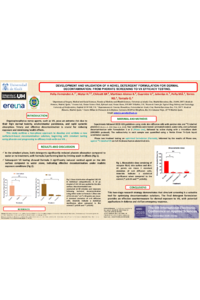
Organophosphorus nerve agents, such as VX, pose an extreme risk due to their high dermal toxicity, environmental persistence, and rapid systemic absorption. Timely and effective decontamination is crucial for reducing exposure and minimizing health effects. This study outlines a two-phase approach to develop and validate a new surfactant-based decontamination solution, beginning with simulant testing using phorate and progressing to efficacy trials with real VX. In phase one, phorate was used as a simulant for VX in dermal exposure studies. Two prototype detergents (F1 and F2) were tested on full-thickness porcine skin using static Franz-type diffusion cells. A ¹⁴C-labelled phorate droplet was applied, followed by no treatment, water-only rinse, or detergent application using the ORCHIDS microfibre protocol. Absorption was measured via liquid scintillation counting. Phase two involved testing an optimized formulation (Formula 3), informed by the results of Phase one, against ¹⁴C-labelled VX on full-thickness human abdominal skin. Decontamination occurred 60 minutes post-application, comparing water-only and detergent treatment. Autoradiography and scintillation counting were used to quantify residual agent. In the simulant phase, both detergents significantly reduced phorate absorption compared to water or no treatment, with Formula 2 performing best by limiting wash-in effects. Subsequent VX testing showed Formula 3 significantly reduced residual agent on the skin surface compared to water alone, indicating effective decontamination under realistic exposure conditions. This two-stage research strategy demonstrates that simulant screening is a valuable tool for optimizing decontamination solutions. The final detergent formulation provides an effective countermeasure for dermal exposure to VX, with potential applications in defense and civilian emergency response.
Keywords
VX
phorate
dermal decontamination
surfactant formulation
human skin model
emergency preparedness
Poster
ASEC 2025_Vx poster_APF.pdf
Modular and Container-Based Construction: Global Trends, Polish Experiences, and Future Prospects
GENERALIZED EXTREME VALUE-BASED FRAGILITY CURVES