Event submissions
Published
This submission belongs to the session S2. Nanosciences, Chemistry and Materials Science of the event The 6th International Electronic Conference on Applied Sciences
Published date
03 Dec, 2025
Academic Editor
'%3e%3cpath%20d='M12.6657%2010.9104C12.4185%2010.325%2012.0599%209.79327%2011.6097%209.34482C11.1609%208.89508%2010.6293%208.5365%2010.0442%208.28888C10.0389%208.28626%2010.0337%208.28495%2010.0285%208.28233C10.8446%207.69279%2011.3752%206.73249%2011.3752%205.64904C11.3752%203.8542%209.92103%202.39999%208.1262%202.39999C6.33136%202.39999%204.87715%203.8542%204.87715%205.64904C4.87715%206.73249%205.40774%207.69279%206.22393%208.28364C6.21869%208.28626%206.21345%208.28757%206.20821%208.29019C5.62129%208.5378%205.09463%208.89284%204.64265%209.34613C4.1929%209.79493%203.83432%2010.3266%203.58671%2010.9117C3.34345%2011.4845%203.21226%2012.0987%203.20023%2012.7209C3.19988%2012.7349%203.20233%2012.7488%203.20744%2012.7619C3.21255%2012.7749%203.22022%2012.7867%203.22998%2012.7968C3.23975%2012.8068%203.25142%2012.8147%203.26431%2012.8202C3.2772%2012.8256%203.29105%2012.8284%203.30504%2012.8284H4.09109C4.14874%2012.8284%204.19459%2012.7825%204.1959%2012.7262C4.2221%2011.7148%204.62823%2010.7676%205.34617%2010.0497C6.08899%209.30683%207.0755%208.89808%208.1262%208.89808C9.17689%208.89808%2010.1634%209.30683%2010.9062%2010.0497C11.6242%2010.7676%2012.0303%2011.7148%2012.0565%2012.7262C12.0578%2012.7838%2012.1037%2012.8284%2012.1613%2012.8284H12.9474C12.9613%2012.8284%2012.9752%2012.8256%2012.9881%2012.8202C13.001%2012.8147%2013.0126%2012.8068%2013.0224%2012.7968C13.0322%2012.7867%2013.0398%2012.7749%2013.0449%2012.7619C13.0501%2012.7488%2013.0525%2012.7349%2013.0522%2012.7209C13.0391%2012.0947%2012.9094%2011.4855%2012.6657%2010.9104ZM8.1262%207.9024C7.52486%207.9024%206.9589%207.6679%206.53312%207.24211C6.10733%206.81633%205.87283%206.25037%205.87283%205.64904C5.87283%205.0477%206.10733%204.48174%206.53312%204.05596C6.9589%203.63018%207.52486%203.39567%208.1262%203.39567C8.72753%203.39567%209.29349%203.63018%209.71927%204.05596C10.1451%204.48174%2010.3796%205.0477%2010.3796%205.64904C10.3796%206.25037%2010.1451%206.81633%209.71927%207.24211C9.29349%207.6679%208.72753%207.9024%208.1262%207.9024Z'%20fill='%235D1EE1'/%3e%3c/g%3e%3c/svg%3e) Alberto Jiménez Suárez
Alberto Jiménez SuárezCitation
Ruzimurod Jurayev, Azimjon Choriyev, Anvar Abdushukurov, Selective Chloroacetylation of Methoxyphenol Isomers in the Presence of Various Catalysts: Product Distribution and Mechanistic Insights, in Proceedings of The 6th International Electronic Conference on Applied Sciences, 9 December–11 December 2025, MDPI: Basel, Switzerland
Share
Email
Facebook
Twitter
LinkedIn
Selective Chloroacetylation of Methoxyphenol Isomers in the Presence of Various Catalysts: Product Distribution and Mechanistic Insights

Ruzimurod Jurayev 1
'%3e%3cpath%20d='M12.6647%2010.9104C12.4176%2010.325%2012.0589%209.7933%2011.6088%209.34485C11.16%208.89511%2010.6283%208.53653%2010.0432%208.28891C10.038%208.28629%2010.0327%208.28498%2010.0275%208.28236C10.8437%207.69282%2011.3743%206.73252%2011.3743%205.64907C11.3743%203.85423%209.92005%202.40002%208.12522%202.40002C6.33038%202.40002%204.87618%203.85423%204.87618%205.64907C4.87618%206.73252%205.40677%207.69282%206.22296%208.28367C6.21772%208.28629%206.21248%208.2876%206.20724%208.29022C5.62031%208.53783%205.09365%208.89287%204.64167%209.34616C4.19192%209.79496%203.83334%2010.3266%203.58573%2010.9117C3.34247%2011.4846%203.21128%2012.0987%203.19925%2012.721C3.1989%2012.735%203.20135%2012.7489%203.20646%2012.7619C3.21157%2012.7749%203.21924%2012.7868%203.22901%2012.7968C3.23877%2012.8068%203.25045%2012.8148%203.26334%2012.8202C3.27623%2012.8256%203.29007%2012.8284%203.30406%2012.8284H4.09012C4.14776%2012.8284%204.19362%2012.7825%204.19493%2012.7262C4.22113%2011.7148%204.62726%2010.7676%205.34519%2010.0497C6.08802%209.30686%207.07452%208.89811%208.12522%208.89811C9.17592%208.89811%2010.1624%209.30686%2010.9052%2010.0497C11.6232%2010.7676%2012.0293%2011.7148%2012.0555%2012.7262C12.0568%2012.7839%2012.1027%2012.8284%2012.1603%2012.8284H12.9464C12.9604%2012.8284%2012.9742%2012.8256%2012.9871%2012.8202C13%2012.8148%2013.0117%2012.8068%2013.0214%2012.7968C13.0312%2012.7868%2013.0389%2012.7749%2013.044%2012.7619C13.0491%2012.7489%2013.0515%2012.735%2013.0512%2012.721C13.0381%2012.0947%2012.9084%2011.4856%2012.6647%2010.9104ZM8.12522%207.90243C7.52388%207.90243%206.95792%207.66793%206.53214%207.24215C6.10636%206.81636%205.87185%206.2504%205.87185%205.64907C5.87185%205.04773%206.10636%204.48177%206.53214%204.05599C6.95792%203.63021%207.52388%203.3957%208.12522%203.3957C8.72655%203.3957%209.29252%203.63021%209.7183%204.05599C10.1441%204.48177%2010.3786%205.04773%2010.3786%205.64907C10.3786%206.2504%2010.1441%206.81636%209.7183%207.24215C9.29252%207.66793%208.72655%207.90243%208.12522%207.90243Z'%20fill='%235D1EE1'/%3e%3c/g%3e%3c/svg%3e)
Azimjon Choriyev 2
Anvar Abdushukurov 3
1. Department of “Chemical Engineering ”, Karshi State Technical University Shahrisabz Faculty of Food Engineering, 20, Shakhrisabz str., Shakhrisabz 181306, Uzbekistan;
2. Department of “Organic chemistry”, Karshi State University, 17, Kuchabog str., Karshi 180103, Uzbekistan
3. Department of “Organic chemistry”, National University of Uzbekistan named after Mirzo Ulugbek, Tashkent, Uzbekistan, 100174;
Abstract
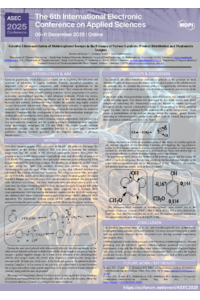
The selective chloroacetylation of methoxyphenol isomers (ortho-, meta-, and para-) was studied under mild conditions using catalytic amounts of various Lewis acids, including FeCl₃, FeCl₃·6H₂O, MoCl₅, WCl₆, ZnCl₂, SnCl₄, VCl₃, TAA, and TSA. The reactivity and selectivity of each isomer toward chloroacetyl chloride were evaluated in nonpolar solvents such as benzene. The influence of catalyst type, molar ratio, temperature, and reaction time on product yield and distribution was systematically investigated. Spectroscopic characterization of the reaction products was performed using IR, UV, and NMR techniques, confirming the formation of O-acylation products (methoxyphenyl chloroacetates) as well as regioisomeric C-acylation products (hydroxy-methoxyphenacyl chlorides). Notably, o-methoxyphenol gave a mixture of three main products, while m- and p-isomers primarily yielded two. Among the catalysts tested, FeCl₃ provided the highest overall yield and favored O-acylation, while stronger Lewis acids like SnCl₄ and MoCl₅ showed greater influence on C-acylation pathways. Mechanistic studies indicate that the reaction proceeds via nucleophilic substitution at the carbonyl carbon of chloroacetyl chloride rather than through a classical acylium ion intermediate, due to the aprotic solvent system and low catalyst concentration. The product distribution correlated strongly with electronic and steric effects of substituents on the aromatic ring. The findings offer valuable insights into structure–reactivity relationships in electrophilic aromatic substitution reactions of substituted phenols and demonstrate the potential of such transformations in the synthesis of bioactive intermediates.
Keywords
Methoxyphenol isomers
Chloroacetylation
Lewis acid catalysis
Regioselectivity
Spectroscopic analysis
Electrophilic aromatic substitution
Product distribution
O-acylation and C-acylation
Reaction mechanism
Phenolic derivatives
Poster
c3e6a758838bf0de34824374535fe123.pdf
TransQSAR-pf: A Bio-Informed QSAR Framework Using Plasmodium falciparum Stress Signatures for Enhanced Antiplasmodial Activity Prediction
Data-Driven Analysis of Tree Structure Variation Across Forest Types in Tapajós National Forest, Brazil