Event submissions
Published
This submission belongs to the session S5. Mechanical and Aerospace Engineering of the event The 6th International Electronic Conference on Applied Sciences
Published date
03 Dec, 2025
Academic Editor
'%3e%3cpath%20d='M12.6657%2010.9104C12.4185%2010.325%2012.0599%209.79327%2011.6097%209.34482C11.1609%208.89508%2010.6293%208.5365%2010.0442%208.28888C10.0389%208.28626%2010.0337%208.28495%2010.0285%208.28233C10.8446%207.69279%2011.3752%206.73249%2011.3752%205.64904C11.3752%203.8542%209.92103%202.39999%208.1262%202.39999C6.33136%202.39999%204.87715%203.8542%204.87715%205.64904C4.87715%206.73249%205.40774%207.69279%206.22393%208.28364C6.21869%208.28626%206.21345%208.28757%206.20821%208.29019C5.62129%208.5378%205.09463%208.89284%204.64265%209.34613C4.1929%209.79493%203.83432%2010.3266%203.58671%2010.9117C3.34345%2011.4845%203.21226%2012.0987%203.20023%2012.7209C3.19988%2012.7349%203.20233%2012.7488%203.20744%2012.7619C3.21255%2012.7749%203.22022%2012.7867%203.22998%2012.7968C3.23975%2012.8068%203.25142%2012.8147%203.26431%2012.8202C3.2772%2012.8256%203.29105%2012.8284%203.30504%2012.8284H4.09109C4.14874%2012.8284%204.19459%2012.7825%204.1959%2012.7262C4.2221%2011.7148%204.62823%2010.7676%205.34617%2010.0497C6.08899%209.30683%207.0755%208.89808%208.1262%208.89808C9.17689%208.89808%2010.1634%209.30683%2010.9062%2010.0497C11.6242%2010.7676%2012.0303%2011.7148%2012.0565%2012.7262C12.0578%2012.7838%2012.1037%2012.8284%2012.1613%2012.8284H12.9474C12.9613%2012.8284%2012.9752%2012.8256%2012.9881%2012.8202C13.001%2012.8147%2013.0126%2012.8068%2013.0224%2012.7968C13.0322%2012.7867%2013.0398%2012.7749%2013.0449%2012.7619C13.0501%2012.7488%2013.0525%2012.7349%2013.0522%2012.7209C13.0391%2012.0947%2012.9094%2011.4855%2012.6657%2010.9104ZM8.1262%207.9024C7.52486%207.9024%206.9589%207.6679%206.53312%207.24211C6.10733%206.81633%205.87283%206.25037%205.87283%205.64904C5.87283%205.0477%206.10733%204.48174%206.53312%204.05596C6.9589%203.63018%207.52486%203.39567%208.1262%203.39567C8.72753%203.39567%209.29349%203.63018%209.71927%204.05596C10.1451%204.48174%2010.3796%205.0477%2010.3796%205.64904C10.3796%206.25037%2010.1451%206.81633%209.71927%207.24211C9.29349%207.6679%208.72753%207.9024%208.1262%207.9024Z'%20fill='%235D1EE1'/%3e%3c/g%3e%3c/svg%3e) André Furtado
André FurtadoCitation
Sofia Kavafaki, Georgios Maliaris, Design and Mechanical Evaluation of SLA-Fabricated Gyroid TPMS Sandwich Structures Under Three-Point Bending, in Proceedings of The 6th International Electronic Conference on Applied Sciences, 9 December–11 December 2025, MDPI: Basel, Switzerland
Share
Email
Facebook
Twitter
LinkedIn
Design and Mechanical Evaluation of SLA-Fabricated Gyroid TPMS Sandwich Structures Under Three-Point Bending

Sofia Kavafaki 1

Georgios Maliaris 1
1. Hephaestus Laboratory, School of Chemistry, Faculty of Sciences, Democritus University of Thrace, GR-65404, Kavala, Greece, Greece
Abstract
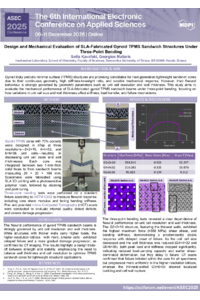
Triply periodic minimal surface (TPMS) structures, particularly the gyroid topology, have been considered as appropriate next-generation lightweight structures due to their high stiffness-to-weight ratio, geometric continuity, and tunable mechanical behavior. In the present study, the mechanical performance of gyroid-based sandwich structures under three-point bending is examined, with a focus on the influence of unit cell resolution and wall thickness on the flexural response.
Three gyroid TPMS core structures were designed using nTop software, featuring a uniform porosity of 70%, and were cast between two solid plates that are each 1 mm thick (20 × 120 mm²) to create sandwich beams with overall dimensions of 20 mm × 20 mm × 160 mm. The core configurations were as follows: (i) 2×2×10 unit cells (10 mm³ each, wall thickness ≈ 1.54 mm), (ii) 4×4×32 unit cells (each 5 mm³, wall thickness ≈ 0.77 mm), and (iii) 6×6×36 unit cells (≈ 3.33̅ mm³ each, wall thickness ≈ 0.52 mm).
The specimens were manufactured employing the stereolithography (SLA) 3D printing technique using a photosensitive polymer resin. The three-point bending tests were performed using a standard fixture according to ASTM C393 standard to measure parameters such as core shear modulus, facing bending stiffness, and failure modes. Pre- and post-testing by Computed Tomography (CT) was carried out to inspect internal flaws, structural integrity, and damage evolution. Results are expressed in the context of unit cell optimisation and its effects on load transfer, stiffness, and energy absorption. This work contributes to the design optimisation of TPMS-based sandwich cores for structural applications with optimised mechanical performance.
Keywords
Additive manufacturing
Gyroid
Sandwich structures
Three-point bending
Mechanical testing
Computed tomography (CT)
Poster
ASEC25_3P_bending.pdf
Urban land use influences on platinum group element (PGE) distribution in Alcalá de Henares
Deep Learning for Automated Detection of Periportal Fibrosis in Ultrasound Imaging: Improving Diagnostic Accuracy in Schistosoma Mansoni Infection