Event submissions
Published
This submission belongs to the session S2. Nanosciences, Chemistry and Materials Science of the event The 6th International Electronic Conference on Applied Sciences
Published date
03 Dec, 2025
Academic Editor
'%3e%3cpath%20d='M12.6657%2010.9104C12.4185%2010.325%2012.0599%209.79327%2011.6097%209.34482C11.1609%208.89508%2010.6293%208.5365%2010.0442%208.28888C10.0389%208.28626%2010.0337%208.28495%2010.0285%208.28233C10.8446%207.69279%2011.3752%206.73249%2011.3752%205.64904C11.3752%203.8542%209.92103%202.39999%208.1262%202.39999C6.33136%202.39999%204.87715%203.8542%204.87715%205.64904C4.87715%206.73249%205.40774%207.69279%206.22393%208.28364C6.21869%208.28626%206.21345%208.28757%206.20821%208.29019C5.62129%208.5378%205.09463%208.89284%204.64265%209.34613C4.1929%209.79493%203.83432%2010.3266%203.58671%2010.9117C3.34345%2011.4845%203.21226%2012.0987%203.20023%2012.7209C3.19988%2012.7349%203.20233%2012.7488%203.20744%2012.7619C3.21255%2012.7749%203.22022%2012.7867%203.22998%2012.7968C3.23975%2012.8068%203.25142%2012.8147%203.26431%2012.8202C3.2772%2012.8256%203.29105%2012.8284%203.30504%2012.8284H4.09109C4.14874%2012.8284%204.19459%2012.7825%204.1959%2012.7262C4.2221%2011.7148%204.62823%2010.7676%205.34617%2010.0497C6.08899%209.30683%207.0755%208.89808%208.1262%208.89808C9.17689%208.89808%2010.1634%209.30683%2010.9062%2010.0497C11.6242%2010.7676%2012.0303%2011.7148%2012.0565%2012.7262C12.0578%2012.7838%2012.1037%2012.8284%2012.1613%2012.8284H12.9474C12.9613%2012.8284%2012.9752%2012.8256%2012.9881%2012.8202C13.001%2012.8147%2013.0126%2012.8068%2013.0224%2012.7968C13.0322%2012.7867%2013.0398%2012.7749%2013.0449%2012.7619C13.0501%2012.7488%2013.0525%2012.7349%2013.0522%2012.7209C13.0391%2012.0947%2012.9094%2011.4855%2012.6657%2010.9104ZM8.1262%207.9024C7.52486%207.9024%206.9589%207.6679%206.53312%207.24211C6.10733%206.81633%205.87283%206.25037%205.87283%205.64904C5.87283%205.0477%206.10733%204.48174%206.53312%204.05596C6.9589%203.63018%207.52486%203.39567%208.1262%203.39567C8.72753%203.39567%209.29349%203.63018%209.71927%204.05596C10.1451%204.48174%2010.3796%205.0477%2010.3796%205.64904C10.3796%206.25037%2010.1451%206.81633%209.71927%207.24211C9.29349%207.6679%208.72753%207.9024%208.1262%207.9024Z'%20fill='%235D1EE1'/%3e%3c/g%3e%3c/svg%3e) Mimimorena Seggio
Mimimorena SeggioCitation
IKRAM DRAI, MOHAMMED BELDJILALI, Elomari Kawthar, Adel Keddou, Kinetic study of Diclofenac removal on Biocomposite microcapsules in aqueous systems, in Proceedings of The 6th International Electronic Conference on Applied Sciences, 9 December–11 December 2025, MDPI: Basel, Switzerland
Share
Email
Facebook
Twitter
LinkedIn
Kinetic study of Diclofenac removal on Biocomposite microcapsules in aqueous systems
'%3e%3cpath%20d='M12.6647%2010.9104C12.4176%2010.325%2012.0589%209.7933%2011.6088%209.34485C11.16%208.89511%2010.6283%208.53653%2010.0432%208.28891C10.038%208.28629%2010.0327%208.28498%2010.0275%208.28236C10.8437%207.69282%2011.3743%206.73252%2011.3743%205.64907C11.3743%203.85423%209.92005%202.40002%208.12522%202.40002C6.33038%202.40002%204.87618%203.85423%204.87618%205.64907C4.87618%206.73252%205.40677%207.69282%206.22296%208.28367C6.21772%208.28629%206.21248%208.2876%206.20724%208.29022C5.62031%208.53783%205.09365%208.89287%204.64167%209.34616C4.19192%209.79496%203.83334%2010.3266%203.58573%2010.9117C3.34247%2011.4846%203.21128%2012.0987%203.19925%2012.721C3.1989%2012.735%203.20135%2012.7489%203.20646%2012.7619C3.21157%2012.7749%203.21924%2012.7868%203.22901%2012.7968C3.23877%2012.8068%203.25045%2012.8148%203.26334%2012.8202C3.27623%2012.8256%203.29007%2012.8284%203.30406%2012.8284H4.09012C4.14776%2012.8284%204.19362%2012.7825%204.19493%2012.7262C4.22113%2011.7148%204.62726%2010.7676%205.34519%2010.0497C6.08802%209.30686%207.07452%208.89811%208.12522%208.89811C9.17592%208.89811%2010.1624%209.30686%2010.9052%2010.0497C11.6232%2010.7676%2012.0293%2011.7148%2012.0555%2012.7262C12.0568%2012.7839%2012.1027%2012.8284%2012.1603%2012.8284H12.9464C12.9604%2012.8284%2012.9742%2012.8256%2012.9871%2012.8202C13%2012.8148%2013.0117%2012.8068%2013.0214%2012.7968C13.0312%2012.7868%2013.0389%2012.7749%2013.044%2012.7619C13.0491%2012.7489%2013.0515%2012.735%2013.0512%2012.721C13.0381%2012.0947%2012.9084%2011.4856%2012.6647%2010.9104ZM8.12522%207.90243C7.52388%207.90243%206.95792%207.66793%206.53214%207.24215C6.10636%206.81636%205.87185%206.2504%205.87185%205.64907C5.87185%205.04773%206.10636%204.48177%206.53214%204.05599C6.95792%203.63021%207.52388%203.3957%208.12522%203.3957C8.72655%203.3957%209.29252%203.63021%209.7183%204.05599C10.1441%204.48177%2010.3786%205.04773%2010.3786%205.64907C10.3786%206.2504%2010.1441%206.81636%209.7183%207.24215C9.29252%207.66793%208.72655%207.90243%208.12522%207.90243Z'%20fill='%235D1EE1'/%3e%3c/g%3e%3c/svg%3e)
IKRAM DRAI 1
MOHAMMED BELDJILALI 1
Elomari Kawthar 2
Adel Keddou 3
1. Institute of Science and Technology, University of Ain Temouchent, Route Sidi Bel Abbes BP 284, 46000 Aïn Témouchent, Algeria., Algeria
2. Laboratoire de Matériaux LABMAT, Ecole National polytechnique d’Oran Maurice-Audin ENPO-MA, Oran, Algérie, Algeria
3. Laboratoire de Matériaux et Environnement LME, Université de Médea, Médea, Algérie, Algeria
Abstract
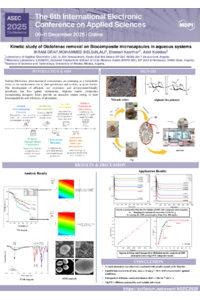
The study of sodium diclofenac (SDF) adsorption on alginate/inorganic filler(Alg/PZ) microcapsules addresses the environmental issues related to the presence of pharmaceutical contaminants in water. The Alg/PZ biomaterial microcapsules were synthesized by crosslinking under various conditions (polymer: 0.75-1.3 g; inorganic filler: 0.4-1.2 g). The product and raw materials were characterized by thermogravimetric analysis (TGA); Fourier transform infrared spectroscopy (FTIR); and scanning electron microscopy (SEM).
TGA revealed optimal encapsulation or synthesis for the 0.75/1.2 mass ratio (Alg/PZ), with 63.87% PZ encapsulation, indicating enhanced thermal stability. Effective entrapment of PZ within the polymeric matrix was proven by FTIR and TGA analyses, highlighting hydrogen and electrostatic bonds, while SEM images confirmed a spherical, uniform, and porous bead morphology with a diameter of 1.73 mm. Sallow-bed adsorption revealed instantaneous pseudo-second-order kinetics, reaching equilibrium in 45 minutes, with a maximum adsorption capacity (qmax) of 21 mg·g-1 for an adsorbent mass of 0.2 g. Furthermore, kinetic studies, supported by the Weber–Morris and Crank (squared driving force model) models, highlighted pore accessibility as well as a concentration-dependent effective diffusion coefficient (Dₑff). The squared driving force mass transfer model validated diffusion-limited kinetics (Dₑff = 2.96×10⁻⁷ cm²·s⁻¹, R² = 0.9832). This study validates Alg/PZ composites as sustainable and scalable solutions compared to conventional adsorbents, enabling 98% SDF removal under optimal conditions.
Keywords
Adsorption
Biocomposite materials
Pharmaceutical contaminant
Kinetic modeling.
Poster
IKRAM DRAI sciforum-140733.pdf
Evaluating Shallow vs. Deep CNNs for Particle Jet Classification in High-Energy Physics
Determination of Carbon Monoxide Dynamics in Hemoglobin Subunits Using Singular Value Decomposition and Maximum Entropy Method