Event submissions
Published
This submission belongs to the session S2. Nanosciences, Chemistry and Materials Science of the event The 6th International Electronic Conference on Applied Sciences
Published date
03 Dec, 2025
Academic Editor
'%3e%3cpath%20d='M12.6657%2010.9104C12.4185%2010.325%2012.0599%209.79327%2011.6097%209.34482C11.1609%208.89508%2010.6293%208.5365%2010.0442%208.28888C10.0389%208.28626%2010.0337%208.28495%2010.0285%208.28233C10.8446%207.69279%2011.3752%206.73249%2011.3752%205.64904C11.3752%203.8542%209.92103%202.39999%208.1262%202.39999C6.33136%202.39999%204.87715%203.8542%204.87715%205.64904C4.87715%206.73249%205.40774%207.69279%206.22393%208.28364C6.21869%208.28626%206.21345%208.28757%206.20821%208.29019C5.62129%208.5378%205.09463%208.89284%204.64265%209.34613C4.1929%209.79493%203.83432%2010.3266%203.58671%2010.9117C3.34345%2011.4845%203.21226%2012.0987%203.20023%2012.7209C3.19988%2012.7349%203.20233%2012.7488%203.20744%2012.7619C3.21255%2012.7749%203.22022%2012.7867%203.22998%2012.7968C3.23975%2012.8068%203.25142%2012.8147%203.26431%2012.8202C3.2772%2012.8256%203.29105%2012.8284%203.30504%2012.8284H4.09109C4.14874%2012.8284%204.19459%2012.7825%204.1959%2012.7262C4.2221%2011.7148%204.62823%2010.7676%205.34617%2010.0497C6.08899%209.30683%207.0755%208.89808%208.1262%208.89808C9.17689%208.89808%2010.1634%209.30683%2010.9062%2010.0497C11.6242%2010.7676%2012.0303%2011.7148%2012.0565%2012.7262C12.0578%2012.7838%2012.1037%2012.8284%2012.1613%2012.8284H12.9474C12.9613%2012.8284%2012.9752%2012.8256%2012.9881%2012.8202C13.001%2012.8147%2013.0126%2012.8068%2013.0224%2012.7968C13.0322%2012.7867%2013.0398%2012.7749%2013.0449%2012.7619C13.0501%2012.7488%2013.0525%2012.7349%2013.0522%2012.7209C13.0391%2012.0947%2012.9094%2011.4855%2012.6657%2010.9104ZM8.1262%207.9024C7.52486%207.9024%206.9589%207.6679%206.53312%207.24211C6.10733%206.81633%205.87283%206.25037%205.87283%205.64904C5.87283%205.0477%206.10733%204.48174%206.53312%204.05596C6.9589%203.63018%207.52486%203.39567%208.1262%203.39567C8.72753%203.39567%209.29349%203.63018%209.71927%204.05596C10.1451%204.48174%2010.3796%205.0477%2010.3796%205.64904C10.3796%206.25037%2010.1451%206.81633%209.71927%207.24211C9.29349%207.6679%208.72753%207.9024%208.1262%207.9024Z'%20fill='%235D1EE1'/%3e%3c/g%3e%3c/svg%3e) Mimimorena Seggio
Mimimorena SeggioCitation
Ruzimurod Jurayev, Azimjon Choriyev, Anvar Abdushukurov, Innat Nakhatov, Synthesis of Naphthalen-2-yl 2-thiocyanatoacetate and Its Application as a Selective Photometric Reagent for Ni(II) Detection, in Proceedings of The 6th International Electronic Conference on Applied Sciences, 9 December–11 December 2025, MDPI: Basel, Switzerland
Share
Email
Facebook
Twitter
LinkedIn
Synthesis of Naphthalen-2-yl 2-thiocyanatoacetate and Its Application as a Selective Photometric Reagent for Ni(II) Detection

Ruzimurod Jurayev 1
'%3e%3cpath%20d='M12.6647%2010.9104C12.4176%2010.325%2012.0589%209.7933%2011.6088%209.34485C11.16%208.89511%2010.6283%208.53653%2010.0432%208.28891C10.038%208.28629%2010.0327%208.28498%2010.0275%208.28236C10.8437%207.69282%2011.3743%206.73252%2011.3743%205.64907C11.3743%203.85423%209.92005%202.40002%208.12522%202.40002C6.33038%202.40002%204.87618%203.85423%204.87618%205.64907C4.87618%206.73252%205.40677%207.69282%206.22296%208.28367C6.21772%208.28629%206.21248%208.2876%206.20724%208.29022C5.62031%208.53783%205.09365%208.89287%204.64167%209.34616C4.19192%209.79496%203.83334%2010.3266%203.58573%2010.9117C3.34247%2011.4846%203.21128%2012.0987%203.19925%2012.721C3.1989%2012.735%203.20135%2012.7489%203.20646%2012.7619C3.21157%2012.7749%203.21924%2012.7868%203.22901%2012.7968C3.23877%2012.8068%203.25045%2012.8148%203.26334%2012.8202C3.27623%2012.8256%203.29007%2012.8284%203.30406%2012.8284H4.09012C4.14776%2012.8284%204.19362%2012.7825%204.19493%2012.7262C4.22113%2011.7148%204.62726%2010.7676%205.34519%2010.0497C6.08802%209.30686%207.07452%208.89811%208.12522%208.89811C9.17592%208.89811%2010.1624%209.30686%2010.9052%2010.0497C11.6232%2010.7676%2012.0293%2011.7148%2012.0555%2012.7262C12.0568%2012.7839%2012.1027%2012.8284%2012.1603%2012.8284H12.9464C12.9604%2012.8284%2012.9742%2012.8256%2012.9871%2012.8202C13%2012.8148%2013.0117%2012.8068%2013.0214%2012.7968C13.0312%2012.7868%2013.0389%2012.7749%2013.044%2012.7619C13.0491%2012.7489%2013.0515%2012.735%2013.0512%2012.721C13.0381%2012.0947%2012.9084%2011.4856%2012.6647%2010.9104ZM8.12522%207.90243C7.52388%207.90243%206.95792%207.66793%206.53214%207.24215C6.10636%206.81636%205.87185%206.2504%205.87185%205.64907C5.87185%205.04773%206.10636%204.48177%206.53214%204.05599C6.95792%203.63021%207.52388%203.3957%208.12522%203.3957C8.72655%203.3957%209.29252%203.63021%209.7183%204.05599C10.1441%204.48177%2010.3786%205.04773%2010.3786%205.64907C10.3786%206.2504%2010.1441%206.81636%209.7183%207.24215C9.29252%207.66793%208.72655%207.90243%208.12522%207.90243Z'%20fill='%235D1EE1'/%3e%3c/g%3e%3c/svg%3e)
Azimjon Choriyev 2
Anvar Abdushukurov 3
Innat Nakhatov 2
1. Department of “Chemical Engineering ”, Karshi State Technical University Shahrisabz Faculty of Food Engineering, 20, Shakhrisabz str., Shakhrisabz 181306, Uzbekistan;, Uzbekistan
2. Department of “Organic chemistry”, Karshi State University, 17, Kuchabog str., Karshi 180103, Uzbekistan, Uzbekistan
3. Department of “Organic chemistry”, National University of Uzbekistan named after Mirzo Ulugbek, Tashkent, Uzbekistan, 100174, Uzbekistan
Abstract
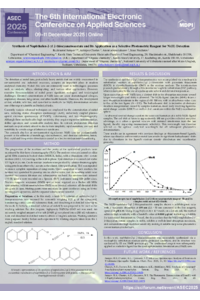
In this study, a novel organic compound—naphthalen-2-yl 2-thiocyanatoacetate—was synthesized via a nucleophilic substitution reaction (SN2 mechanism) in dimethylformamide (DMF) as the solvent. The molecular structure of the synthesized compound was confirmed by infrared (IR) and nuclear magnetic resonance (NMR) spectroscopy. The compound was evaluated for its analytical properties, particularly its ability to form a colored complex with Ni(II) ions, which was investigated using a photometric detection method. A comprehensive optimization of the detection conditions was performed. Factors such as the acidity of the reaction medium (pH), the order of reagent addition, the amount of reagent, the selection of optical filter, maximum absorption wavelength (λmax), Beer’s law linearity range, molar absorptivity, Sandell sensitivity, limit of detection (LOD), equilibrium constant, and the molar ratio of the complex components were studied in detail. The results demonstrated that the synthesized compound exhibits high sensitivity, selectivity, and stability in complex formation with Ni(II) ions. The developed photometric method is simple, cost-effective, and rapid, and can be implemented using basic instrumentation. Therefore, the method shows great potential for application in environmental monitoring, industrial wastewater analysis, and trace metal detection. This work contributes to the development of novel thiocyanate-based analytical reagents and expands the toolbox for photometric determination of transition metal ions, particularly Ni(II).
Keywords
Naphthalen-2-yl 2-thiocyanatoacetate
nickel(II) determination
photometric method
thiocyanate ligand
SN2 nucleophilic substitution
spectrophotometry
complex formation
DMFA solvent
molecular ratio
analytical chemistry
Poster
c3e6a758838bf0de34824374535fe123.pdf
Ensemble-Based Imputation for Handling Missing Values in Healthcare Datasets: A Comparative Study of Machine Learning Models
Blue and Green Phosphate Coatings Formed on Steel without Heating