Event submissions
Published
This submission belongs to the session S7. Food Science and Technology of the event The 6th International Electronic Conference on Applied Sciences
Published date
03 Dec, 2025
Academic Editor
'%3e%3cpath%20d='M12.6657%2010.9104C12.4185%2010.325%2012.0599%209.79327%2011.6097%209.34482C11.1609%208.89508%2010.6293%208.5365%2010.0442%208.28888C10.0389%208.28626%2010.0337%208.28495%2010.0285%208.28233C10.8446%207.69279%2011.3752%206.73249%2011.3752%205.64904C11.3752%203.8542%209.92103%202.39999%208.1262%202.39999C6.33136%202.39999%204.87715%203.8542%204.87715%205.64904C4.87715%206.73249%205.40774%207.69279%206.22393%208.28364C6.21869%208.28626%206.21345%208.28757%206.20821%208.29019C5.62129%208.5378%205.09463%208.89284%204.64265%209.34613C4.1929%209.79493%203.83432%2010.3266%203.58671%2010.9117C3.34345%2011.4845%203.21226%2012.0987%203.20023%2012.7209C3.19988%2012.7349%203.20233%2012.7488%203.20744%2012.7619C3.21255%2012.7749%203.22022%2012.7867%203.22998%2012.7968C3.23975%2012.8068%203.25142%2012.8147%203.26431%2012.8202C3.2772%2012.8256%203.29105%2012.8284%203.30504%2012.8284H4.09109C4.14874%2012.8284%204.19459%2012.7825%204.1959%2012.7262C4.2221%2011.7148%204.62823%2010.7676%205.34617%2010.0497C6.08899%209.30683%207.0755%208.89808%208.1262%208.89808C9.17689%208.89808%2010.1634%209.30683%2010.9062%2010.0497C11.6242%2010.7676%2012.0303%2011.7148%2012.0565%2012.7262C12.0578%2012.7838%2012.1037%2012.8284%2012.1613%2012.8284H12.9474C12.9613%2012.8284%2012.9752%2012.8256%2012.9881%2012.8202C13.001%2012.8147%2013.0126%2012.8068%2013.0224%2012.7968C13.0322%2012.7867%2013.0398%2012.7749%2013.0449%2012.7619C13.0501%2012.7488%2013.0525%2012.7349%2013.0522%2012.7209C13.0391%2012.0947%2012.9094%2011.4855%2012.6657%2010.9104ZM8.1262%207.9024C7.52486%207.9024%206.9589%207.6679%206.53312%207.24211C6.10733%206.81633%205.87283%206.25037%205.87283%205.64904C5.87283%205.0477%206.10733%204.48174%206.53312%204.05596C6.9589%203.63018%207.52486%203.39567%208.1262%203.39567C8.72753%203.39567%209.29349%203.63018%209.71927%204.05596C10.1451%204.48174%2010.3796%205.0477%2010.3796%205.64904C10.3796%206.25037%2010.1451%206.81633%209.71927%207.24211C9.29349%207.6679%208.72753%207.9024%208.1262%207.9024Z'%20fill='%235D1EE1'/%3e%3c/g%3e%3c/svg%3e) Antonios Koutelidakis
Antonios KoutelidakisCitation
Afonso Silva, Eloísa Toledo, Ana Cristina Esteves, Tiago Simões, Ana Augusto, Marco Lemos, Carina Félix, Sustainable Control of Olive Anthracnose: Can Algae Be the Solution?, in Proceedings of The 6th International Electronic Conference on Applied Sciences, 9 December–11 December 2025, MDPI: Basel, Switzerland
Share
Email
Facebook
Twitter
LinkedIn
Sustainable Control of Olive Anthracnose: Can Algae Be the Solution?

Afonso Silva 1
'%3e%3cpath%20d='M12.6647%2010.9104C12.4176%2010.325%2012.0589%209.7933%2011.6088%209.34485C11.16%208.89511%2010.6283%208.53653%2010.0432%208.28891C10.038%208.28629%2010.0327%208.28498%2010.0275%208.28236C10.8437%207.69282%2011.3743%206.73252%2011.3743%205.64907C11.3743%203.85423%209.92005%202.40002%208.12522%202.40002C6.33038%202.40002%204.87618%203.85423%204.87618%205.64907C4.87618%206.73252%205.40677%207.69282%206.22296%208.28367C6.21772%208.28629%206.21248%208.2876%206.20724%208.29022C5.62031%208.53783%205.09365%208.89287%204.64167%209.34616C4.19192%209.79496%203.83334%2010.3266%203.58573%2010.9117C3.34247%2011.4846%203.21128%2012.0987%203.19925%2012.721C3.1989%2012.735%203.20135%2012.7489%203.20646%2012.7619C3.21157%2012.7749%203.21924%2012.7868%203.22901%2012.7968C3.23877%2012.8068%203.25045%2012.8148%203.26334%2012.8202C3.27623%2012.8256%203.29007%2012.8284%203.30406%2012.8284H4.09012C4.14776%2012.8284%204.19362%2012.7825%204.19493%2012.7262C4.22113%2011.7148%204.62726%2010.7676%205.34519%2010.0497C6.08802%209.30686%207.07452%208.89811%208.12522%208.89811C9.17592%208.89811%2010.1624%209.30686%2010.9052%2010.0497C11.6232%2010.7676%2012.0293%2011.7148%2012.0555%2012.7262C12.0568%2012.7839%2012.1027%2012.8284%2012.1603%2012.8284H12.9464C12.9604%2012.8284%2012.9742%2012.8256%2012.9871%2012.8202C13%2012.8148%2013.0117%2012.8068%2013.0214%2012.7968C13.0312%2012.7868%2013.0389%2012.7749%2013.044%2012.7619C13.0491%2012.7489%2013.0515%2012.735%2013.0512%2012.721C13.0381%2012.0947%2012.9084%2011.4856%2012.6647%2010.9104ZM8.12522%207.90243C7.52388%207.90243%206.95792%207.66793%206.53214%207.24215C6.10636%206.81636%205.87185%206.2504%205.87185%205.64907C5.87185%205.04773%206.10636%204.48177%206.53214%204.05599C6.95792%203.63021%207.52388%203.3957%208.12522%203.3957C8.72655%203.3957%209.29252%203.63021%209.7183%204.05599C10.1441%204.48177%2010.3786%205.04773%2010.3786%205.64907C10.3786%206.2504%2010.1441%206.81636%209.7183%207.24215C9.29252%207.66793%208.72655%207.90243%208.12522%207.90243Z'%20fill='%235D1EE1'/%3e%3c/g%3e%3c/svg%3e)
Eloísa Toledo 1,2

Ana Cristina Esteves 3

Tiago Simões 1

Ana Augusto 1

Marco Lemos 1

Carina Félix 1
1. MARE—Marine and Environmental Sciences Centre & ARNET—Aquatic Research Network Associated Laboratory, ESTM, Polytechnic of Leiria, 2520-641 Peniche, Portugal, Portugal
2. REQUIMTE/LAQV, Pharmacognosy Laboratory, Faculty of Pharmacy, University of Porto, 4050-313 Porto, Portugal
3. CESAM and Department of Biology, University of Aveiro, Campus Universitário de Santiago, 3810-193 Aveiro, Portugal, Portugal
Abstract
Olive tree cultivation (Olea europaea) occupies around 12 million hectares worldwide, assuming particular economic and social relevance in Mediterranean regions. In Portugal, olive groves cover approximately 350,000 hectares, with a production of 160,800 tons of olive oil in 2023. However, the olive tree crop is severely affected by phytopathogenic agents, notably anthracnose, caused by species of the genus Colletotrichum, which is responsible for losses of over 50% in susceptible cultivars. The recurrent use of copper-based fungicides raises environmental, toxicological and regulatory concerns, reinforcing the need for sustainable and safe alternatives.
Algae extracts, rich in antifungal and antimicrobial compounds, are promising alternatives for the sustainable control of fungal diseases. Extracts of Asparagopsis armata, Amphidinium carterae, Fucus vesiculosus, Coolia monotis and Sargassum muticum were tested at concentrations of 0.1, 0.5 and 1 mg/mL against Colletotrichum sp. using in vitro assays of mycelial growth, spore germination inhibition and phytotoxicity on olive leaves. For the in vivo assays, Fucus vesiculosus showed a protective effect, reducing the incidence of infection in olives compared to the control.
The extracts of A. carterae (1 mg/mL) and F. vesiculosus (0.5 mg/mL) showed significant antifungal activity, with 60% and 31% inhibition of mycelial growth, respectively, at 24 hours. These results confirm the potential of algae as effective sources of antifungal compounds against olive anthracnose, constituting sustainable and viable alternatives to copper-based fungicides.
Keywords
Olea europea
Anthracnose
Antifungal compounds
Algal extracts.
Poster
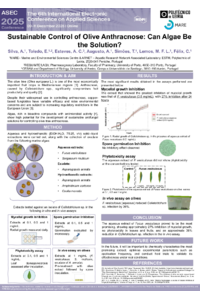
AS_POSTER_ASEC_2025.pdf
Topical Transferosomal Nanogel of Tridax procumbens: Formulation, Characterization, and Antifungal Evaluation
A granular Cu-modified chitosan biocomposite for sulfate removal from laboratory and groundwater sources