Event submissions
Published
This submission belongs to the session S2. Nanosciences, Chemistry and Materials Science of the event The 6th International Electronic Conference on Applied Sciences
Published date
03 Dec, 2025
Academic Editor
'%3e%3cpath%20d='M12.6657%2010.9104C12.4185%2010.325%2012.0599%209.79327%2011.6097%209.34482C11.1609%208.89508%2010.6293%208.5365%2010.0442%208.28888C10.0389%208.28626%2010.0337%208.28495%2010.0285%208.28233C10.8446%207.69279%2011.3752%206.73249%2011.3752%205.64904C11.3752%203.8542%209.92103%202.39999%208.1262%202.39999C6.33136%202.39999%204.87715%203.8542%204.87715%205.64904C4.87715%206.73249%205.40774%207.69279%206.22393%208.28364C6.21869%208.28626%206.21345%208.28757%206.20821%208.29019C5.62129%208.5378%205.09463%208.89284%204.64265%209.34613C4.1929%209.79493%203.83432%2010.3266%203.58671%2010.9117C3.34345%2011.4845%203.21226%2012.0987%203.20023%2012.7209C3.19988%2012.7349%203.20233%2012.7488%203.20744%2012.7619C3.21255%2012.7749%203.22022%2012.7867%203.22998%2012.7968C3.23975%2012.8068%203.25142%2012.8147%203.26431%2012.8202C3.2772%2012.8256%203.29105%2012.8284%203.30504%2012.8284H4.09109C4.14874%2012.8284%204.19459%2012.7825%204.1959%2012.7262C4.2221%2011.7148%204.62823%2010.7676%205.34617%2010.0497C6.08899%209.30683%207.0755%208.89808%208.1262%208.89808C9.17689%208.89808%2010.1634%209.30683%2010.9062%2010.0497C11.6242%2010.7676%2012.0303%2011.7148%2012.0565%2012.7262C12.0578%2012.7838%2012.1037%2012.8284%2012.1613%2012.8284H12.9474C12.9613%2012.8284%2012.9752%2012.8256%2012.9881%2012.8202C13.001%2012.8147%2013.0126%2012.8068%2013.0224%2012.7968C13.0322%2012.7867%2013.0398%2012.7749%2013.0449%2012.7619C13.0501%2012.7488%2013.0525%2012.7349%2013.0522%2012.7209C13.0391%2012.0947%2012.9094%2011.4855%2012.6657%2010.9104ZM8.1262%207.9024C7.52486%207.9024%206.9589%207.6679%206.53312%207.24211C6.10733%206.81633%205.87283%206.25037%205.87283%205.64904C5.87283%205.0477%206.10733%204.48174%206.53312%204.05596C6.9589%203.63018%207.52486%203.39567%208.1262%203.39567C8.72753%203.39567%209.29349%203.63018%209.71927%204.05596C10.1451%204.48174%2010.3796%205.0477%2010.3796%205.64904C10.3796%206.25037%2010.1451%206.81633%209.71927%207.24211C9.29349%207.6679%208.72753%207.9024%208.1262%207.9024Z'%20fill='%235D1EE1'/%3e%3c/g%3e%3c/svg%3e) Alberto Jiménez Suárez
Alberto Jiménez SuárezCitation
Amani Azaizia, Maksim Dorogov, Nada Redjimi, Evaluation of Silicon–Graphene Oxide and Silicon Dioxide–Graphene Oxide Composite Anodes for High-Capacity Lithium-Ion Batteries in Terms of Electrochemical Performance, in Proceedings of The 6th International Electronic Conference on Applied Sciences, 9 December–11 December 2025, MDPI: Basel, Switzerland
Share
Email
Facebook
Twitter
LinkedIn
Evaluation of Silicon–Graphene Oxide and Silicon Dioxide–Graphene Oxide Composite Anodes for High-Capacity Lithium-Ion Batteries in Terms of Electrochemical Performance

Amani Azaizia 1
'%3e%3cpath%20d='M12.6647%2010.9104C12.4176%2010.325%2012.0589%209.7933%2011.6088%209.34485C11.16%208.89511%2010.6283%208.53653%2010.0432%208.28891C10.038%208.28629%2010.0327%208.28498%2010.0275%208.28236C10.8437%207.69282%2011.3743%206.73252%2011.3743%205.64907C11.3743%203.85423%209.92005%202.40002%208.12522%202.40002C6.33038%202.40002%204.87618%203.85423%204.87618%205.64907C4.87618%206.73252%205.40677%207.69282%206.22296%208.28367C6.21772%208.28629%206.21248%208.2876%206.20724%208.29022C5.62031%208.53783%205.09365%208.89287%204.64167%209.34616C4.19192%209.79496%203.83334%2010.3266%203.58573%2010.9117C3.34247%2011.4846%203.21128%2012.0987%203.19925%2012.721C3.1989%2012.735%203.20135%2012.7489%203.20646%2012.7619C3.21157%2012.7749%203.21924%2012.7868%203.22901%2012.7968C3.23877%2012.8068%203.25045%2012.8148%203.26334%2012.8202C3.27623%2012.8256%203.29007%2012.8284%203.30406%2012.8284H4.09012C4.14776%2012.8284%204.19362%2012.7825%204.19493%2012.7262C4.22113%2011.7148%204.62726%2010.7676%205.34519%2010.0497C6.08802%209.30686%207.07452%208.89811%208.12522%208.89811C9.17592%208.89811%2010.1624%209.30686%2010.9052%2010.0497C11.6232%2010.7676%2012.0293%2011.7148%2012.0555%2012.7262C12.0568%2012.7839%2012.1027%2012.8284%2012.1603%2012.8284H12.9464C12.9604%2012.8284%2012.9742%2012.8256%2012.9871%2012.8202C13%2012.8148%2013.0117%2012.8068%2013.0214%2012.7968C13.0312%2012.7868%2013.0389%2012.7749%2013.044%2012.7619C13.0491%2012.7489%2013.0515%2012.735%2013.0512%2012.721C13.0381%2012.0947%2012.9084%2011.4856%2012.6647%2010.9104ZM8.12522%207.90243C7.52388%207.90243%206.95792%207.66793%206.53214%207.24215C6.10636%206.81636%205.87185%206.2504%205.87185%205.64907C5.87185%205.04773%206.10636%204.48177%206.53214%204.05599C6.95792%203.63021%207.52388%203.3957%208.12522%203.3957C8.72655%203.3957%209.29252%203.63021%209.7183%204.05599C10.1441%204.48177%2010.3786%205.04773%2010.3786%205.64907C10.3786%206.2504%2010.1441%206.81636%209.7183%207.24215C9.29252%207.66793%208.72655%207.90243%208.12522%207.90243Z'%20fill='%235D1EE1'/%3e%3c/g%3e%3c/svg%3e)
Maksim Dorogov 1
Nada Redjimi 2
1. Institute of Advanced Data Transfer Systems, ITMO University, St. Petersburg, 197101, Russia, Russia
2. Nice Physics Institute, Université Côte d'Azur, Nice, 06000, France, France
Abstract
Abstract
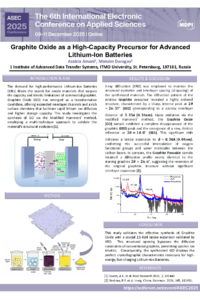
Elevated density in energy-advanced anodes is required for LIBs; however, problems like volume growth or reduced capacity make silicon (Si) and silicon dioxide (SiO₂) unsuitable. Using graphene to overcome these real-world constraints, this study compares Si–graphene oxide (Si-GO) and SiO₂–graphene oxide (SiO₂-GO) composite anodes.
The purpose of this study is to elucidate the different performance characteristics of Si-GO and SiO₂-GO anodes. By comprehending these distinctions, silicon-based materials may be rationally designed to meet specific energy density and cycle life needs for new batteries. This will allow for a customized selection or ideal blend of Si and SiO₂ in graphene composites.
A modified Hummer's method is proposed to manufacture graphene oxide (GO). GO is combined with either silicon from magnesiothermic reduction (for Si-GO) or a silica precursor (for SiO₂-GO) to generate composites. The morphology and structure of the materials are examined using elemental analysis, TGA, SEM, XRD, Raman spectroscopy, and XPS. Impedance spectroscopy, rate capability testing, galvanostatic cycling, and cyclic voltammetry are used to assess the electrochemical performance of LiFePO₄-based cells.
Si-GO is anticipated to provide a greater initial specific capacity, and because of its conversion reaction mechanism, SiO₂-GO should exhibit improved long-term cycle stability. Both composites should benefit from graphene's ability to improve electrical conductivity and buffer volume expansion. The trade-off between large capacity and long cycle life will be described in the analysis.
Acknowledgements. This research was supported by the Ministry of Science and Higher Education of the Russian Federation (project No. FSER-2025-0005).
Keywords
Lithium-ion batteries
Anodes
Silicon
Silicon dioxide
Graphene oxide
Composite materials
Electrochemical performance
Volume expansion
Cycle stability
High capacity
Oral Presentation
AzaiziaAmani_6thInternationElectronic Conference on Applied Sciences_021225.pptx
Poster
AzaiziaAmani_6thInternationElectronic Conference on Applied Sciences_021225.pdf
AI-Driven Spatiotemporal Mapping and Grid Optimization for Solar and Wind Energy
Prevalence of antibiotic resistant Eschericha coli strains isolated from food and environmental samples