Event submissions
Published
This submission belongs to the session S2. Nanosciences, Chemistry and Materials Science of the event The 6th International Electronic Conference on Applied Sciences
Published date
03 Dec, 2025
Academic Editor
'%3e%3cpath%20d='M12.6657%2010.9104C12.4185%2010.325%2012.0599%209.79327%2011.6097%209.34482C11.1609%208.89508%2010.6293%208.5365%2010.0442%208.28888C10.0389%208.28626%2010.0337%208.28495%2010.0285%208.28233C10.8446%207.69279%2011.3752%206.73249%2011.3752%205.64904C11.3752%203.8542%209.92103%202.39999%208.1262%202.39999C6.33136%202.39999%204.87715%203.8542%204.87715%205.64904C4.87715%206.73249%205.40774%207.69279%206.22393%208.28364C6.21869%208.28626%206.21345%208.28757%206.20821%208.29019C5.62129%208.5378%205.09463%208.89284%204.64265%209.34613C4.1929%209.79493%203.83432%2010.3266%203.58671%2010.9117C3.34345%2011.4845%203.21226%2012.0987%203.20023%2012.7209C3.19988%2012.7349%203.20233%2012.7488%203.20744%2012.7619C3.21255%2012.7749%203.22022%2012.7867%203.22998%2012.7968C3.23975%2012.8068%203.25142%2012.8147%203.26431%2012.8202C3.2772%2012.8256%203.29105%2012.8284%203.30504%2012.8284H4.09109C4.14874%2012.8284%204.19459%2012.7825%204.1959%2012.7262C4.2221%2011.7148%204.62823%2010.7676%205.34617%2010.0497C6.08899%209.30683%207.0755%208.89808%208.1262%208.89808C9.17689%208.89808%2010.1634%209.30683%2010.9062%2010.0497C11.6242%2010.7676%2012.0303%2011.7148%2012.0565%2012.7262C12.0578%2012.7838%2012.1037%2012.8284%2012.1613%2012.8284H12.9474C12.9613%2012.8284%2012.9752%2012.8256%2012.9881%2012.8202C13.001%2012.8147%2013.0126%2012.8068%2013.0224%2012.7968C13.0322%2012.7867%2013.0398%2012.7749%2013.0449%2012.7619C13.0501%2012.7488%2013.0525%2012.7349%2013.0522%2012.7209C13.0391%2012.0947%2012.9094%2011.4855%2012.6657%2010.9104ZM8.1262%207.9024C7.52486%207.9024%206.9589%207.6679%206.53312%207.24211C6.10733%206.81633%205.87283%206.25037%205.87283%205.64904C5.87283%205.0477%206.10733%204.48174%206.53312%204.05596C6.9589%203.63018%207.52486%203.39567%208.1262%203.39567C8.72753%203.39567%209.29349%203.63018%209.71927%204.05596C10.1451%204.48174%2010.3796%205.0477%2010.3796%205.64904C10.3796%206.25037%2010.1451%206.81633%209.71927%207.24211C9.29349%207.6679%208.72753%207.9024%208.1262%207.9024Z'%20fill='%235D1EE1'/%3e%3c/g%3e%3c/svg%3e) Alberto Jiménez Suárez
Alberto Jiménez SuárezCitation
Fathi BRIOUA, Chouaib Daoudi, Finite Element Modeling of Bilayer P3HT/C60 Organic Solar Cells: Influence of Active-Layer Thickness on Optical Performance, in Proceedings of The 6th International Electronic Conference on Applied Sciences, 9 December–11 December 2025, MDPI: Basel, Switzerland
Share
Email
Facebook
Twitter
LinkedIn
Finite Element Modeling of Bilayer P3HT/C60 Organic Solar Cells: Influence of Active-Layer Thickness on Optical Performance
'%3e%3cpath%20d='M12.6647%2010.9104C12.4176%2010.325%2012.0589%209.7933%2011.6088%209.34485C11.16%208.89511%2010.6283%208.53653%2010.0432%208.28891C10.038%208.28629%2010.0327%208.28498%2010.0275%208.28236C10.8437%207.69282%2011.3743%206.73252%2011.3743%205.64907C11.3743%203.85423%209.92005%202.40002%208.12522%202.40002C6.33038%202.40002%204.87618%203.85423%204.87618%205.64907C4.87618%206.73252%205.40677%207.69282%206.22296%208.28367C6.21772%208.28629%206.21248%208.2876%206.20724%208.29022C5.62031%208.53783%205.09365%208.89287%204.64167%209.34616C4.19192%209.79496%203.83334%2010.3266%203.58573%2010.9117C3.34247%2011.4846%203.21128%2012.0987%203.19925%2012.721C3.1989%2012.735%203.20135%2012.7489%203.20646%2012.7619C3.21157%2012.7749%203.21924%2012.7868%203.22901%2012.7968C3.23877%2012.8068%203.25045%2012.8148%203.26334%2012.8202C3.27623%2012.8256%203.29007%2012.8284%203.30406%2012.8284H4.09012C4.14776%2012.8284%204.19362%2012.7825%204.19493%2012.7262C4.22113%2011.7148%204.62726%2010.7676%205.34519%2010.0497C6.08802%209.30686%207.07452%208.89811%208.12522%208.89811C9.17592%208.89811%2010.1624%209.30686%2010.9052%2010.0497C11.6232%2010.7676%2012.0293%2011.7148%2012.0555%2012.7262C12.0568%2012.7839%2012.1027%2012.8284%2012.1603%2012.8284H12.9464C12.9604%2012.8284%2012.9742%2012.8256%2012.9871%2012.8202C13%2012.8148%2013.0117%2012.8068%2013.0214%2012.7968C13.0312%2012.7868%2013.0389%2012.7749%2013.044%2012.7619C13.0491%2012.7489%2013.0515%2012.735%2013.0512%2012.721C13.0381%2012.0947%2012.9084%2011.4856%2012.6647%2010.9104ZM8.12522%207.90243C7.52388%207.90243%206.95792%207.66793%206.53214%207.24215C6.10636%206.81636%205.87185%206.2504%205.87185%205.64907C5.87185%205.04773%206.10636%204.48177%206.53214%204.05599C6.95792%203.63021%207.52388%203.3957%208.12522%203.3957C8.72655%203.3957%209.29252%203.63021%209.7183%204.05599C10.1441%204.48177%2010.3786%205.04773%2010.3786%205.64907C10.3786%206.2504%2010.1441%206.81636%209.7183%207.24215C9.29252%207.66793%208.72655%207.90243%208.12522%207.90243Z'%20fill='%235D1EE1'/%3e%3c/g%3e%3c/svg%3e)
Fathi BRIOUA 1
Chouaib Daoudi 2
1. Electrical Engineering Department, Ahmed Draia University, Route Nationale N°6, Adrar, Algeria, Algeria
2. Département Génie Électrique, Université 20 Août 1955, Skikda, Algeria, Algeria
Abstract
Introduction
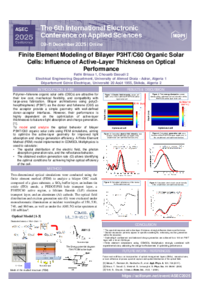
Polymer–fullerene organic solar cells (OSCs) are attractive for their low cost, mechanical flexibility, and compatibility with large-area fabrication. Bilayer architectures using poly(3-hexylthiophene) (P3HT) as the donor and fullerene (C60) as the acceptor provide a simple geometry with well-defined donor–acceptor interfaces. However, their performance is highly dependent on the optimization of active-layer thicknesses to balance light absorption and charge generation.
Methods
Two-dimensional optical simulations were conducted using the finite element method (FEM) to analyze a bilayer OSC stack composed of a glass substrate, a SiO₂ buffer layer, an indium tin oxide (ITO) anode, a PEDOT:PSS hole transport layer, a P3HT/C60 active region, a lithium fluoride (LiF) electron transport layer, and an aluminum (Al) cathode. The optical field distribution and exciton generation rate (G) were evaluated under monochromatic illumination at incident wavelengths of 350, 530, 740, and 860 nm, as well as under the AM1.5G solar spectrum at 100 mW/cm².
Results
The simulations revealed that both the spectral response and the active-layer thicknesses strongly influence device performance. At the selected wavelengths, distinct resonance patterns were observed, showing enhanced exciton generation within the absorber. The optimization study further demonstrated that maximum absorption and short-circuit current density (JSC) were achieved for a 100 nm P3HT layer combined with a 55 nm C60 layer, yielding balanced light confinement and charge generation efficiency across the investigated spectrum.
Conclusion
This numerical investigation highlights the combined impact of wavelength-dependent optical behavior and active-layer thickness on bilayer P3HT/C60 OSCs. The results confirm that precise control of geometry enables substantial improvements in light harvesting and photocurrent generation. These findings are consistent with experimental reports, validating FEM-based modeling as a reliable approach for guiding the optimization of organic photovoltaic devices.
Keywords
Organic solar cells (OSCs)
Bilayer configuration
P3HT
Fullerene (C60)
Optical simulations
Poster
MDPI conf 2 P3HT_C60 26 11 2025 brioua and daoudi.pdf
Plasmonic coupling in GaN films by Au and Ag Nanoparticles: Synthesis and characterization
Improved Optical and Electrical Characteristics of PTB7:PCBM Organic Solar Cells via ZnO Spacer Integration