Event submissions
Published
This submission belongs to the session S1. Personalised nutrition for athletic performance of the event The 5th International Online Conference on Nutrients
Published date
05 Dec, 2025
Academic Editor
'%3e%3cpath%20d='M12.6657%2010.9104C12.4185%2010.325%2012.0599%209.79327%2011.6097%209.34482C11.1609%208.89508%2010.6293%208.5365%2010.0442%208.28888C10.0389%208.28626%2010.0337%208.28495%2010.0285%208.28233C10.8446%207.69279%2011.3752%206.73249%2011.3752%205.64904C11.3752%203.8542%209.92103%202.39999%208.1262%202.39999C6.33136%202.39999%204.87715%203.8542%204.87715%205.64904C4.87715%206.73249%205.40774%207.69279%206.22393%208.28364C6.21869%208.28626%206.21345%208.28757%206.20821%208.29019C5.62129%208.5378%205.09463%208.89284%204.64265%209.34613C4.1929%209.79493%203.83432%2010.3266%203.58671%2010.9117C3.34345%2011.4845%203.21226%2012.0987%203.20023%2012.7209C3.19988%2012.7349%203.20233%2012.7488%203.20744%2012.7619C3.21255%2012.7749%203.22022%2012.7867%203.22998%2012.7968C3.23975%2012.8068%203.25142%2012.8147%203.26431%2012.8202C3.2772%2012.8256%203.29105%2012.8284%203.30504%2012.8284H4.09109C4.14874%2012.8284%204.19459%2012.7825%204.1959%2012.7262C4.2221%2011.7148%204.62823%2010.7676%205.34617%2010.0497C6.08899%209.30683%207.0755%208.89808%208.1262%208.89808C9.17689%208.89808%2010.1634%209.30683%2010.9062%2010.0497C11.6242%2010.7676%2012.0303%2011.7148%2012.0565%2012.7262C12.0578%2012.7838%2012.1037%2012.8284%2012.1613%2012.8284H12.9474C12.9613%2012.8284%2012.9752%2012.8256%2012.9881%2012.8202C13.001%2012.8147%2013.0126%2012.8068%2013.0224%2012.7968C13.0322%2012.7867%2013.0398%2012.7749%2013.0449%2012.7619C13.0501%2012.7488%2013.0525%2012.7349%2013.0522%2012.7209C13.0391%2012.0947%2012.9094%2011.4855%2012.6657%2010.9104ZM8.1262%207.9024C7.52486%207.9024%206.9589%207.6679%206.53312%207.24211C6.10733%206.81633%205.87283%206.25037%205.87283%205.64904C5.87283%205.0477%206.10733%204.48174%206.53312%204.05596C6.9589%203.63018%207.52486%203.39567%208.1262%203.39567C8.72753%203.39567%209.29349%203.63018%209.71927%204.05596C10.1451%204.48174%2010.3796%205.0477%2010.3796%205.64904C10.3796%206.25037%2010.1451%206.81633%209.71927%207.24211C9.29349%207.6679%208.72753%207.9024%208.1262%207.9024Z'%20fill='%235D1EE1'/%3e%3c/g%3e%3c/svg%3e) Mauro Lombardo
Mauro LombardoCitation
Jose Herrero Barceló, José Miguel Martínez Sanz, Mónica Castillo Martínez, Do you know body composition and dietary habits of combat sports athletes? A systematic review., in Proceedings of The 5th International Online Conference on Nutrients, 10 December–12 December 2025, MDPI: Basel, Switzerland
Share
Email
Facebook
Twitter
LinkedIn
Do you know body composition and dietary habits of combat sports athletes? A systematic review.

Jose Herrero Barceló 1

José Miguel Martínez Sanz 2,3
'%3e%3cpath%20d='M12.6647%2010.9104C12.4176%2010.325%2012.0589%209.7933%2011.6088%209.34485C11.16%208.89511%2010.6283%208.53653%2010.0432%208.28891C10.038%208.28629%2010.0327%208.28498%2010.0275%208.28236C10.8437%207.69282%2011.3743%206.73252%2011.3743%205.64907C11.3743%203.85423%209.92005%202.40002%208.12522%202.40002C6.33038%202.40002%204.87618%203.85423%204.87618%205.64907C4.87618%206.73252%205.40677%207.69282%206.22296%208.28367C6.21772%208.28629%206.21248%208.2876%206.20724%208.29022C5.62031%208.53783%205.09365%208.89287%204.64167%209.34616C4.19192%209.79496%203.83334%2010.3266%203.58573%2010.9117C3.34247%2011.4846%203.21128%2012.0987%203.19925%2012.721C3.1989%2012.735%203.20135%2012.7489%203.20646%2012.7619C3.21157%2012.7749%203.21924%2012.7868%203.22901%2012.7968C3.23877%2012.8068%203.25045%2012.8148%203.26334%2012.8202C3.27623%2012.8256%203.29007%2012.8284%203.30406%2012.8284H4.09012C4.14776%2012.8284%204.19362%2012.7825%204.19493%2012.7262C4.22113%2011.7148%204.62726%2010.7676%205.34519%2010.0497C6.08802%209.30686%207.07452%208.89811%208.12522%208.89811C9.17592%208.89811%2010.1624%209.30686%2010.9052%2010.0497C11.6232%2010.7676%2012.0293%2011.7148%2012.0555%2012.7262C12.0568%2012.7839%2012.1027%2012.8284%2012.1603%2012.8284H12.9464C12.9604%2012.8284%2012.9742%2012.8256%2012.9871%2012.8202C13%2012.8148%2013.0117%2012.8068%2013.0214%2012.7968C13.0312%2012.7868%2013.0389%2012.7749%2013.044%2012.7619C13.0491%2012.7489%2013.0515%2012.735%2013.0512%2012.721C13.0381%2012.0947%2012.9084%2011.4856%2012.6647%2010.9104ZM8.12522%207.90243C7.52388%207.90243%206.95792%207.66793%206.53214%207.24215C6.10636%206.81636%205.87185%206.2504%205.87185%205.64907C5.87185%205.04773%206.10636%204.48177%206.53214%204.05599C6.95792%203.63021%207.52388%203.3957%208.12522%203.3957C8.72655%203.3957%209.29252%203.63021%209.7183%204.05599C10.1441%204.48177%2010.3786%205.04773%2010.3786%205.64907C10.3786%206.2504%2010.1441%206.81636%209.7183%207.24215C9.29252%207.66793%208.72655%207.90243%208.12522%207.90243Z'%20fill='%235D1EE1'/%3e%3c/g%3e%3c/svg%3e)
Mónica Castillo Martínez 3,4
1. Nursing department. Faculty of Health Sciences, University of Alicante. San Vicente del Rasapeig (Alicante), 03690, Spain.
2. Nursing Department. Faculty of Health Sciences, University of Alicante. San Vicente del Raspeig (Alicante), 03690, Spain.
3. Research Group on Applied Dietetics, Nutrition and Body Composition (DANUC). University of Alicante. San Vicente del Raspeig (Alicante) , 03690, Spain.
4. Nursing Department. Faculty of Health Sciences, University of Alicante. San Vicente del Raspeig (Alicante), 03690, Spain.
Abstract
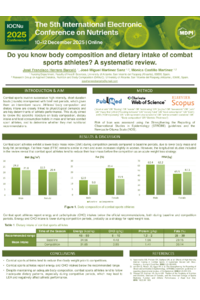
Introduction: Combat sports involve successive high-intensity, short-duration bouts (rounds) interspersed with brief rest periods, which gives them an intermittent nature. Athletes’ body composition and dietary intake are closely linked to physiological demands and are key determinants of athletic performance. The aim of this study is to review the scientific literature on body composition, dietary intake, and eating habits of male and female combat sport athletes.
Methods: A search was conducted in the PubMed-MEDLINE, Web of Science, and Scopus databases, identifying 320 documents. The research focused on amateur, semi-professional, and professional athletes in boxing, karate, kickboxing, jiu-jitsu, taekwondo, judo, muay thai, and mixed martial arts (MMA). After screening and data extraction, 17 studies met the inclusion criteria and were included in the review.
Results: A total of 500 athletes (390 males and 110 females) were assessed across all studies. Most athletes, both male and female, had BMI values within the normal range, with low or normal body fat percentages and adequate muscle mass, during both reference periods (BMI M: 24.45 ± 3.61, F: 22.49 ± 2.45; %Fat M: 12.59 ± 6.16, F: 23.42 ± 4.60; lean mass (kg) M: 62.45 ± 6.83, F: 43.28 ± 4.79) and pre-competitive periods (BMI M: 21.56 ± 1.94, F: 19.40 ± 2.20; %Fat M: 9.03 ± 4.09, F: 13.91 ± 3.85; lean mass (kg) M: 62.65 ± 8.72, F: 47.14 ± 5.35). Regarding dietary intake, most athletes reported energy (32.8 ± 14.4 kcal/kg/day) and carbohydrate (4.1 ± 2.2 g/kg/day) intakes below official recommendations. During pre-competition periods, energy and nutrient intake decreased as a strategy to achieve rapid weight loss, primarily through the loss of lean mass.
Conclusions: Despite maintaining adequate body composition, combat sport athletes tend to follow inadequate dietary patterns, especially during pre-competitive periods, which may negatively affect athletic performance.
Keywords
Combat sports
Body composition
Eating habits
Dietary intake
Sport athletes
Poster
Póster IOCNu 2025-1.pdf
Development and evaluation of plant-based 3D-printed oral dispersible films for personalized nutrition for athletes
The Role of Nutrient and Activity Timing in Healthy Aging: A Conceptual Perspective