Event submissions
Published
This submission belongs to the session S5. Sustainable diets in sport: Balancing performance and health of the event The 5th International Online Conference on Nutrients
Published date
05 Dec, 2025
Academic Editor
'%3e%3cpath%20d='M12.6657%2010.9104C12.4185%2010.325%2012.0599%209.79327%2011.6097%209.34482C11.1609%208.89508%2010.6293%208.5365%2010.0442%208.28888C10.0389%208.28626%2010.0337%208.28495%2010.0285%208.28233C10.8446%207.69279%2011.3752%206.73249%2011.3752%205.64904C11.3752%203.8542%209.92103%202.39999%208.1262%202.39999C6.33136%202.39999%204.87715%203.8542%204.87715%205.64904C4.87715%206.73249%205.40774%207.69279%206.22393%208.28364C6.21869%208.28626%206.21345%208.28757%206.20821%208.29019C5.62129%208.5378%205.09463%208.89284%204.64265%209.34613C4.1929%209.79493%203.83432%2010.3266%203.58671%2010.9117C3.34345%2011.4845%203.21226%2012.0987%203.20023%2012.7209C3.19988%2012.7349%203.20233%2012.7488%203.20744%2012.7619C3.21255%2012.7749%203.22022%2012.7867%203.22998%2012.7968C3.23975%2012.8068%203.25142%2012.8147%203.26431%2012.8202C3.2772%2012.8256%203.29105%2012.8284%203.30504%2012.8284H4.09109C4.14874%2012.8284%204.19459%2012.7825%204.1959%2012.7262C4.2221%2011.7148%204.62823%2010.7676%205.34617%2010.0497C6.08899%209.30683%207.0755%208.89808%208.1262%208.89808C9.17689%208.89808%2010.1634%209.30683%2010.9062%2010.0497C11.6242%2010.7676%2012.0303%2011.7148%2012.0565%2012.7262C12.0578%2012.7838%2012.1037%2012.8284%2012.1613%2012.8284H12.9474C12.9613%2012.8284%2012.9752%2012.8256%2012.9881%2012.8202C13.001%2012.8147%2013.0126%2012.8068%2013.0224%2012.7968C13.0322%2012.7867%2013.0398%2012.7749%2013.0449%2012.7619C13.0501%2012.7488%2013.0525%2012.7349%2013.0522%2012.7209C13.0391%2012.0947%2012.9094%2011.4855%2012.6657%2010.9104ZM8.1262%207.9024C7.52486%207.9024%206.9589%207.6679%206.53312%207.24211C6.10733%206.81633%205.87283%206.25037%205.87283%205.64904C5.87283%205.0477%206.10733%204.48174%206.53312%204.05596C6.9589%203.63018%207.52486%203.39567%208.1262%203.39567C8.72753%203.39567%209.29349%203.63018%209.71927%204.05596C10.1451%204.48174%2010.3796%205.0477%2010.3796%205.64904C10.3796%206.25037%2010.1451%206.81633%209.71927%207.24211C9.29349%207.6679%208.72753%207.9024%208.1262%207.9024Z'%20fill='%235D1EE1'/%3e%3c/g%3e%3c/svg%3e) David Nieman
David NiemanCitation
Gjorgji Temov, Krume Bogevski, Panda Joveva, Viktorija Maksimova, Quantitative Analysis of Anthocyanins in Natural Fruit Juices and Evidence-Based Rationale for Their Inclusion as Bioactive Agents in Individuals with Increased Physical Activity, in Proceedings of The 5th International Online Conference on Nutrients, 10 December–12 December 2025, MDPI: Basel, Switzerland
Share
Email
Facebook
Twitter
LinkedIn
Quantitative Analysis of Anthocyanins in Natural Fruit Juices and Evidence-Based Rationale for Their Inclusion as Bioactive Agents in Individuals with Increased Physical Activity
'%3e%3cpath%20d='M12.6647%2010.9104C12.4176%2010.325%2012.0589%209.7933%2011.6088%209.34485C11.16%208.89511%2010.6283%208.53653%2010.0432%208.28891C10.038%208.28629%2010.0327%208.28498%2010.0275%208.28236C10.8437%207.69282%2011.3743%206.73252%2011.3743%205.64907C11.3743%203.85423%209.92005%202.40002%208.12522%202.40002C6.33038%202.40002%204.87618%203.85423%204.87618%205.64907C4.87618%206.73252%205.40677%207.69282%206.22296%208.28367C6.21772%208.28629%206.21248%208.2876%206.20724%208.29022C5.62031%208.53783%205.09365%208.89287%204.64167%209.34616C4.19192%209.79496%203.83334%2010.3266%203.58573%2010.9117C3.34247%2011.4846%203.21128%2012.0987%203.19925%2012.721C3.1989%2012.735%203.20135%2012.7489%203.20646%2012.7619C3.21157%2012.7749%203.21924%2012.7868%203.22901%2012.7968C3.23877%2012.8068%203.25045%2012.8148%203.26334%2012.8202C3.27623%2012.8256%203.29007%2012.8284%203.30406%2012.8284H4.09012C4.14776%2012.8284%204.19362%2012.7825%204.19493%2012.7262C4.22113%2011.7148%204.62726%2010.7676%205.34519%2010.0497C6.08802%209.30686%207.07452%208.89811%208.12522%208.89811C9.17592%208.89811%2010.1624%209.30686%2010.9052%2010.0497C11.6232%2010.7676%2012.0293%2011.7148%2012.0555%2012.7262C12.0568%2012.7839%2012.1027%2012.8284%2012.1603%2012.8284H12.9464C12.9604%2012.8284%2012.9742%2012.8256%2012.9871%2012.8202C13%2012.8148%2013.0117%2012.8068%2013.0214%2012.7968C13.0312%2012.7868%2013.0389%2012.7749%2013.044%2012.7619C13.0491%2012.7489%2013.0515%2012.735%2013.0512%2012.721C13.0381%2012.0947%2012.9084%2011.4856%2012.6647%2010.9104ZM8.12522%207.90243C7.52388%207.90243%206.95792%207.66793%206.53214%207.24215C6.10636%206.81636%205.87185%206.2504%205.87185%205.64907C5.87185%205.04773%206.10636%204.48177%206.53214%204.05599C6.95792%203.63021%207.52388%203.3957%208.12522%203.3957C8.72655%203.3957%209.29252%203.63021%209.7183%204.05599C10.1441%204.48177%2010.3786%205.04773%2010.3786%205.64907C10.3786%206.2504%2010.1441%206.81636%209.7183%207.24215C9.29252%207.66793%208.72655%207.90243%208.12522%207.90243Z'%20fill='%235D1EE1'/%3e%3c/g%3e%3c/svg%3e)
Gjorgji Temov 1
Krume Bogevski 1
Panda Joveva 2
Viktorija Maksimova 1
1. Faculty of Medical Sciences, Goce Delcev University, Štip 2000, North Macedonia
2. “VV Tikveš" AD Kavadarci, 8-mi Septemvri Street No. 5, Kavadarci 1430, North Macedonia
Abstract
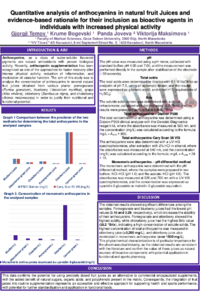
For the last few decades, plant bioactive molecules in various formulations, such as herbal medicines or dietary supplements, have been increasingly recommended for enhancing overall psycho-physical performance and resilience. The focus is directed towards natural sources of antioxidants, which not only provide health protection but also contribute to enhancing physical performance, accelerating recovery, and reducing oxidative stress through sports nutrition. Supplementation with anthocyanins has been identified as a means to accelerate recovery following intense physical activity, reduce inflammatory processes, and modulate vascular function in both recreational and professional athletes.
The main aim of this study was to perform quantitative analysis of anthocyanins in a few natural fruit juices, obtained from Punica granatum (pomegranate), Vaccinium myrtillus (bilberry), Vitis vinifera (grape), Sambucus nigra (elderberry), and Aronia melanocarpa (chokeberry), that were found locally in the region of North Macedonia. Additionally, several other parameters were evaluated, including pH, organic acid content, and Brix values, in order to serve as evidence for their rational use as nutritional and functional potential for targeted supplementation.
The results indicated significant variations depending mainly on the type of fruit the juices were obtained from. Pomegranate and bilberry juices exhibited the lowest pH values (3.16 and 3.29, respectively), consistent with conditions favoring anthocyanin stability. Pomegranate and elderberry samples demonstrated the highest titratable acidity. Chokeberry juice recorded the highest Brix value (26.2 °Brix), reflecting elevated levels of soluble solids. Elderberry juice demonstrated the highest measured concentration of total anthocyanins (>3.20 mg/L) and the highest measured concentration of monomeric anthocyanins (>1,50 mg/L).
These findings provide evidence that natural fruit juices rich in anthocyanins represent an easily accessible and nutritionally valuable alternative to synthetic supplements, particularly in the context of sports nutrition. Among the examined samples, elderberry juice appeared to be the most effective choice, supporting its potential application in functional and sports-related nutrition or dietary supplementation.
Keywords
anthocyanins
physical endurance
sports pharmacy
supplementation
phytochemical characterization
Poster
Gjorgji Temov sciforum pdf.pdf
The Impact of Caffeine-Related Genetic Variants on Power and Endurance Performance in Athletes: A Personalized Nutrigenetic Approach
Sustainable Nutrition Strategies for Rhythmic Gymnasts: Balancing Performance, Health, and Early Prediction of Anorexia Risk