Event submissions
Published
This submission belongs to the session S6. Microbiota and sports nutrition: The gut-performance connection of the event The 5th International Online Conference on Nutrients
Published date
05 Dec, 2025
Academic Editor
'%3e%3cpath%20d='M12.6657%2010.9104C12.4185%2010.325%2012.0599%209.79327%2011.6097%209.34482C11.1609%208.89508%2010.6293%208.5365%2010.0442%208.28888C10.0389%208.28626%2010.0337%208.28495%2010.0285%208.28233C10.8446%207.69279%2011.3752%206.73249%2011.3752%205.64904C11.3752%203.8542%209.92103%202.39999%208.1262%202.39999C6.33136%202.39999%204.87715%203.8542%204.87715%205.64904C4.87715%206.73249%205.40774%207.69279%206.22393%208.28364C6.21869%208.28626%206.21345%208.28757%206.20821%208.29019C5.62129%208.5378%205.09463%208.89284%204.64265%209.34613C4.1929%209.79493%203.83432%2010.3266%203.58671%2010.9117C3.34345%2011.4845%203.21226%2012.0987%203.20023%2012.7209C3.19988%2012.7349%203.20233%2012.7488%203.20744%2012.7619C3.21255%2012.7749%203.22022%2012.7867%203.22998%2012.7968C3.23975%2012.8068%203.25142%2012.8147%203.26431%2012.8202C3.2772%2012.8256%203.29105%2012.8284%203.30504%2012.8284H4.09109C4.14874%2012.8284%204.19459%2012.7825%204.1959%2012.7262C4.2221%2011.7148%204.62823%2010.7676%205.34617%2010.0497C6.08899%209.30683%207.0755%208.89808%208.1262%208.89808C9.17689%208.89808%2010.1634%209.30683%2010.9062%2010.0497C11.6242%2010.7676%2012.0303%2011.7148%2012.0565%2012.7262C12.0578%2012.7838%2012.1037%2012.8284%2012.1613%2012.8284H12.9474C12.9613%2012.8284%2012.9752%2012.8256%2012.9881%2012.8202C13.001%2012.8147%2013.0126%2012.8068%2013.0224%2012.7968C13.0322%2012.7867%2013.0398%2012.7749%2013.0449%2012.7619C13.0501%2012.7488%2013.0525%2012.7349%2013.0522%2012.7209C13.0391%2012.0947%2012.9094%2011.4855%2012.6657%2010.9104ZM8.1262%207.9024C7.52486%207.9024%206.9589%207.6679%206.53312%207.24211C6.10733%206.81633%205.87283%206.25037%205.87283%205.64904C5.87283%205.0477%206.10733%204.48174%206.53312%204.05596C6.9589%203.63018%207.52486%203.39567%208.1262%203.39567C8.72753%203.39567%209.29349%203.63018%209.71927%204.05596C10.1451%204.48174%2010.3796%205.0477%2010.3796%205.64904C10.3796%206.25037%2010.1451%206.81633%209.71927%207.24211C9.29349%207.6679%208.72753%207.9024%208.1262%207.9024Z'%20fill='%235D1EE1'/%3e%3c/g%3e%3c/svg%3e) David Nieman
David NiemanCitation
Mónica Castillo Martínez, Estela González Rodríguez, Ana Cifuentes Martínez, Isabel Sospedra López, José Miguel Martínez Sanz, Characterization of the gut microbiota in elite female futsal players throughout the season, in Proceedings of The 5th International Online Conference on Nutrients, 10 December–12 December 2025, MDPI: Basel, Switzerland
Share
Email
Facebook
Twitter
LinkedIn
Characterization of the gut microbiota in elite female futsal players throughout the season
'%3e%3cpath%20d='M12.6647%2010.9104C12.4176%2010.325%2012.0589%209.7933%2011.6088%209.34485C11.16%208.89511%2010.6283%208.53653%2010.0432%208.28891C10.038%208.28629%2010.0327%208.28498%2010.0275%208.28236C10.8437%207.69282%2011.3743%206.73252%2011.3743%205.64907C11.3743%203.85423%209.92005%202.40002%208.12522%202.40002C6.33038%202.40002%204.87618%203.85423%204.87618%205.64907C4.87618%206.73252%205.40677%207.69282%206.22296%208.28367C6.21772%208.28629%206.21248%208.2876%206.20724%208.29022C5.62031%208.53783%205.09365%208.89287%204.64167%209.34616C4.19192%209.79496%203.83334%2010.3266%203.58573%2010.9117C3.34247%2011.4846%203.21128%2012.0987%203.19925%2012.721C3.1989%2012.735%203.20135%2012.7489%203.20646%2012.7619C3.21157%2012.7749%203.21924%2012.7868%203.22901%2012.7968C3.23877%2012.8068%203.25045%2012.8148%203.26334%2012.8202C3.27623%2012.8256%203.29007%2012.8284%203.30406%2012.8284H4.09012C4.14776%2012.8284%204.19362%2012.7825%204.19493%2012.7262C4.22113%2011.7148%204.62726%2010.7676%205.34519%2010.0497C6.08802%209.30686%207.07452%208.89811%208.12522%208.89811C9.17592%208.89811%2010.1624%209.30686%2010.9052%2010.0497C11.6232%2010.7676%2012.0293%2011.7148%2012.0555%2012.7262C12.0568%2012.7839%2012.1027%2012.8284%2012.1603%2012.8284H12.9464C12.9604%2012.8284%2012.9742%2012.8256%2012.9871%2012.8202C13%2012.8148%2013.0117%2012.8068%2013.0214%2012.7968C13.0312%2012.7868%2013.0389%2012.7749%2013.044%2012.7619C13.0491%2012.7489%2013.0515%2012.735%2013.0512%2012.721C13.0381%2012.0947%2012.9084%2011.4856%2012.6647%2010.9104ZM8.12522%207.90243C7.52388%207.90243%206.95792%207.66793%206.53214%207.24215C6.10636%206.81636%205.87185%206.2504%205.87185%205.64907C5.87185%205.04773%206.10636%204.48177%206.53214%204.05599C6.95792%203.63021%207.52388%203.3957%208.12522%203.3957C8.72655%203.3957%209.29252%203.63021%209.7183%204.05599C10.1441%204.48177%2010.3786%205.04773%2010.3786%205.64907C10.3786%206.2504%2010.1441%206.81636%209.7183%207.24215C9.29252%207.66793%208.72655%207.90243%208.12522%207.90243Z'%20fill='%235D1EE1'/%3e%3c/g%3e%3c/svg%3e)
Mónica Castillo Martínez 1,2
Estela González Rodríguez 2,3
Ana Cifuentes Martínez 2,4

Isabel Sospedra López 2,3

José Miguel Martínez Sanz 2,5
1. Nursing department. Faculty of Health Sciences, University of Alicante. San Vicente del Rasapeig (Alicante), 03690, Spain.
2. Research Group on Applied Dietetics, Nutrition and Body Composition (DANUC). University of Alicante. San Vicente del Raspeig (Alicante) , 03690, Spain.
3. Nursing Department. Faculty of Health Sciences, University of Alicante. San Vicente del Raspeig (Alicante), 03690, Spain.
4. Optics, Pharmacology and Anatomy Department. Faculty Sciences, University of Alicante. San Vicente del Raspeig (Alicante), 03690, Spain.
5. Nursing Department. Faculty of Health Sciences, University of Alicante. San Vicente del Raspeig (Alicante), 03690, Spain.
Abstract
Introduction:
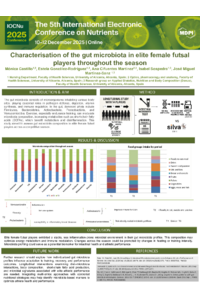
The gut microbiota consists of microorganisms inhabiting various body sites, playing essential roles in pathogen defense, digestion, vitamin synthesis, and immune regulation. In the gut, dominant phyla include Firmicutes, Bacteroidetes, Actinobacteria, Proteobacteria, and Verrucomicrobia. Exercise, especially endurance training, can modulate microbiota composition, increasing metabolites such as short-chain fatty acids (SCFAs), which benefit metabolism and inflammation. This study aimed to assess gut microbiota composition in elite female futsal players across a competitive season.
Materials and Methods:
A longitudinal descriptive observational study was conducted on 14 elite female futsal players. Quarterly, a food frequency questionnaire (CFA-95) and fecal samples were collected using self-sampling kits (Ubiome,inc. United States). Participants received sampling instructions and nutritional guidance to optimize diet and microbiota diversity. For each sample, the amplicons of the 16S rDNA region were individually barcoded and sequenced in multiplex mode on the NextSeq 500 platform, using 150 bp paired-end reads. Taxonomic classification was performed using reference cluster (99% similarity groups) against SILVA 138.1 database to determine relative abundances.
Results:
The mean diversity index was 7.96 ± 0.46, with a Firmicutes/Bacteroidetes ratio of 2.03 ± 0.079. Relative abundances were as follows: Actinobacteria, 0.40 ± 5.63; Proteobacteria, 0.87 ± 1.57; and Lactobacillus, 1.38 ± 5.02. An increase in Verrucomicrobia and Proteobacteria was observed towards the season’s end.
Discussion:
The reduction in the Firmicutes/Bacteroidetes ratio may reflect a lower risk of obesity-related metabolic profiles. Higher Actinobacteria abundance is linked to improved immune function and reduced intestinal inflammation, potentially supporting sustained performance. Verrucomicrobia, notably Akkermansia, may enhance intestinal barrier protection. Lower Proteobacteria levels could indicate a reduced susceptibility to inflammatory bowel diseases.
Conclusion:
Elite female futsal players exhibited a stable, less inflammation-prone microbial environment in their gut microbiota profiles. This composition may optimize energy metabolism and immune modulation. Microbiota profiling could serve as a potential biomarker for intestinal health and athletic performance.
Keywords
gut microbiota
female elite athletes
futsal
football indoor
intestinal health
Poster
Poster template IOCNu_MCM.pdf
Gut Resistome in Athletes: Impact of Sports Nutrition on Antimicrobial Resistance Genes
Fatty acid-primed S. boulardii enhances obesity treatment by improving gut survival and microbiota