Event submissions
Published
This submission belongs to the session S1. Dental Restorative Materials in Prosthodontics of the event The 1st International Online Conference on Prosthesis
Published date
05 Dec, 2025
Academic Editor
'%3e%3cpath%20d='M12.6657%2010.9104C12.4185%2010.325%2012.0599%209.79327%2011.6097%209.34482C11.1609%208.89508%2010.6293%208.5365%2010.0442%208.28888C10.0389%208.28626%2010.0337%208.28495%2010.0285%208.28233C10.8446%207.69279%2011.3752%206.73249%2011.3752%205.64904C11.3752%203.8542%209.92103%202.39999%208.1262%202.39999C6.33136%202.39999%204.87715%203.8542%204.87715%205.64904C4.87715%206.73249%205.40774%207.69279%206.22393%208.28364C6.21869%208.28626%206.21345%208.28757%206.20821%208.29019C5.62129%208.5378%205.09463%208.89284%204.64265%209.34613C4.1929%209.79493%203.83432%2010.3266%203.58671%2010.9117C3.34345%2011.4845%203.21226%2012.0987%203.20023%2012.7209C3.19988%2012.7349%203.20233%2012.7488%203.20744%2012.7619C3.21255%2012.7749%203.22022%2012.7867%203.22998%2012.7968C3.23975%2012.8068%203.25142%2012.8147%203.26431%2012.8202C3.2772%2012.8256%203.29105%2012.8284%203.30504%2012.8284H4.09109C4.14874%2012.8284%204.19459%2012.7825%204.1959%2012.7262C4.2221%2011.7148%204.62823%2010.7676%205.34617%2010.0497C6.08899%209.30683%207.0755%208.89808%208.1262%208.89808C9.17689%208.89808%2010.1634%209.30683%2010.9062%2010.0497C11.6242%2010.7676%2012.0303%2011.7148%2012.0565%2012.7262C12.0578%2012.7838%2012.1037%2012.8284%2012.1613%2012.8284H12.9474C12.9613%2012.8284%2012.9752%2012.8256%2012.9881%2012.8202C13.001%2012.8147%2013.0126%2012.8068%2013.0224%2012.7968C13.0322%2012.7867%2013.0398%2012.7749%2013.0449%2012.7619C13.0501%2012.7488%2013.0525%2012.7349%2013.0522%2012.7209C13.0391%2012.0947%2012.9094%2011.4855%2012.6657%2010.9104ZM8.1262%207.9024C7.52486%207.9024%206.9589%207.6679%206.53312%207.24211C6.10733%206.81633%205.87283%206.25037%205.87283%205.64904C5.87283%205.0477%206.10733%204.48174%206.53312%204.05596C6.9589%203.63018%207.52486%203.39567%208.1262%203.39567C8.72753%203.39567%209.29349%203.63018%209.71927%204.05596C10.1451%204.48174%2010.3796%205.0477%2010.3796%205.64904C10.3796%206.25037%2010.1451%206.81633%209.71927%207.24211C9.29349%207.6679%208.72753%207.9024%208.1262%207.9024Z'%20fill='%235D1EE1'/%3e%3c/g%3e%3c/svg%3e) Marco Cicciù
Marco CicciùCitation
Jyothi Venkat Sainath, Akhileshwar Namani, Vinayak Munirathnam, Karthik Rishi, Prosthetic rehabilitation of velopharyngeal insufficiency in a patient with locally advanced carcinoma oropharynx: a case report, in Proceedings of The 1st International Online Conference on Prosthesis, 10 December–12 December 2025, MDPI: Basel, Switzerland
Share
Email
Facebook
Twitter
LinkedIn
Prosthetic rehabilitation of velopharyngeal insufficiency in a patient with locally advanced carcinoma oropharynx: a case report
'%3e%3cpath%20d='M12.6647%2010.9104C12.4176%2010.325%2012.0589%209.7933%2011.6088%209.34485C11.16%208.89511%2010.6283%208.53653%2010.0432%208.28891C10.038%208.28629%2010.0327%208.28498%2010.0275%208.28236C10.8437%207.69282%2011.3743%206.73252%2011.3743%205.64907C11.3743%203.85423%209.92005%202.40002%208.12522%202.40002C6.33038%202.40002%204.87618%203.85423%204.87618%205.64907C4.87618%206.73252%205.40677%207.69282%206.22296%208.28367C6.21772%208.28629%206.21248%208.2876%206.20724%208.29022C5.62031%208.53783%205.09365%208.89287%204.64167%209.34616C4.19192%209.79496%203.83334%2010.3266%203.58573%2010.9117C3.34247%2011.4846%203.21128%2012.0987%203.19925%2012.721C3.1989%2012.735%203.20135%2012.7489%203.20646%2012.7619C3.21157%2012.7749%203.21924%2012.7868%203.22901%2012.7968C3.23877%2012.8068%203.25045%2012.8148%203.26334%2012.8202C3.27623%2012.8256%203.29007%2012.8284%203.30406%2012.8284H4.09012C4.14776%2012.8284%204.19362%2012.7825%204.19493%2012.7262C4.22113%2011.7148%204.62726%2010.7676%205.34519%2010.0497C6.08802%209.30686%207.07452%208.89811%208.12522%208.89811C9.17592%208.89811%2010.1624%209.30686%2010.9052%2010.0497C11.6232%2010.7676%2012.0293%2011.7148%2012.0555%2012.7262C12.0568%2012.7839%2012.1027%2012.8284%2012.1603%2012.8284H12.9464C12.9604%2012.8284%2012.9742%2012.8256%2012.9871%2012.8202C13%2012.8148%2013.0117%2012.8068%2013.0214%2012.7968C13.0312%2012.7868%2013.0389%2012.7749%2013.044%2012.7619C13.0491%2012.7489%2013.0515%2012.735%2013.0512%2012.721C13.0381%2012.0947%2012.9084%2011.4856%2012.6647%2010.9104ZM8.12522%207.90243C7.52388%207.90243%206.95792%207.66793%206.53214%207.24215C6.10636%206.81636%205.87185%206.2504%205.87185%205.64907C5.87185%205.04773%206.10636%204.48177%206.53214%204.05599C6.95792%203.63021%207.52388%203.3957%208.12522%203.3957C8.72655%203.3957%209.29252%203.63021%209.7183%204.05599C10.1441%204.48177%2010.3786%205.04773%2010.3786%205.64907C10.3786%206.2504%2010.1441%206.81636%209.7183%207.24215C9.29252%207.66793%208.72655%207.90243%208.12522%207.90243Z'%20fill='%235D1EE1'/%3e%3c/g%3e%3c/svg%3e)
Jyothi Venkat Sainath 1
Akhileshwar Namani 2
Vinayak Munirathnam 3
Karthik Rishi 4
1. Department of Maxillofacial Prosthodontics, Sri Shankara Cancer Hospital and Research Centre, Bangalore 560004, India., India
2. Department of Molecular Oncology, Sri Shankara Cancer Hospital and Research Centre, Sri Shankara National Centre for Cancer Prevention and Research, Sri Shankara Cancer Foundation, Bangalore 560004, India., India
3. Department of Medical Oncology, Sri Shankara Cancer Hospital and Research Centre, Bangalore 560004, India, India
4. Department of Radiation Oncology, Sri Shankara Cancer Hospital and Research Centre, Bangalore 560004, India, India
Abstract
Introduction:
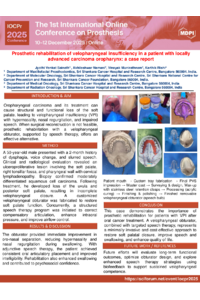
Oropharyngeal carcinoma and its treatment can cause structural and functional loss of the soft palate, leading to velopharyngeal insufficiency (VPI) with hypernasality, nasal regurgitation, and impaired speech. When surgical reconstruction is not feasible, prosthetic rehabilitation with a velopharyngeal obturator, supported by speech therapy, offers an effective alternative.
Methods:
A 50-year-old male presented with a 2-month history of dysphagia, voice change, and slurred speech. Clinical and radiological evaluation revealed an ulceroproliferative lesion involving the soft palate, right tonsillar fossa, and pharyngeal wall with cervical lymphadenopathy. Biopsy confirmed moderately differentiated squamous cell carcinoma. Following treatment, he developed loss of the uvula and posterior soft palate, resulting in incomplete velopharyngeal closure. A customized velopharyngeal obturator was fabricated to restore soft palate function. Concurrently, a structured speech therapy program was initiated to correct compensatory articulation, enhance intraoral pressure, and improve airflow control.
Results:
The obturator provided immediate improvement in oro-nasal separation, reducing hypernasality and nasal regurgitation during swallowing. With adjunctive speech therapy, the patient achieved consistent oral articulatory placement and improved intelligibility. Rehabilitation also enhanced swallowing and contributed to psychosocial confidence.
Conclusion:
This case demonstrates the importance of prosthetic rehabilitation for patients with VPI after oral cancer treatment. A velopharyngeal obturator, combined with targeted speech therapy, represents a minimally invasive and cost-effective approach to restore soft palatal closure, improve speech and swallowing, and enhance quality of life.
Keywords
Velopharyngeal insufficiency
oral cancer
soft palate defect
velopharyngeal obturator
speech therapy
prosthetic rehabilitation
Poster
Poster Jyothi Venkat Sainath.pdf
"Evaluating the Effects of Mechanical and Electrical Stimuli on Osteoblast Mineralization in Dynamic Cell Cultures"
Effect of Brushing on Surface Roughness, Microbial Adhesion, and Color stability of 3D-Printed Provisional Restorations Fabricated with Different Print Orientations: An In Vitro Study.