Event submissions
Published
This submission belongs to the session S2. Digital Technologies and Artificial Intelligence in Prosthodontics of the event The 1st International Online Conference on Prosthesis
Published date
05 Dec, 2025
Academic Editor
'%3e%3cpath%20d='M12.6657%2010.9104C12.4185%2010.325%2012.0599%209.79327%2011.6097%209.34482C11.1609%208.89508%2010.6293%208.5365%2010.0442%208.28888C10.0389%208.28626%2010.0337%208.28495%2010.0285%208.28233C10.8446%207.69279%2011.3752%206.73249%2011.3752%205.64904C11.3752%203.8542%209.92103%202.39999%208.1262%202.39999C6.33136%202.39999%204.87715%203.8542%204.87715%205.64904C4.87715%206.73249%205.40774%207.69279%206.22393%208.28364C6.21869%208.28626%206.21345%208.28757%206.20821%208.29019C5.62129%208.5378%205.09463%208.89284%204.64265%209.34613C4.1929%209.79493%203.83432%2010.3266%203.58671%2010.9117C3.34345%2011.4845%203.21226%2012.0987%203.20023%2012.7209C3.19988%2012.7349%203.20233%2012.7488%203.20744%2012.7619C3.21255%2012.7749%203.22022%2012.7867%203.22998%2012.7968C3.23975%2012.8068%203.25142%2012.8147%203.26431%2012.8202C3.2772%2012.8256%203.29105%2012.8284%203.30504%2012.8284H4.09109C4.14874%2012.8284%204.19459%2012.7825%204.1959%2012.7262C4.2221%2011.7148%204.62823%2010.7676%205.34617%2010.0497C6.08899%209.30683%207.0755%208.89808%208.1262%208.89808C9.17689%208.89808%2010.1634%209.30683%2010.9062%2010.0497C11.6242%2010.7676%2012.0303%2011.7148%2012.0565%2012.7262C12.0578%2012.7838%2012.1037%2012.8284%2012.1613%2012.8284H12.9474C12.9613%2012.8284%2012.9752%2012.8256%2012.9881%2012.8202C13.001%2012.8147%2013.0126%2012.8068%2013.0224%2012.7968C13.0322%2012.7867%2013.0398%2012.7749%2013.0449%2012.7619C13.0501%2012.7488%2013.0525%2012.7349%2013.0522%2012.7209C13.0391%2012.0947%2012.9094%2011.4855%2012.6657%2010.9104ZM8.1262%207.9024C7.52486%207.9024%206.9589%207.6679%206.53312%207.24211C6.10733%206.81633%205.87283%206.25037%205.87283%205.64904C5.87283%205.0477%206.10733%204.48174%206.53312%204.05596C6.9589%203.63018%207.52486%203.39567%208.1262%203.39567C8.72753%203.39567%209.29349%203.63018%209.71927%204.05596C10.1451%204.48174%2010.3796%205.0477%2010.3796%205.64904C10.3796%206.25037%2010.1451%206.81633%209.71927%207.24211C9.29349%207.6679%208.72753%207.9024%208.1262%207.9024Z'%20fill='%235D1EE1'/%3e%3c/g%3e%3c/svg%3e) Marco Cicciù
Marco CicciùCitation
Vito Cirillo, Annamaria Mastrosimone, Gennaro Ruggiero, Giulia de Durante, Ruben Maria Paino, Clarissa Esposito, Roberto Sorrentino, Fernando Zarone, Evaluation of Dental Students’ Perception and Appreciation of 3D Augmented Reality Systems in Education: An Experimental Study., in Proceedings of The 1st International Online Conference on Prosthesis, 10 December–12 December 2025, MDPI: Basel, Switzerland
Share
Email
Facebook
Twitter
LinkedIn
Evaluation of Dental Students’ Perception and Appreciation of 3D Augmented Reality Systems in Education: An Experimental Study.
'%3e%3cpath%20d='M12.6647%2010.9104C12.4176%2010.325%2012.0589%209.7933%2011.6088%209.34485C11.16%208.89511%2010.6283%208.53653%2010.0432%208.28891C10.038%208.28629%2010.0327%208.28498%2010.0275%208.28236C10.8437%207.69282%2011.3743%206.73252%2011.3743%205.64907C11.3743%203.85423%209.92005%202.40002%208.12522%202.40002C6.33038%202.40002%204.87618%203.85423%204.87618%205.64907C4.87618%206.73252%205.40677%207.69282%206.22296%208.28367C6.21772%208.28629%206.21248%208.2876%206.20724%208.29022C5.62031%208.53783%205.09365%208.89287%204.64167%209.34616C4.19192%209.79496%203.83334%2010.3266%203.58573%2010.9117C3.34247%2011.4846%203.21128%2012.0987%203.19925%2012.721C3.1989%2012.735%203.20135%2012.7489%203.20646%2012.7619C3.21157%2012.7749%203.21924%2012.7868%203.22901%2012.7968C3.23877%2012.8068%203.25045%2012.8148%203.26334%2012.8202C3.27623%2012.8256%203.29007%2012.8284%203.30406%2012.8284H4.09012C4.14776%2012.8284%204.19362%2012.7825%204.19493%2012.7262C4.22113%2011.7148%204.62726%2010.7676%205.34519%2010.0497C6.08802%209.30686%207.07452%208.89811%208.12522%208.89811C9.17592%208.89811%2010.1624%209.30686%2010.9052%2010.0497C11.6232%2010.7676%2012.0293%2011.7148%2012.0555%2012.7262C12.0568%2012.7839%2012.1027%2012.8284%2012.1603%2012.8284H12.9464C12.9604%2012.8284%2012.9742%2012.8256%2012.9871%2012.8202C13%2012.8148%2013.0117%2012.8068%2013.0214%2012.7968C13.0312%2012.7868%2013.0389%2012.7749%2013.044%2012.7619C13.0491%2012.7489%2013.0515%2012.735%2013.0512%2012.721C13.0381%2012.0947%2012.9084%2011.4856%2012.6647%2010.9104ZM8.12522%207.90243C7.52388%207.90243%206.95792%207.66793%206.53214%207.24215C6.10636%206.81636%205.87185%206.2504%205.87185%205.64907C5.87185%205.04773%206.10636%204.48177%206.53214%204.05599C6.95792%203.63021%207.52388%203.3957%208.12522%203.3957C8.72655%203.3957%209.29252%203.63021%209.7183%204.05599C10.1441%204.48177%2010.3786%205.04773%2010.3786%205.64907C10.3786%206.2504%2010.1441%206.81636%209.7183%207.24215C9.29252%207.66793%208.72655%207.90243%208.12522%207.90243Z'%20fill='%235D1EE1'/%3e%3c/g%3e%3c/svg%3e)
Vito Cirillo 1
Annamaria Mastrosimone 1

Gennaro Ruggiero 1
Giulia de Durante 1
Ruben Maria Paino 1
Clarissa Esposito 1

Roberto Sorrentino 1

Fernando Zarone 1
1. Department of Neuroscience and Reproductive and Odontostomatological Sciences, University of Naples Federico II, Naples 80131, Italy
Abstract
ABSTRACT:
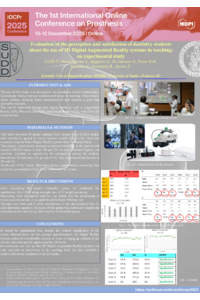
Digital technologies have become an integral part of daily life, offering increasingly sophisticated tools across many professional sectors. With the growing integration of artificial intelligence and digital realities (AR, VR, MR), even specialized fields such as dentistry are beginning to benefit from these advancements. In particular, augmented reality now allows for the simultaneous visualization of intraoperative information and the remote sharing of clinical procedures.
AIM:
This study aimed to evaluate dental students’ perception and appreciation of a 3D Augmented Reality system (Falko) used in an educational context, comparing 3D and 2D visualizations. The null hypothesis stated that no statistically significant difference would be found between the two modalities.
METHODS:
During a standard clinical teaching session, thirty dental students from various academic years were divided into two groups. One group used the 3D system via head-mounted displays and VR glasses, while the other used 2D displays via smartphones or clinic monitors. The session was delivered both in the clinical environment and remotely. At the end of the session, participants completed a questionnaire via Google Forms, consisting of six VAS-scale questions evaluating key aspects of the system’s educational usefulness.
RESULTS:
Students reported a highly positive experience, with increased engagement and attention noted across both groups. Due to the non-normal distribution , the Student’s t-test was not applicable. Instead, the Mann–Whitney test revealed a statistically significant difference for the 3D group.
CONCLUSION:
The null hypothesis was rejected, confirming that the 3D visualization mode was significantly more appreciated than the 2D one. Despite the encouraging findings, the innovative nature of this study and the limited sample size; further research with a larger sample size is needed to validate these results.
Keywords
Students
Digital technologies
3D
2D
Augmented Reality systems
Perception
Poster
POSTER CIRILLO Vito.pdf
Systematic Review of CAD/CAM-Fabricated Customized Healing Abutments and Their Effect on Soft Tissue Esthetics
Comparative in vitro study of the marginal fit of 3D-printed nanocomposite crowns with horizontal and vertical preparation geometries