Event submissions
Published
This submission belongs to the session S1. Biostimulation and Biocontrol Strategies of the event The 5th International Electronic Conference on Agronomy
Published date
11 Dec, 2025
Academic Editor
'%3e%3cpath%20d='M12.6657%2010.9104C12.4185%2010.325%2012.0599%209.79327%2011.6097%209.34482C11.1609%208.89508%2010.6293%208.5365%2010.0442%208.28888C10.0389%208.28626%2010.0337%208.28495%2010.0285%208.28233C10.8446%207.69279%2011.3752%206.73249%2011.3752%205.64904C11.3752%203.8542%209.92103%202.39999%208.1262%202.39999C6.33136%202.39999%204.87715%203.8542%204.87715%205.64904C4.87715%206.73249%205.40774%207.69279%206.22393%208.28364C6.21869%208.28626%206.21345%208.28757%206.20821%208.29019C5.62129%208.5378%205.09463%208.89284%204.64265%209.34613C4.1929%209.79493%203.83432%2010.3266%203.58671%2010.9117C3.34345%2011.4845%203.21226%2012.0987%203.20023%2012.7209C3.19988%2012.7349%203.20233%2012.7488%203.20744%2012.7619C3.21255%2012.7749%203.22022%2012.7867%203.22998%2012.7968C3.23975%2012.8068%203.25142%2012.8147%203.26431%2012.8202C3.2772%2012.8256%203.29105%2012.8284%203.30504%2012.8284H4.09109C4.14874%2012.8284%204.19459%2012.7825%204.1959%2012.7262C4.2221%2011.7148%204.62823%2010.7676%205.34617%2010.0497C6.08899%209.30683%207.0755%208.89808%208.1262%208.89808C9.17689%208.89808%2010.1634%209.30683%2010.9062%2010.0497C11.6242%2010.7676%2012.0303%2011.7148%2012.0565%2012.7262C12.0578%2012.7838%2012.1037%2012.8284%2012.1613%2012.8284H12.9474C12.9613%2012.8284%2012.9752%2012.8256%2012.9881%2012.8202C13.001%2012.8147%2013.0126%2012.8068%2013.0224%2012.7968C13.0322%2012.7867%2013.0398%2012.7749%2013.0449%2012.7619C13.0501%2012.7488%2013.0525%2012.7349%2013.0522%2012.7209C13.0391%2012.0947%2012.9094%2011.4855%2012.6657%2010.9104ZM8.1262%207.9024C7.52486%207.9024%206.9589%207.6679%206.53312%207.24211C6.10733%206.81633%205.87283%206.25037%205.87283%205.64904C5.87283%205.0477%206.10733%204.48174%206.53312%204.05596C6.9589%203.63018%207.52486%203.39567%208.1262%203.39567C8.72753%203.39567%209.29349%203.63018%209.71927%204.05596C10.1451%204.48174%2010.3796%205.0477%2010.3796%205.64904C10.3796%206.25037%2010.1451%206.81633%209.71927%207.24211C9.29349%207.6679%208.72753%207.9024%208.1262%207.9024Z'%20fill='%235D1EE1'/%3e%3c/g%3e%3c/svg%3e) Monica Boscaiu
Monica BoscaiuCitation
Melanie Desiree Desirée Gomez Herrera, Alejo Oliva, Alfonso Lovato Echeverria, Maria Victoria Traffano-Schiffo, Maria VIctoria Avanza, Biocompatibility between biopolymers and Trichoderma virens, in Proceedings of The 5th International Electronic Conference on Agronomy, 15 December–18 December 2025, MDPI: Basel, Switzerland
Share
Email
Facebook
Twitter
LinkedIn
Biocompatibility between biopolymers and Trichoderma virens
'%3e%3cpath%20d='M12.6647%2010.9104C12.4176%2010.325%2012.0589%209.7933%2011.6088%209.34485C11.16%208.89511%2010.6283%208.53653%2010.0432%208.28891C10.038%208.28629%2010.0327%208.28498%2010.0275%208.28236C10.8437%207.69282%2011.3743%206.73252%2011.3743%205.64907C11.3743%203.85423%209.92005%202.40002%208.12522%202.40002C6.33038%202.40002%204.87618%203.85423%204.87618%205.64907C4.87618%206.73252%205.40677%207.69282%206.22296%208.28367C6.21772%208.28629%206.21248%208.2876%206.20724%208.29022C5.62031%208.53783%205.09365%208.89287%204.64167%209.34616C4.19192%209.79496%203.83334%2010.3266%203.58573%2010.9117C3.34247%2011.4846%203.21128%2012.0987%203.19925%2012.721C3.1989%2012.735%203.20135%2012.7489%203.20646%2012.7619C3.21157%2012.7749%203.21924%2012.7868%203.22901%2012.7968C3.23877%2012.8068%203.25045%2012.8148%203.26334%2012.8202C3.27623%2012.8256%203.29007%2012.8284%203.30406%2012.8284H4.09012C4.14776%2012.8284%204.19362%2012.7825%204.19493%2012.7262C4.22113%2011.7148%204.62726%2010.7676%205.34519%2010.0497C6.08802%209.30686%207.07452%208.89811%208.12522%208.89811C9.17592%208.89811%2010.1624%209.30686%2010.9052%2010.0497C11.6232%2010.7676%2012.0293%2011.7148%2012.0555%2012.7262C12.0568%2012.7839%2012.1027%2012.8284%2012.1603%2012.8284H12.9464C12.9604%2012.8284%2012.9742%2012.8256%2012.9871%2012.8202C13%2012.8148%2013.0117%2012.8068%2013.0214%2012.7968C13.0312%2012.7868%2013.0389%2012.7749%2013.044%2012.7619C13.0491%2012.7489%2013.0515%2012.735%2013.0512%2012.721C13.0381%2012.0947%2012.9084%2011.4856%2012.6647%2010.9104ZM8.12522%207.90243C7.52388%207.90243%206.95792%207.66793%206.53214%207.24215C6.10636%206.81636%205.87185%206.2504%205.87185%205.64907C5.87185%205.04773%206.10636%204.48177%206.53214%204.05599C6.95792%203.63021%207.52388%203.3957%208.12522%203.3957C8.72655%203.3957%209.29252%203.63021%209.7183%204.05599C10.1441%204.48177%2010.3786%205.04773%2010.3786%205.64907C10.3786%206.2504%2010.1441%206.81636%209.7183%207.24215C9.29252%207.66793%208.72655%207.90243%208.12522%207.90243Z'%20fill='%235D1EE1'/%3e%3c/g%3e%3c/svg%3e)
Melanie Desiree Desirée Gomez Herrera 1
Alejo Oliva 2
Alfonso Lovato Echeverria 2
Maria Victoria Traffano-Schiffo 3
Maria VIctoria Avanza 3
1. Faculty of Agricultural Engineering, National University of the Northeast (UNNE), National Scientific and Technical Research Council (CONICET), Corrientes 3400, Argentina
2. Faculty of Agricultural Engineering, Department of Plant Protection, National University of the Northeast (UNNE), Corrientes 3400, Argentina
3. Institute of basic and applied chemistry (IQUIBA NEA UNNE CONICET), National University of the Northeast (UNNE) Roca Campus, Corrientes 3400, Argentina
Abstract
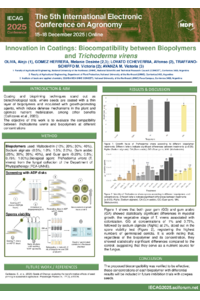
The use of biopolymers as seed coating is an innovative, pre-germinative method of controlled seed hydration, combined with the inoculation of biological agents that act as biocontrollers or growth promoters, helping to improve germination, initial plant growth, and overcome different types of biotic or abiotic stress. Therefore, the objective of this work was to evaluate the compatibility between Trichoderma virens and biopolymers at different concentrations. The following biopolymers were used: Maltodextrin (M), Sodium Alginate (AlNa), Guar Gum (GG), and Arabig Gum (AG) in four different concentrations. The native Trichoderma virens fungus used as a biostimulant belongs to the fungal collection of the Plant Pathology Department of the Faculty of Agricultural Sciences of the National University of the Northeast (FCA-UNNE). Two methodologies were used in petri culture: Screening with PDA (potato dextrose agar) discs and spore viability counting for the different biopolymers and concentrations (treatments). Regarding the screening technique, the biopolymers with the lowest incidence on mycelial growth were M and AlNa, while those with the highest statistical impact were AG and GG. In the spore viability assay, the treatment that statistically yielded the highest number of viable spores was 1% guar gum, followed by 0.75% GG and 2% AlNa. In conclusion, these preliminary results on the compatibility between biopolymers and T. virens lay the groundwork for their inclusion as a coating in the seed. The assay indicates that GG was the most effective biopolymer for spore viability, while AG and GG significantly favored mycelial growth of T. virens. These differences could be attributed to the different nutritional requirements of the fungus during its growth and germination phases, underscoring the importance of selecting compatible biopolymers for each phase.
Keywords
coating
Trichoderma
biopolymers
Poster
sciforum-144890.pdf
Spatiotemporal Dynamics of Ecological Health in Punjab (2001–2023): Integrated Remote Sensing Approach for Sustainable Paddy Cultivation
Sustainable Mango Production through Innovative and Community-based Management: The Mango Tayo! Model