Event submissions
Published
This submission belongs to the session S5. Data-Driven Design for Energy Forecasting, Security, and Resilience of the event The 1st International Online Conference on Designs
Published date
06 Feb, 2026
Academic Editor
'%3e%3cpath%20d='M12.6657%2010.9104C12.4185%2010.325%2012.0599%209.79327%2011.6097%209.34482C11.1609%208.89508%2010.6293%208.5365%2010.0442%208.28888C10.0389%208.28626%2010.0337%208.28495%2010.0285%208.28233C10.8446%207.69279%2011.3752%206.73249%2011.3752%205.64904C11.3752%203.8542%209.92103%202.39999%208.1262%202.39999C6.33136%202.39999%204.87715%203.8542%204.87715%205.64904C4.87715%206.73249%205.40774%207.69279%206.22393%208.28364C6.21869%208.28626%206.21345%208.28757%206.20821%208.29019C5.62129%208.5378%205.09463%208.89284%204.64265%209.34613C4.1929%209.79493%203.83432%2010.3266%203.58671%2010.9117C3.34345%2011.4845%203.21226%2012.0987%203.20023%2012.7209C3.19988%2012.7349%203.20233%2012.7488%203.20744%2012.7619C3.21255%2012.7749%203.22022%2012.7867%203.22998%2012.7968C3.23975%2012.8068%203.25142%2012.8147%203.26431%2012.8202C3.2772%2012.8256%203.29105%2012.8284%203.30504%2012.8284H4.09109C4.14874%2012.8284%204.19459%2012.7825%204.1959%2012.7262C4.2221%2011.7148%204.62823%2010.7676%205.34617%2010.0497C6.08899%209.30683%207.0755%208.89808%208.1262%208.89808C9.17689%208.89808%2010.1634%209.30683%2010.9062%2010.0497C11.6242%2010.7676%2012.0303%2011.7148%2012.0565%2012.7262C12.0578%2012.7838%2012.1037%2012.8284%2012.1613%2012.8284H12.9474C12.9613%2012.8284%2012.9752%2012.8256%2012.9881%2012.8202C13.001%2012.8147%2013.0126%2012.8068%2013.0224%2012.7968C13.0322%2012.7867%2013.0398%2012.7749%2013.0449%2012.7619C13.0501%2012.7488%2013.0525%2012.7349%2013.0522%2012.7209C13.0391%2012.0947%2012.9094%2011.4855%2012.6657%2010.9104ZM8.1262%207.9024C7.52486%207.9024%206.9589%207.6679%206.53312%207.24211C6.10733%206.81633%205.87283%206.25037%205.87283%205.64904C5.87283%205.0477%206.10733%204.48174%206.53312%204.05596C6.9589%203.63018%207.52486%203.39567%208.1262%203.39567C8.72753%203.39567%209.29349%203.63018%209.71927%204.05596C10.1451%204.48174%2010.3796%205.0477%2010.3796%205.64904C10.3796%206.25037%2010.1451%206.81633%209.71927%207.24211C9.29349%207.6679%208.72753%207.9024%208.1262%207.9024Z'%20fill='%235D1EE1'/%3e%3c/g%3e%3c/svg%3e) Yichen Zong
Yichen ZongCitation
Alvaro Garcia Ruiz, Pablo Fernández-Arias, Antonio del Bosque, Diego Vergara, Optimizing Offshore Green Hydrogen Systems via Modular Simulation, in Proceedings of The 1st International Online Conference on Designs, 9 February–10 February 2026, MDPI: Basel, Switzerland
Share
Email
Facebook
Twitter
LinkedIn
Optimizing Offshore Green Hydrogen Systems via Modular Simulation
'%3e%3cpath%20d='M12.6647%2010.9104C12.4176%2010.325%2012.0589%209.7933%2011.6088%209.34485C11.16%208.89511%2010.6283%208.53653%2010.0432%208.28891C10.038%208.28629%2010.0327%208.28498%2010.0275%208.28236C10.8437%207.69282%2011.3743%206.73252%2011.3743%205.64907C11.3743%203.85423%209.92005%202.40002%208.12522%202.40002C6.33038%202.40002%204.87618%203.85423%204.87618%205.64907C4.87618%206.73252%205.40677%207.69282%206.22296%208.28367C6.21772%208.28629%206.21248%208.2876%206.20724%208.29022C5.62031%208.53783%205.09365%208.89287%204.64167%209.34616C4.19192%209.79496%203.83334%2010.3266%203.58573%2010.9117C3.34247%2011.4846%203.21128%2012.0987%203.19925%2012.721C3.1989%2012.735%203.20135%2012.7489%203.20646%2012.7619C3.21157%2012.7749%203.21924%2012.7868%203.22901%2012.7968C3.23877%2012.8068%203.25045%2012.8148%203.26334%2012.8202C3.27623%2012.8256%203.29007%2012.8284%203.30406%2012.8284H4.09012C4.14776%2012.8284%204.19362%2012.7825%204.19493%2012.7262C4.22113%2011.7148%204.62726%2010.7676%205.34519%2010.0497C6.08802%209.30686%207.07452%208.89811%208.12522%208.89811C9.17592%208.89811%2010.1624%209.30686%2010.9052%2010.0497C11.6232%2010.7676%2012.0293%2011.7148%2012.0555%2012.7262C12.0568%2012.7839%2012.1027%2012.8284%2012.1603%2012.8284H12.9464C12.9604%2012.8284%2012.9742%2012.8256%2012.9871%2012.8202C13%2012.8148%2013.0117%2012.8068%2013.0214%2012.7968C13.0312%2012.7868%2013.0389%2012.7749%2013.044%2012.7619C13.0491%2012.7489%2013.0515%2012.735%2013.0512%2012.721C13.0381%2012.0947%2012.9084%2011.4856%2012.6647%2010.9104ZM8.12522%207.90243C7.52388%207.90243%206.95792%207.66793%206.53214%207.24215C6.10636%206.81636%205.87185%206.2504%205.87185%205.64907C5.87185%205.04773%206.10636%204.48177%206.53214%204.05599C6.95792%203.63021%207.52388%203.3957%208.12522%203.3957C8.72655%203.3957%209.29252%203.63021%209.7183%204.05599C10.1441%204.48177%2010.3786%205.04773%2010.3786%205.64907C10.3786%206.2504%2010.1441%206.81636%209.7183%207.24215C9.29252%207.66793%208.72655%207.90243%208.12522%207.90243Z'%20fill='%235D1EE1'/%3e%3c/g%3e%3c/svg%3e)
Alvaro Garcia Ruiz 1

Pablo Fernández-Arias 2

Antonio del Bosque 2

Diego Vergara 2
1. School of Nautical Science and Marine Engineering, Square Marina Mercante, s/n, 15011 A Coruña, Spain
2. Technology, Instruction and Design in Engineering and Education Research Group (TiDEE.rg),
Catholic University of Ávila, C/Canteros s/n, 05005 Ávila, Spain
Abstract
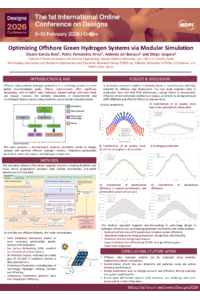
This study presents a mathematics-based simulation model for designing, analyzing, and optimizing offshore green hydrogen stations powered by solar photovoltaic systems, applicable to any location worldwide. Developed in Python, the model integrates environmental, physical, and technological parameters to simulate and forecast hydrogen production via water electrolysis using ALK or PEM electrolyzers, combined with an adiabatic compressor that enhances energy storage and facilitates integration into smart grids.
The five-phase modular methodology includes timeframe definition; estimation of solar electricity generation based on solar trajectory and the geographic orientation of photovoltaic panels; performance modeling of electrolyzers and compressors; and the integration of all components into a cohesive system. A case study demonstrates the model’s real-world applicability.
Results based on 2025 efficiency projections for ALK and PEM technologies show a substantial increase in solar energy capture in offshore environments, due to reduced atmospheric pollution and sea-surface reflectivity. Reflectivity is modeled as a function of sea surface flatness. A 20% increase in electrolyzer efficiency improves production by 32.28%, and the same efficiency gain in the compressor adds 0.81%. These impacts directly correlate with proportional reductions in the photovoltaic panel surface area required—greater electricity generation capacity translates into smaller infrastructure needs.
The model enables quantitative evaluation of trade-offs among solar irradiance, component performance, and system design. It supports cost reduction through optimized sizing and improved integration. This approach contributes to lowering the Levelized Cost of Electricity (LCOE) and promoting the viability of marine-based green hydrogen deployment.
Keywords
Renewable Energy
Smart Grids
Energy Storage
Energy Efficiency
Energy Forecasting
marine energy
green hydrogen
station
offshore
solar
photovoltaic
electrolyzer
adiabatic compressor
model
simulation
Poster
AG, PFA, AdB, DV. Optimizing Offshore Green Hydrogen Systems via Modular Simulation.pdf
Adaptive Neuro-Fuzzy Control of a Small Wind Turbine Integrated with Battery Storage for Remote Villages in Uzbekistan