Event submissions
Published
This submission belongs to the session S1. Artificial Intelligence for Renewable Energy Systems and Optimization of the event The 1st International Online Conference on Designs
Published date
06 Feb, 2026
Academic Editor
'%3e%3cpath%20d='M12.6657%2010.9104C12.4185%2010.325%2012.0599%209.79327%2011.6097%209.34482C11.1609%208.89508%2010.6293%208.5365%2010.0442%208.28888C10.0389%208.28626%2010.0337%208.28495%2010.0285%208.28233C10.8446%207.69279%2011.3752%206.73249%2011.3752%205.64904C11.3752%203.8542%209.92103%202.39999%208.1262%202.39999C6.33136%202.39999%204.87715%203.8542%204.87715%205.64904C4.87715%206.73249%205.40774%207.69279%206.22393%208.28364C6.21869%208.28626%206.21345%208.28757%206.20821%208.29019C5.62129%208.5378%205.09463%208.89284%204.64265%209.34613C4.1929%209.79493%203.83432%2010.3266%203.58671%2010.9117C3.34345%2011.4845%203.21226%2012.0987%203.20023%2012.7209C3.19988%2012.7349%203.20233%2012.7488%203.20744%2012.7619C3.21255%2012.7749%203.22022%2012.7867%203.22998%2012.7968C3.23975%2012.8068%203.25142%2012.8147%203.26431%2012.8202C3.2772%2012.8256%203.29105%2012.8284%203.30504%2012.8284H4.09109C4.14874%2012.8284%204.19459%2012.7825%204.1959%2012.7262C4.2221%2011.7148%204.62823%2010.7676%205.34617%2010.0497C6.08899%209.30683%207.0755%208.89808%208.1262%208.89808C9.17689%208.89808%2010.1634%209.30683%2010.9062%2010.0497C11.6242%2010.7676%2012.0303%2011.7148%2012.0565%2012.7262C12.0578%2012.7838%2012.1037%2012.8284%2012.1613%2012.8284H12.9474C12.9613%2012.8284%2012.9752%2012.8256%2012.9881%2012.8202C13.001%2012.8147%2013.0126%2012.8068%2013.0224%2012.7968C13.0322%2012.7867%2013.0398%2012.7749%2013.0449%2012.7619C13.0501%2012.7488%2013.0525%2012.7349%2013.0522%2012.7209C13.0391%2012.0947%2012.9094%2011.4855%2012.6657%2010.9104ZM8.1262%207.9024C7.52486%207.9024%206.9589%207.6679%206.53312%207.24211C6.10733%206.81633%205.87283%206.25037%205.87283%205.64904C5.87283%205.0477%206.10733%204.48174%206.53312%204.05596C6.9589%203.63018%207.52486%203.39567%208.1262%203.39567C8.72753%203.39567%209.29349%203.63018%209.71927%204.05596C10.1451%204.48174%2010.3796%205.0477%2010.3796%205.64904C10.3796%206.25037%2010.1451%206.81633%209.71927%207.24211C9.29349%207.6679%208.72753%207.9024%208.1262%207.9024Z'%20fill='%235D1EE1'/%3e%3c/g%3e%3c/svg%3e) Ziliang Wang
Ziliang WangCitation
Thiago Ferro de Oliveira, Simoni Margareti Plentz Meneghetti, Python-Based Automated Response Surface Methodology: Computational Replication and Validation Framework for Supercapattery Materials Optimization , in Proceedings of The 1st International Online Conference on Designs, 9 February–10 February 2026, MDPI: Basel, Switzerland
Share
Email
Facebook
Twitter
LinkedIn
Python-Based Automated Response Surface Methodology: Computational Replication and Validation Framework for Supercapattery Materials Optimization

Thiago Ferro de Oliveira 1,2,3
'%3e%3cpath%20d='M12.6647%2010.9104C12.4176%2010.325%2012.0589%209.7933%2011.6088%209.34485C11.16%208.89511%2010.6283%208.53653%2010.0432%208.28891C10.038%208.28629%2010.0327%208.28498%2010.0275%208.28236C10.8437%207.69282%2011.3743%206.73252%2011.3743%205.64907C11.3743%203.85423%209.92005%202.40002%208.12522%202.40002C6.33038%202.40002%204.87618%203.85423%204.87618%205.64907C4.87618%206.73252%205.40677%207.69282%206.22296%208.28367C6.21772%208.28629%206.21248%208.2876%206.20724%208.29022C5.62031%208.53783%205.09365%208.89287%204.64167%209.34616C4.19192%209.79496%203.83334%2010.3266%203.58573%2010.9117C3.34247%2011.4846%203.21128%2012.0987%203.19925%2012.721C3.1989%2012.735%203.20135%2012.7489%203.20646%2012.7619C3.21157%2012.7749%203.21924%2012.7868%203.22901%2012.7968C3.23877%2012.8068%203.25045%2012.8148%203.26334%2012.8202C3.27623%2012.8256%203.29007%2012.8284%203.30406%2012.8284H4.09012C4.14776%2012.8284%204.19362%2012.7825%204.19493%2012.7262C4.22113%2011.7148%204.62726%2010.7676%205.34519%2010.0497C6.08802%209.30686%207.07452%208.89811%208.12522%208.89811C9.17592%208.89811%2010.1624%209.30686%2010.9052%2010.0497C11.6232%2010.7676%2012.0293%2011.7148%2012.0555%2012.7262C12.0568%2012.7839%2012.1027%2012.8284%2012.1603%2012.8284H12.9464C12.9604%2012.8284%2012.9742%2012.8256%2012.9871%2012.8202C13%2012.8148%2013.0117%2012.8068%2013.0214%2012.7968C13.0312%2012.7868%2013.0389%2012.7749%2013.044%2012.7619C13.0491%2012.7489%2013.0515%2012.735%2013.0512%2012.721C13.0381%2012.0947%2012.9084%2011.4856%2012.6647%2010.9104ZM8.12522%207.90243C7.52388%207.90243%206.95792%207.66793%206.53214%207.24215C6.10636%206.81636%205.87185%206.2504%205.87185%205.64907C5.87185%205.04773%206.10636%204.48177%206.53214%204.05599C6.95792%203.63021%207.52388%203.3957%208.12522%203.3957C8.72655%203.3957%209.29252%203.63021%209.7183%204.05599C10.1441%204.48177%2010.3786%205.04773%2010.3786%205.64907C10.3786%206.2504%2010.1441%206.81636%209.7183%207.24215C9.29252%207.66793%208.72655%207.90243%208.12522%207.90243Z'%20fill='%235D1EE1'/%3e%3c/g%3e%3c/svg%3e)
Simoni Margareti Plentz Meneghetti 2,3
1. Institute of Mathematics, Federal University of Alagoas, Maceió 57072-970, AL, Brazil
2. Postgraduate Program in Chemical Engineering, Federal University of Alagoas, Maceió 57072-970, AL, Brazil
3. Catalysis and Chemical Reactivity Group (GCAR), Chemistry Department, Federal University of Alagoas, Maceió 57072-970, AL, Brazil
Abstract
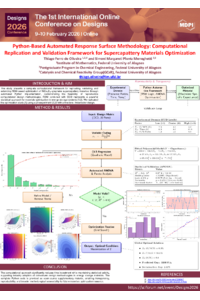
Response Surface Methodology (RSM) combined with Central Composite Design (CCD) represents a powerful statistical approach for materials optimization in energy storage systems [1,2]. RSM has been extensively applied in materials science to efficiently explore design spaces and identify optimal synthesis conditions, reducing experimental burden while maintaining rigor [2]. This study presents a complete computational framework for replicating, validating, and extending RSM-based optimization of NiCo₂S₄–graphene supercapattery materials through automated Python implementation, demonstrating the feasibility of reproducible computational design methodologies.
We replicated the optimization study [1] using a 20-experiment CCD with a five-level three-factor design. Independent variables were graphene/NCS ratio (0.6–7.4%), hydrothermal time (4.6–11.4 hours), and S/Ni molar ratio (3.3–6.7). Specific capacitance served as the response variable. A quadratic polynomial model was developed using multiple linear regression, with automated analysis including ANOVA calculations, Pareto analysis (α = 0.05), Shapiro–Wilk normality testing, and response surface mapping implemented in Python.
The quadratic model achieved R² = 0.9716 and adjusted R² = 0.9460, explaining 97.16% of variance. The G/NCS ratio emerged as the dominant factor (57.19% contribution, p < 0.0001), with significant synergistic interactions for G/NCS×S/Ni (p = 0.0068) and time×S/Ni (p = 0.0057). Residuals demonstrated normal distribution (Shapiro–Wilk p = 0.8531). The optimal predictions were G/NCS = 6.0% and time = 10.0 h, S/Ni = 6.0, yielding 2263 F/g with 2.32% deviation from the original experimental results.
This automated Python framework validates RSM methodology through independent replication with 97.68% agreement with the original study [1]. The computational approach significantly reduces time investment while maintaining statistical validity, supporting industry adoption of data-driven design methodologies in energy storage materials. The complete Python code is provided as open-source supplementary material, enabling transparency, reproducibility, and broader methodological accessibility for future materials optimization research.
References
[1] Hong, Z.-Y. et al. Response Surface Methodology Optimization in High-Performance Solid-State Supercapattery Cells Using NiCo₂S₄–Graphene Hybrids. Molecules 2022, 27, 6867.
[2] Pandey, V.K. et al. A Response Surface Methodology Optimization Approach to Architect Low-Cost Activated Carbon-Based Ternary Composite for Supercapacitor Application with Enhanced Electrochemical Performance. Synth. Metals 2025, 311, 117844.
Keywords
Python Automation
Supercapacitors
Design of Experiments
Computational Framework
Materials Optimization
Reproducible Research.
Poster
designs 2026-sciforum-159161.pdf
Digital Twin-Driven Design for Disassembly and Recycling of End-of-Life Solar Panels
Optimization of Power Stability Index in Presence of Large-scale Integration of Green Power Generation