Event submissions
Published
This submission belongs to the session S1. Environmental Assessment Methods and Management Technologies of the event The 1st International Online Conference on Environments
Published date
27 Feb, 2026
Academic Editor
'%3e%3cpath%20d='M12.6657%2010.9104C12.4185%2010.325%2012.0599%209.79327%2011.6097%209.34482C11.1609%208.89508%2010.6293%208.5365%2010.0442%208.28888C10.0389%208.28626%2010.0337%208.28495%2010.0285%208.28233C10.8446%207.69279%2011.3752%206.73249%2011.3752%205.64904C11.3752%203.8542%209.92103%202.39999%208.1262%202.39999C6.33136%202.39999%204.87715%203.8542%204.87715%205.64904C4.87715%206.73249%205.40774%207.69279%206.22393%208.28364C6.21869%208.28626%206.21345%208.28757%206.20821%208.29019C5.62129%208.5378%205.09463%208.89284%204.64265%209.34613C4.1929%209.79493%203.83432%2010.3266%203.58671%2010.9117C3.34345%2011.4845%203.21226%2012.0987%203.20023%2012.7209C3.19988%2012.7349%203.20233%2012.7488%203.20744%2012.7619C3.21255%2012.7749%203.22022%2012.7867%203.22998%2012.7968C3.23975%2012.8068%203.25142%2012.8147%203.26431%2012.8202C3.2772%2012.8256%203.29105%2012.8284%203.30504%2012.8284H4.09109C4.14874%2012.8284%204.19459%2012.7825%204.1959%2012.7262C4.2221%2011.7148%204.62823%2010.7676%205.34617%2010.0497C6.08899%209.30683%207.0755%208.89808%208.1262%208.89808C9.17689%208.89808%2010.1634%209.30683%2010.9062%2010.0497C11.6242%2010.7676%2012.0303%2011.7148%2012.0565%2012.7262C12.0578%2012.7838%2012.1037%2012.8284%2012.1613%2012.8284H12.9474C12.9613%2012.8284%2012.9752%2012.8256%2012.9881%2012.8202C13.001%2012.8147%2013.0126%2012.8068%2013.0224%2012.7968C13.0322%2012.7867%2013.0398%2012.7749%2013.0449%2012.7619C13.0501%2012.7488%2013.0525%2012.7349%2013.0522%2012.7209C13.0391%2012.0947%2012.9094%2011.4855%2012.6657%2010.9104ZM8.1262%207.9024C7.52486%207.9024%206.9589%207.6679%206.53312%207.24211C6.10733%206.81633%205.87283%206.25037%205.87283%205.64904C5.87283%205.0477%206.10733%204.48174%206.53312%204.05596C6.9589%203.63018%207.52486%203.39567%208.1262%203.39567C8.72753%203.39567%209.29349%203.63018%209.71927%204.05596C10.1451%204.48174%2010.3796%205.0477%2010.3796%205.64904C10.3796%206.25037%2010.1451%206.81633%209.71927%207.24211C9.29349%207.6679%208.72753%207.9024%208.1262%207.9024Z'%20fill='%235D1EE1'/%3e%3c/g%3e%3c/svg%3e) Milena Horvat
Milena HorvatCitation
Thiago Ferro de Oliveira, Simoni Margareti Plentz Meneghetti, Mechanistic Insights into Phenol Adsorption and Mass Transport on Multi-Walled Carbon Nanotubes, in Proceedings of The 1st International Online Conference on Environments, 2 March–4 March 2026, MDPI: Basel, Switzerland
Share
Email
Facebook
Twitter
LinkedIn
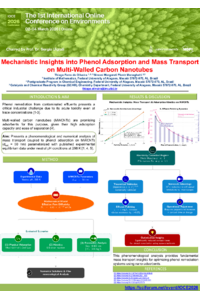
Mechanistic Insights into Phenol Adsorption and Mass Transport on Multi-Walled Carbon Nanotubes

Thiago Ferro de Oliveira 1,2,3
'%3e%3cpath%20d='M12.6647%2010.9104C12.4176%2010.325%2012.0589%209.7933%2011.6088%209.34485C11.16%208.89511%2010.6283%208.53653%2010.0432%208.28891C10.038%208.28629%2010.0327%208.28498%2010.0275%208.28236C10.8437%207.69282%2011.3743%206.73252%2011.3743%205.64907C11.3743%203.85423%209.92005%202.40002%208.12522%202.40002C6.33038%202.40002%204.87618%203.85423%204.87618%205.64907C4.87618%206.73252%205.40677%207.69282%206.22296%208.28367C6.21772%208.28629%206.21248%208.2876%206.20724%208.29022C5.62031%208.53783%205.09365%208.89287%204.64167%209.34616C4.19192%209.79496%203.83334%2010.3266%203.58573%2010.9117C3.34247%2011.4846%203.21128%2012.0987%203.19925%2012.721C3.1989%2012.735%203.20135%2012.7489%203.20646%2012.7619C3.21157%2012.7749%203.21924%2012.7868%203.22901%2012.7968C3.23877%2012.8068%203.25045%2012.8148%203.26334%2012.8202C3.27623%2012.8256%203.29007%2012.8284%203.30406%2012.8284H4.09012C4.14776%2012.8284%204.19362%2012.7825%204.19493%2012.7262C4.22113%2011.7148%204.62726%2010.7676%205.34519%2010.0497C6.08802%209.30686%207.07452%208.89811%208.12522%208.89811C9.17592%208.89811%2010.1624%209.30686%2010.9052%2010.0497C11.6232%2010.7676%2012.0293%2011.7148%2012.0555%2012.7262C12.0568%2012.7839%2012.1027%2012.8284%2012.1603%2012.8284H12.9464C12.9604%2012.8284%2012.9742%2012.8256%2012.9871%2012.8202C13%2012.8148%2013.0117%2012.8068%2013.0214%2012.7968C13.0312%2012.7868%2013.0389%2012.7749%2013.044%2012.7619C13.0491%2012.7489%2013.0515%2012.735%2013.0512%2012.721C13.0381%2012.0947%2012.9084%2011.4856%2012.6647%2010.9104ZM8.12522%207.90243C7.52388%207.90243%206.95792%207.66793%206.53214%207.24215C6.10636%206.81636%205.87185%206.2504%205.87185%205.64907C5.87185%205.04773%206.10636%204.48177%206.53214%204.05599C6.95792%203.63021%207.52388%203.3957%208.12522%203.3957C8.72655%203.3957%209.29252%203.63021%209.7183%204.05599C10.1441%204.48177%2010.3786%205.04773%2010.3786%205.64907C10.3786%206.2504%2010.1441%206.81636%209.7183%207.24215C9.29252%207.66793%208.72655%207.90243%208.12522%207.90243Z'%20fill='%235D1EE1'/%3e%3c/g%3e%3c/svg%3e)
Simoni Margareti Plentz Meneghetti 2,4
1. Institute of Mathematics, Federal University of Alagoas, Maceió 57072-970, AL, Brazil, Brazil
2. Postgraduate Program in Chemical Engineering, Federal University of Alagoas, Maceió 57072-970, AL, Brazil
3. Catalysis and Chemical Reactivity Group (GCAR), Chemistry Department, Federal University of Alagoas, Maceió 57072-970, AL, Brazil
4. Catalysis and Chemical Reactivity Group (GCAR), Chemistry Department, Federal University of Alagoas, Maceió 57072-970, AL, Brazil, Brazil
Abstract
Phenol remediation from contaminated effluents presents a critical industrial challenge due to its acute toxicity even at trace concentrations [1-3]. Multi-walled carbon nanotubes (MWCNTs) are promising adsorbents for this purpose, given their high adsorption capacity and ease of separation [4]. This work presents a phenomenological and numerical analysis of mass transport coupled to phenol adsorption on MWCNTs (dext = 50 nm) parameterized with published experimental equilibrium data under neutral pH conditions at 298 K [1,4, 5]. The mathematical model incorporates effective pore diffusivity (De = 4.82 × 10⁻¹⁰ m²/s) derived from pore structure parameters and describes three distinct scenarios: (1) pure physical adsorption via modified Fick's Second Law, (2) kinetics incorporating 0.5-order reaction kinetics, and (3) parametric analysis of particle size (1–100 nm) and concentration sensitivity (1–5 mg/L). Numerical solutions establish a Thiele modulus of ϕ ≪ 1 across the tested range, indicating kinetically controlled mass transfer with effectiveness factor η = 1.0, and validate the theoretical dependence ϕ ∝ Cs⁻⁰·²⁵. During effluent polishing operations (reduction from 5 to 1 mg/L), relative diffusive resistance increases by 49.5%, necessitating proportional increases in contact time or adsorbent dosage. The nanoscale architecture of MWCNTs reduces diffusional limitations by approximately 10⁶ compared to macroscopic granular adsorbents, enabling significantly reduced contact times. This phenomenological analysis provides fundamental mass transport insights for optimizing phenol remediation systems using nano-adsorbents.
References
[1] Surkatti, R., Al-Zuhair, S. Microalgae cultivation for phenolic compounds removal. Environ Sci Pollut Res 25, 33936–33956 (2018). https://doi.org/10.1007/s11356-018-3450-8
[2] Abhilasha Rai, Aniket Sen, Biswajit Sarkar, Jitamanyu Chakrabarty, Bikash Kumar Mondal, Susmita Dutta; Phycoremediation of pollutants from secondary treated coke-oven wastewater using poultry litter as nutrient source: a cost-effective polishing technique. Water Sci Technol 1 November 2021; 84 (9): 2406–2421. doi: https://doi.org/10.2166/wst.2021.433
[3] Moraes, F. D. de, Figueiredo, J. S. L. de, Rossi, P. A., Venturini, F. P., & Moraes, G. (2015). Acute toxicity and sublethal effects of phenol on hematological parameters of channel catfish Ictalurus punctatus and pacu Piaractus mesopotamicus. Ecotoxicology and Environmental Contamination, 10(1), 31–36. https://doi.org/10.5132/eec.2015.01.05
[4] Abdel-Ghani, N. T., El-Chaghaby, G. A., & Helal, F. S. (2015). Individual and competitive adsorption of phenol and nickel onto multiwalled carbon nanotubes. Journal of advanced research, 6(3), 405-415. https://doi.org/10.1016/j.jare.2014.06.001
[5] Plugatyr, A., & Svishchev, I. M. (2011). Molecular diffusivity of phenol in sub-and supercritical water: application of the split-flow Taylor dispersion technique. The Journal of Physical Chemistry B, 115(11), 2555-2562. https://doi.org/10.1021/jp1107075
Keywords
Nanoremediation
Aromatic pollutants
Wastewater treatment
Intraparticle diffusion
Carbon nanomaterials
Poster
banner.pdf
Challenges and Strategies for Implementing the Circular Economy in Modular Construction: Evidence from Germany
Evaluating the Use of Scanning Electron Microscopy with Energy-Dispersive X-ray Spectroscopy for Identifying Airborne Particles in Industrial Areas